MACHINE REFERENCE

IBM PC 5150

IBM PC 5150 — the machine that turned “IBM compatible” into the defining phrase of an entire industry for the next two decades, built from off-the-shelf parts IBM never expected anyone to reverse-engineer quite so fast.

Why it matters

IBM’s Entry Level Systems team built the 5150 out of an open architecture and third-party chips specifically to get it to market quickly, never anticipating that Columbia Data Products would legally clone the BIOS within a year and open the floodgates for Compaq and everyone after. That decision, not any particular technical brilliance in the 8088 or the CGA card, is why the “PC” became a standard rather than just another proprietary Big Blue product — and why compatibility with a 1981 expansion slot layout still echoes, however faintly, in a modern motherboard.

What to check before you buy

  • Power it up through a variac or with a known-good PSU first; shorted tantalum or PSU capacitors are common enough to write off a board that’s actually fine
  • Check the RAM and BIOS chips seat cleanly — oxidised sockets cause “dead machine” symptoms that look far worse than the actual fault
  • Confirm which display adapter is fitted (MDA or CGA) before assuming what monitor you’ll need
  • A complete example with its correct keyboard and a period monitor is worth chasing over a bare system unit, even at a premium
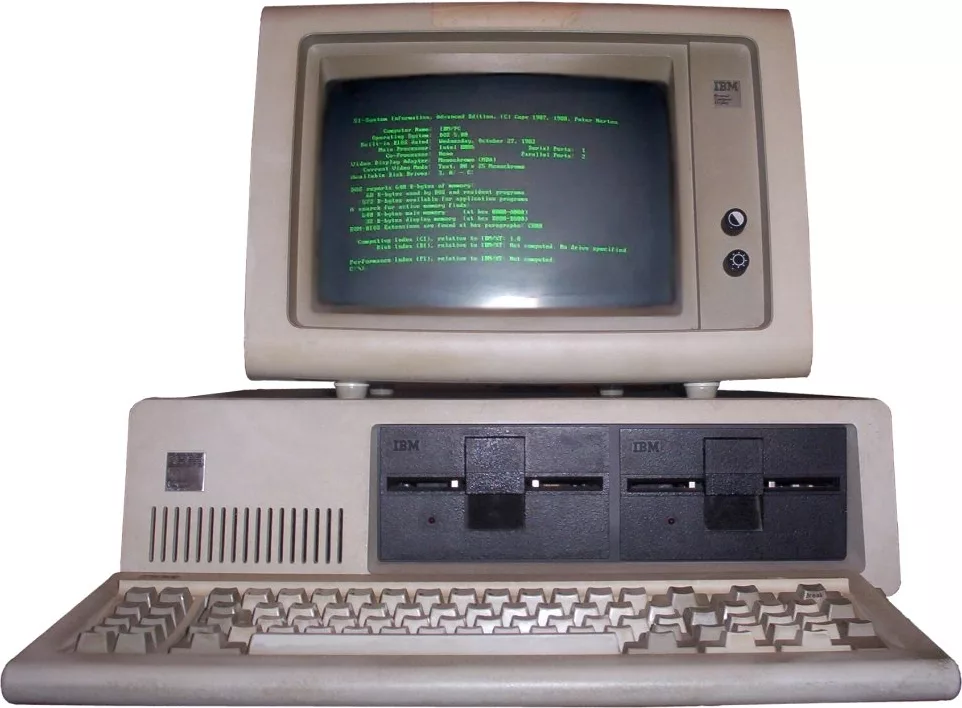
IBM PC 5150 with a green-screen monitor, twin floppy drives and keyboard

Photo: Reseletti, Wikimedia Commons (CC BY-SA 3.0)

Released

1981

RAM

16 KB or 64 KB on the motherboard depending on configuration, expandable to 256 KB onboard on later revisions and 640 KB conventional memory via expansion cards

CPU

Intel 8088 @ 4.77 MHz

Launch price

$1,565 base configuration (16 KB RAM, CGA, no floppy drives); fuller setups with monitor and floppy from around $3,005

Manufacturer

International Business Machines (IBM)

Form factor

Desktop system unit (approx. 51.4 × 41.9 × 14.0 cm) with a separate keyboard and monitor

CPU

Intel 8088 @ 4.77 MHz

Chipset

Intel 8259 (programmable interrupt controller), Intel 8237 (DMA controller), Intel 8253 (programmable interval timer)

RAM

16 KB or 64 KB on the motherboard depending on configuration, expandable to 256 KB onboard on later revisions and 640 KB conventional memory via expansion cards

ROM

One 8 KB BIOS chip (three revisions issued across the model’s life: April 1981, October 1981, October 1982), plus four 8 KB ROM BASIC chips

Graphics

IBM Monochrome Display Adapter (MDA, text-only) or Color Graphics Adapter (CGA, medium/low-res colour), sold as separate add-in cards

Audio

Single programmable-frequency square wave through a built-in speaker

Storage

One or two internal 5.25″ floppy drive bays (160 KB single-sided / 320 KB double-sided per disk); cassette port for external tape storage; no factory-supported hard drive at launch

Ports

Serial port (8250 UART), Centronics-compatible parallel port, cassette connector, 5-pin keyboard connector, five 62-pin expansion slots (later known as ISA)

OS

PC DOS 1.0 (Microsoft-supplied, based on 86-DOS); CP/M-86 and the UCSD p-System were also available

PSU

Internal, 120/240V AC

Units sold

over 750,000 by 1983; IBM shipped as many as 40,000 units a month at peak, roughly 800% ahead of its own internal projections

Successors

IBM Personal Computer XT (5160, March 1983)

  • Tantalum capacitor short-circuit failure
    The tantalum capacitors used on the motherboard and ISA cards are prone to failing short after decades of storage, which can cascade into the system's power fail-safe shutting the machine down entirely.
  • Power supply capacitor ageing
    The PSU's ageing electrolytic and Rifa-type capacitors are a common source of failure, sometimes shorting a supply rail outright.
  • Oxidised RAM and BIOS sockets
    Motherboards are otherwise reliable, but oxidised DIP sockets for the RAM and BIOS chips are a frequent cause of an apparently "dead" board — the failure of even one chip in the first RAM bank can prevent the system posting at all.
  • 1981 Working prototype demonstrated internally in January
  • 1981 Official launch on 12 August at $1,565
  • 1982 First legal clone, the Columbia Data Products MPC 1600, released in June
  • 1983 IBM PC XT (5160) launched in March with the first factory-fitted internal hard drive
  • 1987 5150 discontinued on 2 April