MACHINE REFERENCE

Sega Mega Drive

Sega Mega Drive — sold in North America as the Genesis, and marketed there with a slogan aimed squarely at the market leader: “Genesis does what Nintendon’t.”

Why it matters

Sega got to the 16-bit generation over a year before Nintendo’s SNES, and used that head start to sell the Mega Drive on raw arcade-accurate speed rather than the more considered, colourful approach Nintendo would eventually answer with. It was enough to hand Sega a genuine, if brief, lead in the North American market during the early 1990s, and Sonic the Hedgehog — deliberately built to show off that speed — became the console’s calling card in a way few pack-in games ever manage.

What to check before you buy

  • Smell and inspect the power brick before plugging it in — leaking capacitors are corrosive and a known issue on original units
  • Ask about the sound if buying a Model 1; muffled or distorted audio usually points to ageing audio-path capacitors rather than a dead sound chip
  • Check whether it’s a Genesis III or later board with TMSS fitted, which requires a genuine or TMSS-compatible cartridge to boot at all
  • Confirm the region and output type (RF, composite or RGB via Model 2’s mini-DIN) match what your display can actually use
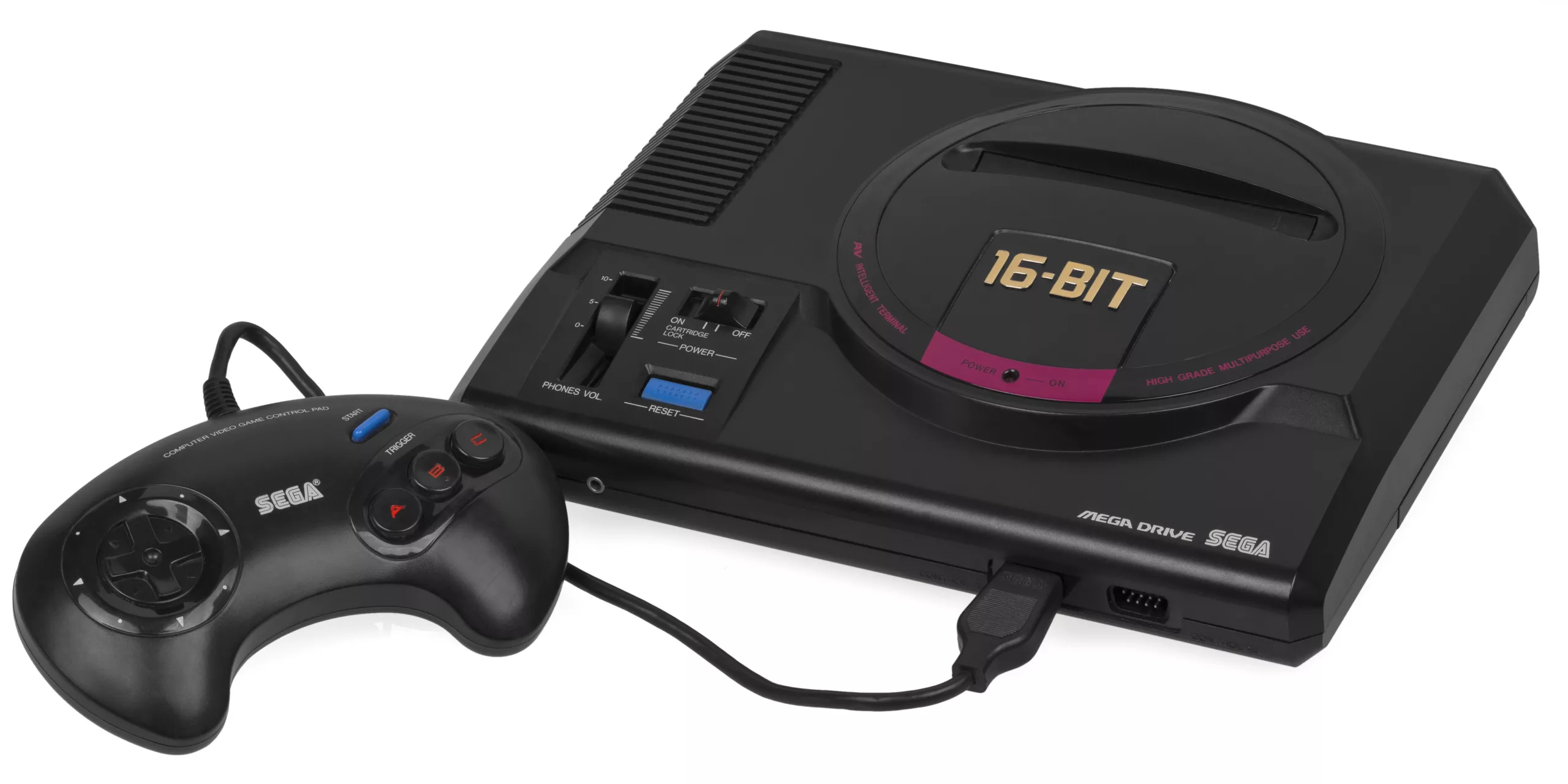
Sega Mega Drive console in black with a three-button controller

Photo: Evan-Amos, Wikimedia Commons (Public domain)

Released

1988 (Japan, as Mega Drive); 1989 (North America, as Genesis)

RAM

64 KB system RAM, 64 KB video RAM, 8 KB audio RAM

CPU

Motorola 68000 @ 7.6 MHz (main), Zilog Z80 @ 3.58 MHz (sound processing and Master System compatibility)

Launch price

¥21,000 (Japan); $189 (North America); £189.99 (UK)

Manufacturer

Sega

Form factor

Home console, top-loading cartridge slot; a smaller Model 2 redesign followed in 1993

CPU

Motorola 68000 @ 7.6 MHz (main), Zilog Z80 @ 3.58 MHz (sound processing and Master System compatibility)

Chipset

Yamaha YM7101 Video Display Processor (also labelled Sega 315-5313 on some boards)

RAM

64 KB system RAM, 64 KB video RAM, 8 KB audio RAM

ROM

Cartridge-supplied

Graphics

320×224 or 256×224 (NTSC) / 320×240 or 256×240 (PAL); 512-colour palette with 61 colours on screen simultaneously

Audio

Yamaha YM2612 FM synthesiser plus a Texas Instruments SN76489 programmable sound generator; stereo via headphone jack, mono via RF/DIN

Storage

ROM cartridges, inserted on top

Ports

Model 1: RF output, 8-pin DIN audio/video, headphone jack, cartridge edge connector; Model 2: 9-pin mini-DIN composite/RGB output, RF switch

OS

None — cartridge boot ROM

PSU

External AC adapter (exact voltage/current rating not independently confirmed against a primary source)

Units sold

30.75 million (Sega’s own figure), plus a further roughly 4.5 million across later Tectoy (Brazil) and Majesco licensed re-releases

Successors

Sega Saturn (1994)

  • OEM power supply capacitor leakage
    The original Mega Drive/Genesis power bricks used low-quality, unbranded electrolytic capacitors rated at only 85°C, which commonly fail and leak electrolyte fluid — a genuine fire/damage risk if left unaddressed.
  • Model 1 audio-path capacitor degradation
    Discrete audio-mixing capacitors and op-amps on Model 1 boards are a common failure point, causing muffled, distorted or missing sound as the capacitors dry out.
  • 1988 Mega Drive launched in Japan on 29 October
  • 1989 Genesis launched in North America in August
  • 1990 PAL Mega Drive launched across Europe in September
  • 1991 Genesis III revision introduces the Trademark Security System (TMSS) boot lockout
  • 1994 Sega Saturn launched as the Mega Drive's successor, beginning the platform's wind-down