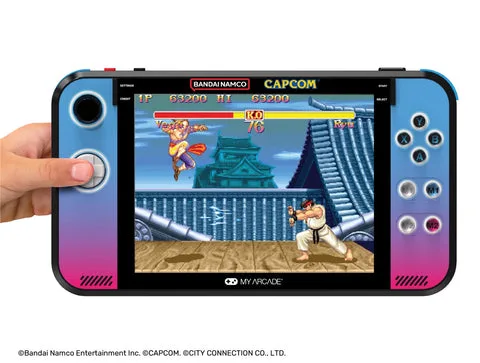
My Arcade first showed off the Gamestation Retro Go at CES in January 2025, promising a Switch-shaped handheld stuffed with Capcom and Bandai Namco licences for a Q3 2025 launch. Q3 2025 came and went without it. So did the rest of 2025. The device has now resurfaced with an actual release date: 31 October 2026, listed for pre-order on GameStop’s site at $199.
For that money you get an 8-inch display, an internal rechargeable battery and upwards of 100 games baked in rather than sold separately, including Pac-Man, Galaga, Dig Dug, Street Fighter II, Mega Man, Final Fight and 1942. SmartGlow lighting carries over too. It lights up only the buttons a game actually needs, not the whole pad. The Retro Go is the first of three machines in the range to ship; a 1080p console version with wireless controllers and a tabletop cabinet with a mechanical joystick are both still waiting behind it.
A company that has done this before
My Arcade isn’t new to licensing someone else’s back catalogue into a slab of plastic. Its Atari Gamestation Go, built on the same idea but around Atari’s 2600-era library, has already been sitting on shelves for a while. Not its first go, either. So the Retro Go’s delay reads as a scheduling problem, not a sign My Arcade can’t ship this category of product, though eighteen months between a CES reveal and a confirmed street date is still a long wait for what was, on paper, mostly a licensing exercise rather than a fresh piece of engineering.
None of that is unusual in retro handheld land right now. The category has gone from a niche a handful of companies bothered with to a crowded shelf of Switch-shaped boxes, all chasing the same nostalgia at broadly the same price point, and a firm licence with a recognisable publisher’s name on the box is still the thing that separates My Arcade’s approach from a device quietly running an emulator against ROMs nobody paid for.
A hundred-plus licensed classics for $199 is a fair price on its own terms. Whether it still looks like the better buy once you put it next to the FPGA and emulation handhelds now selling at similar money, with far larger libraries and none of the licensing restrictions, is the argument actually worth having before pre-order weekend hits.