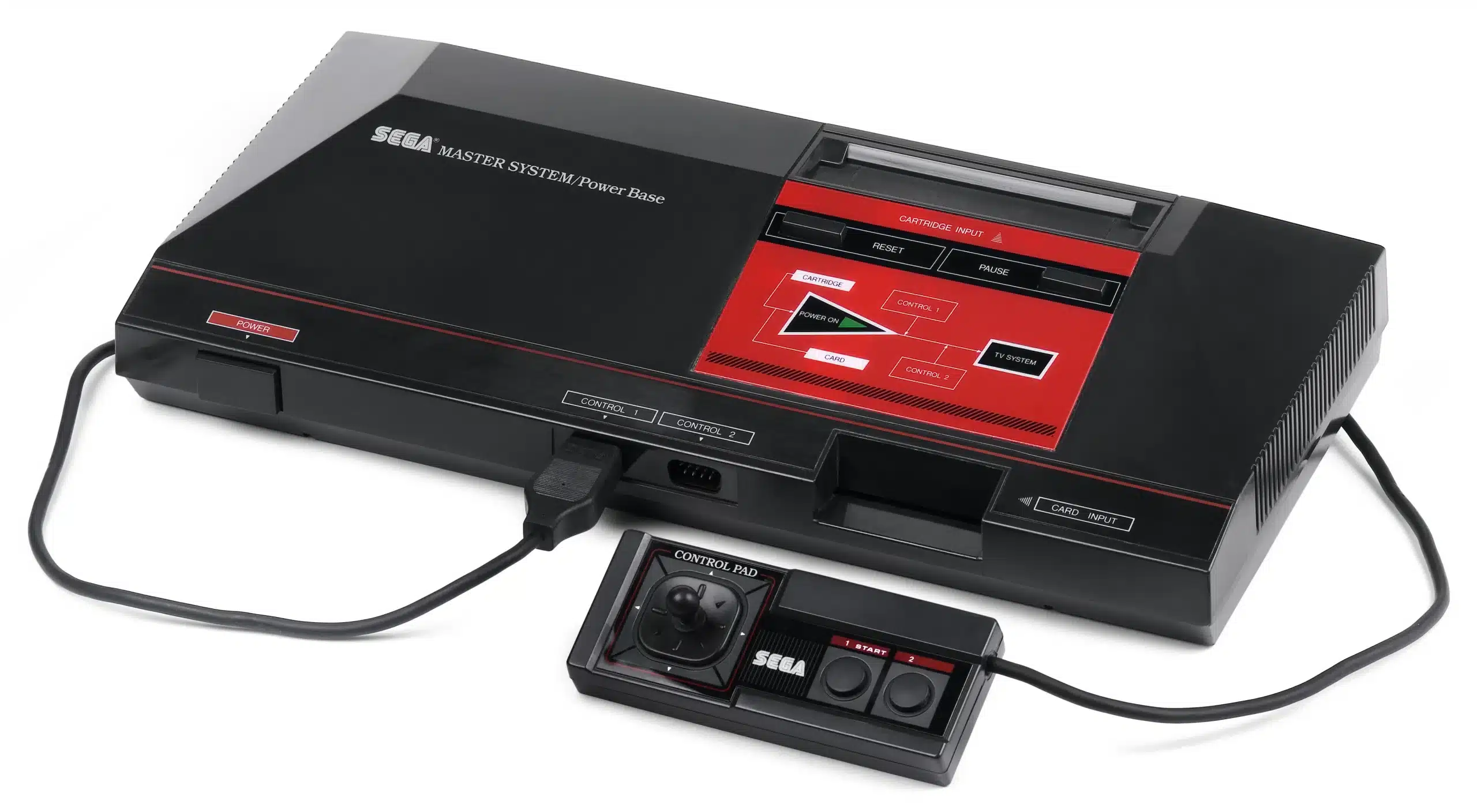
The Sega Master System arrived in America in September 1986 carrying a Zilog Z80A running at 3.58 MHz, a graphics chip descended from the same TMS9918 family Texas Instruments had been licensing out for years, and a straightforward promise: better hardware than the machine that had already won.
Why it matters
On paper, the Master System should have beaten the NES outright. Its VDP could put more colours on screen, its cartridge slot took bigger games, and Sega backed it with a genuinely strong library once Alex Kidd and, later, Sonic arrived to carry the flag. What it didn’t have was Nintendo’s stranglehold on Western retailers and third-party publishers, and no amount of silicon fixes a distribution problem. The Master System’s real legacy isn’t the sales column against the NES, it’s what happened in Brazil, where Tectoy kept building and selling the thing well into the 2000s, and in Europe, where it quietly outsold the NES in several markets and gave Sega a foothold it would spend the Mega Drive years cashing in on.
What to check before you buy
- Ask whether the unit outputs RF only or has been modded for composite/RGB — an unmodified RF-only Master System will look genuinely rough on a modern television.
- Check the cartridge and Sega Card slots for worn or bent pins, especially on well-used units.
- Confirm the seller has actually tested the console with a game, not just powered it on — a lit power LED with no picture is a classic sign of RF modulator or capacitor trouble.
- Bring your own known-good 9V power adaptor if you can, or at least ask what's included.
- If buying a PAL VA3-revision board (common in Europe), ask specifically about trace corrosion under the RF can, a documented weak point on that revision.