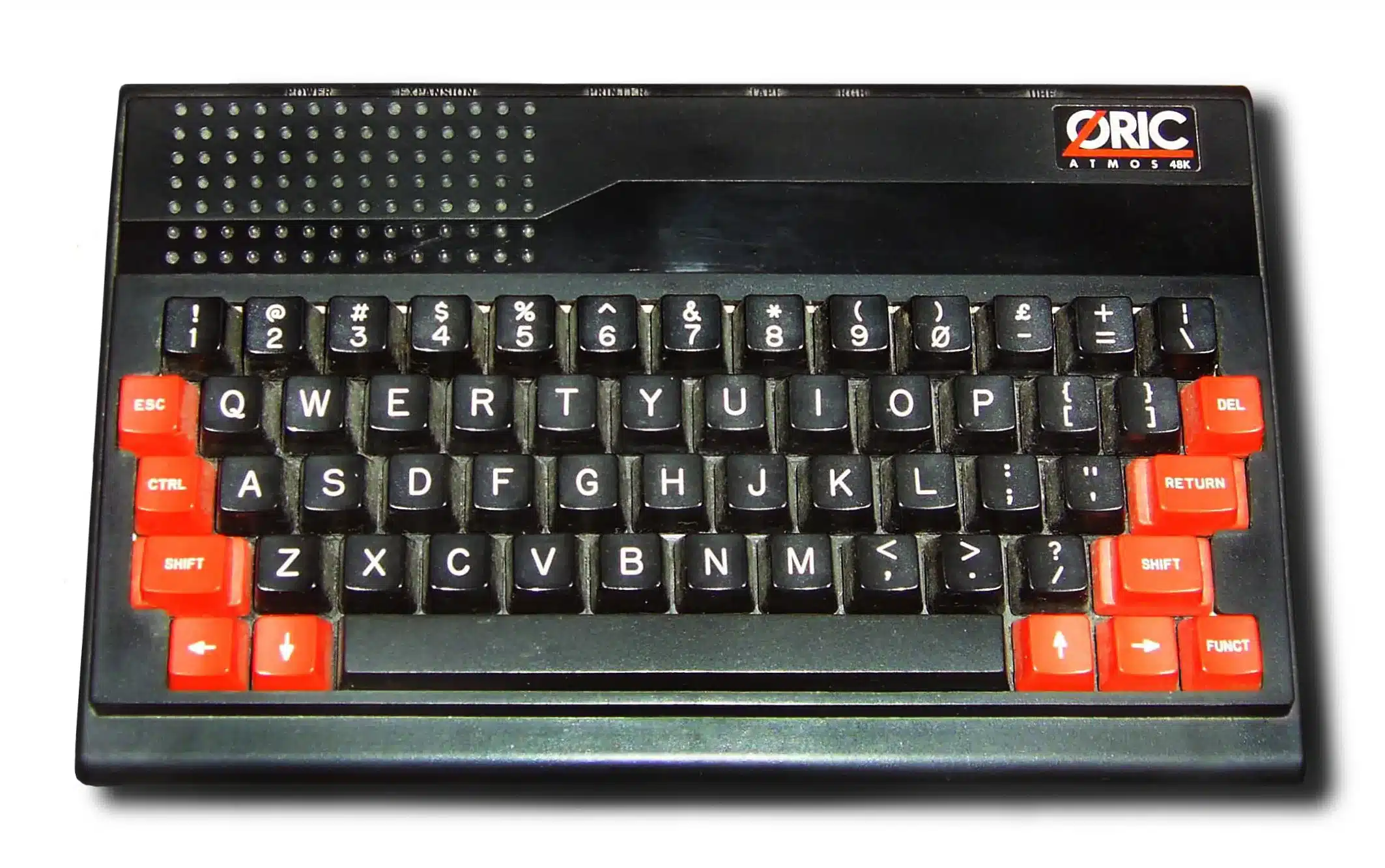
The Oric Atmos landed in British shops on 1 February 1984 wearing a proper full-travel keyboard where the Oric-1 had made do with a flat rubber membrane, and a price tag of £170 that lasted barely a month before Oric blamed the exchange rate and put it up to £189.95.
Why it matters
The Atmos never had to win on raw specification. A 6502A at 1 MHz and 48 KB of RAM was competitive but not exceptional against the Commodore 64 or the Spectrum in the same shops, and the ULA driving its display was doing broadly the same job as a dozen other 8-bit machines of the era. What the Atmos actually represents is a small British company trying to out-fix its own reputation: the Oric-1 had shipped with a genuinely unreliable keyboard and a cassette routine that dropped data, and the Atmos existed largely to correct both, under new ownership that had just taken the company over in a rescue deal. It half worked. The keyboard was better. The Advertising Standards Authority still reprimanded Oric that same year for overstating usable memory against the C64, and the company that made it never separated itself from that credibility problem, finding a stronger following in France than it ever managed at home before collapsing by the mid-1980s.
What to check before you buy
- Ask for a photo or video of the machine actually running, not just powered on — a black-and-white patterned screen with no BASIC prompt is a classic sign of RAM chip failure, a very common fault on this machine.
- If specific keys don't respond, don't assume a dirty membrane: on the Atmos that's frequently the 4051 keyboard multiplexer chip rather than the keys themselves.
- Check the DC power jack for corrosion or play — a common restoration finding that causes intermittent power loss and can be mistaken for a deeper fault.
- Ask whether it's the 48 KB configuration, which is what most surviving Atmos units are, since 16 KB variants are rarer and more limited for running period software.
- Factor in a Microdisc floppy add-on separately if you want anything beyond cassette loading — original units are scarce and command their own premium.