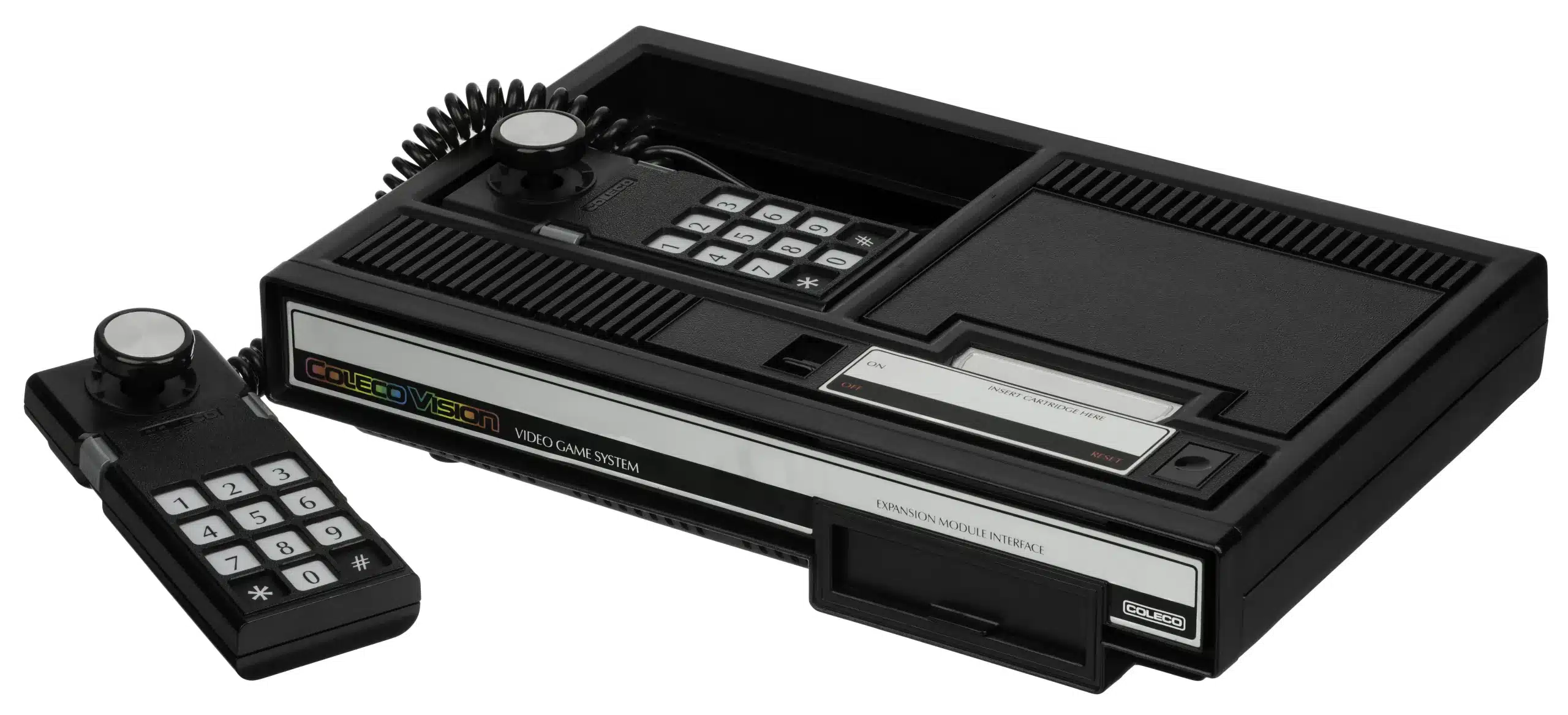
The ColecoVision turned up in August 1982 with a graphics chip good enough to make the Atari 2600 look like a toy, and for about eighteen months, that was exactly the point.
Why it matters
Coleco built its case on a single, brutally effective demo: an arcade-accurate port of Donkey Kong, bundled in the box, running on hardware that finally had the horsepower to do the arcade game justice rather than a flattened approximation of it. The TMS9928A video chip and SN76489 sound chip weren’t custom silicon dreamed up in-house, they were the same off-the-shelf parts Texas Instruments was already selling elsewhere, but wired together with enough RAM behind them to matter. Then Coleco doubled down with Expansion Module #1, a genuinely clever bit of engineering that let the console swallow the entire existing Atari 2600 cartridge library, turning a new machine into an instant library of hundreds of games on day one. It worked, and sales passed a million units within months. Then the 1983 crash arrived, the market that had made room for a graphics-led console evaporated almost overnight, and Coleco’s answer, the ill-fated Adam computer, dragged the whole company down with it by 1985.
What to check before you buy
- Test the controller ports before you commit to a price. Static damage to the 74LS541 buffer chips is common, and a unit that registers phantom keypad or joystick input is a repair job, not a quirk.
- Ask, or check yourself, whether the capacitors have been serviced. Original electrolytics are now decades past their rated life.
- Confirm the power supply is present and original or a known-good replacement. The 4-pin connector and triple-rail output are proprietary enough that a wrong or failing PSU can damage the board.
- Factor in Expansion Module #1 separately if Atari 2600 compatibility matters to you. It's a distinct accessory, not built in.
- Treat "complete in box" pricing with some scepticism. A boxed Donkey Kong bundle is the most commonly reproduced or reshuffled combination on the resale market.