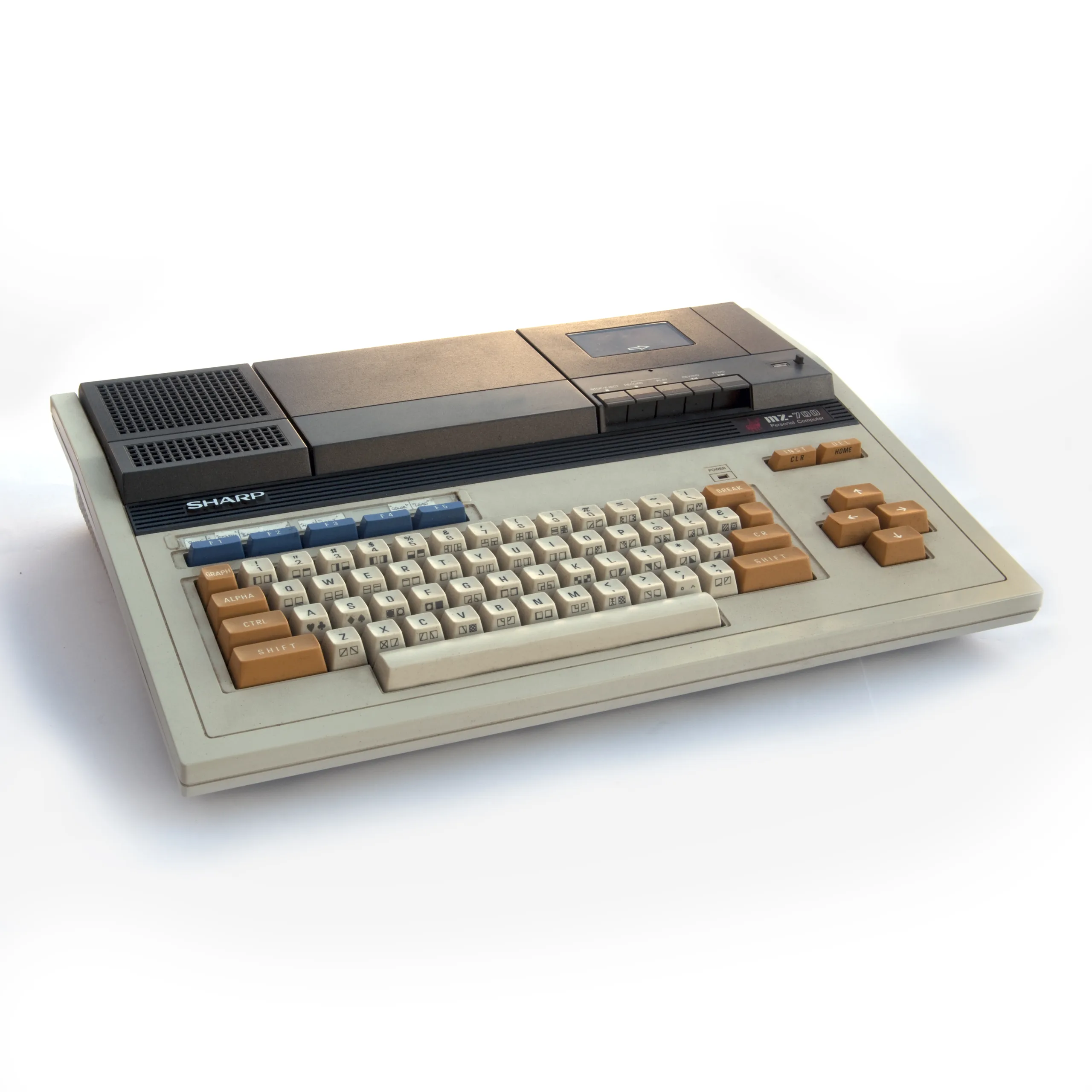
The Sharp MZ-700 arrived in November 1982 with a deliberate gap where its rivals put a BASIC interpreter: no operating system lived in ROM at all, so the machine booted from cassette into whatever you chose to load, Sharp’s own environment or CP/M.
Why it matters
Sharp called this the “Clean Computer” philosophy, and it was a genuine design stance rather than a cost-cutting shortcut: ship the hardware with nothing assumed, and let the owner decide what it runs. That put the MZ-700 at odds with nearly everything else on a 1983 shelf, where Commodore and Sinclair machines sold a BASIC dialect baked into silicon whether the buyer wanted it or not. The approach came with a real trade-off. With no bitmap graphics mode at all, just 512 fixed 8×8 characters doing double duty as block graphics, the MZ-700 looked plain next to a Spectrum or a CPC. What it earned instead was a reputation, in the UK press and in West Germany’s crowded computer market, for being solidly built and reliable enough at cassette loading to be worth the asking price, which is how a machine with no graphics chip to speak of still finished 1983 ranked above the Apple IIe and the Atari 800 in UK sales.
What to check before you buy
- Ask for a power-on test before buying, or budget immediately for a capacitor service. The PSU and board electrolytics are now over 40 years old and failure is closer to the rule than the exception.
- Check which variant you are actually being offered: MZ-711 (bare), MZ-721 (built-in tape deck) or MZ-731 (deck plus four-colour plotter). The plotter models are worth more but also have more that can go wrong.
- Confirm the keyboard responds across all keys; unresponsive keys are usually a cheap membrane clean rather than a dead unit.
- If buying for software use, check whether a working data recorder or cassettes are included. The MZ-700's cassette interface is proprietary enough that a generic tape deck will not simply plug in.
- UK and West German market units are more commonly available than Japanese-market examples; factor in that original documentation and software for Japanese units will be in Japanese.