MACHINE REFERENCE

Tatung Einstein

The Tatung Einstein arrived in the summer of 1984 carrying a Taiwanese company’s name on a British-built machine, with a price tag of £499 that left it uncomfortably placed between the home and business computer markets.

Why it matters

The Einstein is a useful case study in a company trying to split the difference between two markets and landing in neither. Tatung designed it in Bradford and assembled it in Bridgnorth and Telford, fitted it with a proper CP/M-compatible operating system in Xtal-DOS, and built in a 3-inch disk drive at a time when most home users were still loading software from cassette. None of that made it cheap enough to tempt a Spectrum owner or serious enough to win an office away from an IBM PC, and retail sales stayed modest as a result. What kept it in circulation among people who actually used one was a second career as a development machine: its disk-based CP/M workflow made it a convenient platform for writing games that were then ported across to the Spectrum, Amstrad CPC and other 8-bit machines, so a computer that barely dented the shop shelves still left its mark on software most buyers never knew had passed through one first.

What to check before you buy

  • Confirm the drive configuration, single or twin 3-inch drives, since media and spares differ between them.
  • Ask whether the machine has been recapped. The original switch-mode PSU and motherboard electrolytics are now over four decades old, and failure is the norm rather than the exception.
  • Test every key individually if you can before buying. Keyboard faults are one of the most frequently reported issues, and the assembly isn't a quick strip-down.
  • Check whether original 3-inch disks or disk images are included; working software is harder to source now than the hardware itself.
  • If a monitor is bundled, ask about its condition. The Tatung TM01 shares the same era's vulnerability to failing capacitors and sync faults.
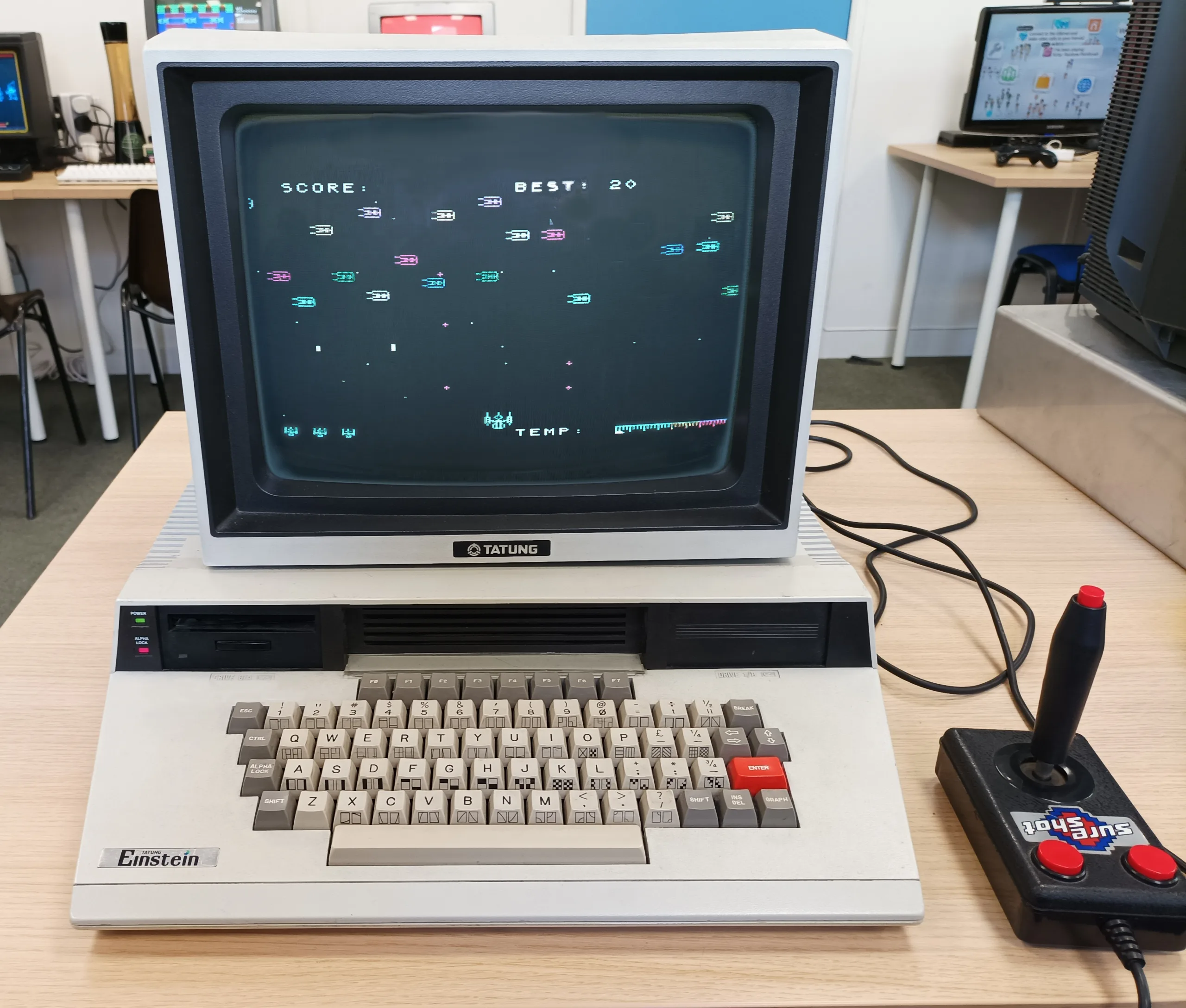
Tatung Einstein TC01 home computer

Photo: RetroEditor, Wikimedia Commons (CC BY 4.0)

Released

1984

RAM

64 KB system RAM plus 16 KB dedicated video RAM

CPU

Zilog Z80A, 4 MHz

Launch price

£499 (TC01)

Manufacturer

Tatung Company (Taiwan); designed in Bradford, England and assembled in Bridgnorth and Telford, England

Form factor

All-in-one desktop unit with integrated keyboard and one or two built-in 3-inch floppy disk drives

CPU

Zilog Z80A, 4 MHz

Chipset

WD1770 floppy disc controller, Z80 CTC, Z80 PIO, Intel 8251 SIO, plus the Tatung Pipe expansion bus exposing the raw Z80 data bus

RAM

64 KB system RAM plus 16 KB dedicated video RAM

ROM

8 KB, expandable to 32 KB internally

Graphics

Texas Instruments TMS9129, 256×192 resolution, 16 colours, 32 sprite planes

Audio

General Instrument AY-3-8910 programmable sound generator, 3 channels

Storage

Built-in 3-inch floppy drive (TEAC FD30A mechanism), single or twin-drive configurations

Ports

RS-232 serial, Centronics parallel/printer, two analogue joystick ports, RGB and composite/TV video output, Tatung Pipe expansion connector

OS

MOS (Machine Operating System) with Xtal-DOS (CP/M-compatible) and Xtal BASIC, developed by Crystal Computers of Torquay

PSU

Internal switch-mode power supply, 220-240V AC 50-60Hz input, 1A fused, regulated 5V output with overvoltage and short-circuit protection

Units sold

Unknown; no verified total production or sales figure exists. The only documented quantity is a batch of roughly 5,000 units exported to Taipei in 1984

Successors

Tatung Einstein 256 (1985)

  • Power supply failure
    The internal switch-mode PSU is a recurring point of failure: ageing electrolytic capacitors and the chopper transistor degrade with age, and a failed component can blow the mains fuse immediately on power-up or take the 5V rail down with it.
    Tatung Einstein TC-01 PSU repair →
  • Keyboard key failures
    Individual keys losing contact or stopping working is a recurring complaint, and the keyboard assembly is awkward to strip down and repair compared with simpler membrane designs.
    Tatung Einstein TC01 improvements and repairs →
  • Disk drive and logic chip faults
    The built-in TEAC FD30A floppy drive's belt perishes with age and needs replacing to read disks reliably, and boot failures have also been traced to failed 74LS157 multiplexer logic chips on the motherboard.
    Tatung Computers — James S' Kingdom →
  • 1984 Tatung launches the Einstein TC01 in the UK in summer, priced at £499, positioned between the home and small-business markets
  • 1984 A batch of roughly 5,000 units is exported to Taipei
  • 1985 Tatung releases the Einstein 256 as successor, with a Yamaha V9938 graphics chip, 192 KB of video RAM and 512 available colours
  • 1986 Despite weak retail sales, the Einstein finds a niche as a games development machine, its CP/M-compatible disk workflow making it a convenient platform for writing software later ported to the Spectrum, Amstrad CPC and other 8-bit machines