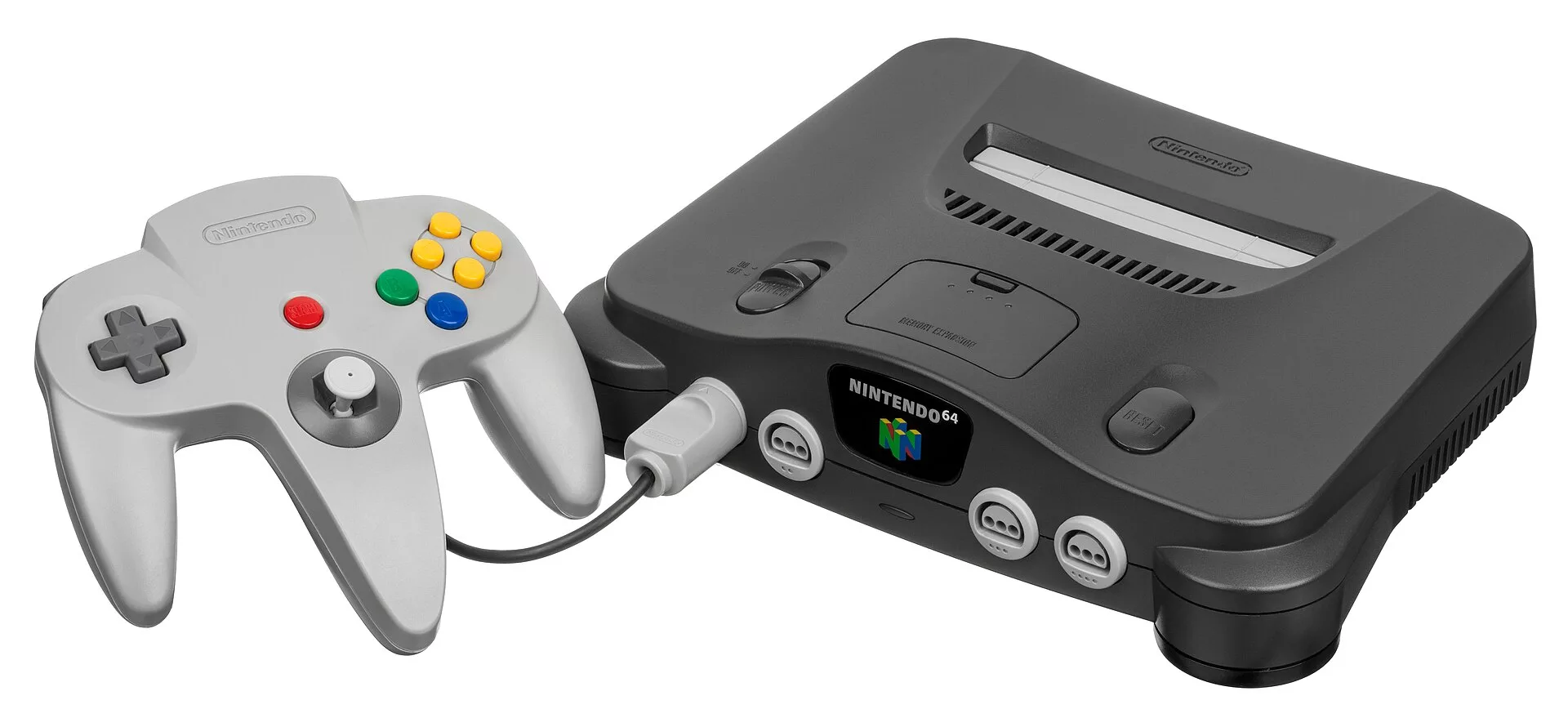
The ModRetro M64 is an FPGA-based Nintendo 64 clone that went on sale on 28 July 2026. It takes original N64 cartridges from any region, outputs up to 4K at 60fps over HDMI and rebuilds the console’s circuitry in reconfigurable logic instead of emulating it in software. It is shipping now. This is a finished product on sale, not a crowdfunding campaign and not a pre-order.
- Released: 28 July 2026, available from ModRetro’s own store
- FPGA: 16nm AMD Artix UltraScale+
- Price: $199.99 early-bird launch price, $229.99 standard retail; the M64 Pro controller is a separate $89.99
- Video: 720p, 1080p, 1440p and 4K, auto-detected, over HDMI
- Cartridges: original NTSC and PAL carts, plus EverDrive and SummerCart64 flash carts
- Ports: four front-facing N64 controller ports, three USB-C, HDMI, microSD
Retro hardware announcements have trained all of us to expect the slippage email. Announce a date, take the money, apologise for a year, blame tariffs. ModRetro said 28 July, and on 28 July the M64 was in stock and going out of the door. That on its own puts it ahead of most of the field.
Why an FPGA N64 is different from an emulator
An emulator is a program pretending to be a console. It reads the game’s instructions and works out, in software, what the original silicon would have done with them. Get it right and the illusion holds. Get it slightly wrong and you get the N64’s particular flavour of wrongness: fog that is nearly fog, a framebuffer effect that quietly stops happening, audio that drifts a semitone off where it should be.
An FPGA takes another route entirely. It is a chip packed with logic blocks you wire up after manufacture, so rather than describing the N64’s behaviour in code, you rebuild its circuits in reconfigurable hardware and let them run. Signals turn up when they turned up on the original board, because the thing producing them is shaped like the thing that produced them in 1996.
ModRetro pointed a 16nm AMD Artix UltraScale+ at the problem, which is a genuinely silly amount of modern silicon to aim at a console that shipped with 4MB of RDRAM. CEO Torin Herndon has described the work as adapting the core to make proper use of the UltraScale+ fabric’s speed and its 6-input lookup tables, which is the unglamorous half of the job and also the half that makes the accuracy affordable.
The cartridge slot is a real cartridge slot. It reads original carts regardless of region, and it handles EverDrive and SummerCart64 flash carts too. Round the front there are four proper N64 controller ports, so original pads, Rumble Paks and Transfer Paks all work without an adapter dongle hanging off the back.
The core running on it was written by a hobbyist and given away
The logic running on that AMD chip began life as the N64 core for the MiSTer FPGA project, written by Robert Peip, better known in the scene as FPGAzumSpass. He built it as an open-source project. The licence permits commercial use, so there is nothing underhanded going on here, whatever you may have read.
Time Extension reported in August 2025 that ModRetro’s console appeared to be running Peip’s core. ModRetro then confirmed it was working directly with him, and Herndon has said the improved core code will go back to the community. That is a promise, and promises stay cheap until a repository appears. Worth checking back on.
One person, in his own time, reverse-engineered a 1996 console accurately enough that a venture-funded company could build a retail product on top of it. Every 4K screenshot you have seen of this machine is downstream of that.
What the M64 does today, and what it still owes you
ModRetro’s feature list and ModRetro’s shipping feature list are not quite the same document.
Overclocking works today. The M64 offers stepped modes named Off, Super, Ultra, Extreme and Insane, topping out at 67 per cent over stock clock. RetroDodo’s review lists the first step as 17 per cent; Generation Amiga’s write-up gives it as 16 per cent, so take the low end as approximate. What matters more is that RetroDodo found the feature to be experimental in practice, with glitches when switching between settings. ModRetro is also still developing a separate advanced mode built around the M64’s PSRAM, which will arrive in a future firmware update. It is not on the machine you buy today.
Save states are absent at launch. So is Virtual Controller Pak support, and integration with ModRetro’s Chromatic handheld. A CRT AV adapter that auto-detects 240p and 480i and puts out composite, component and S-Video is in development rather than on sale. All of these are promised. None of them are here.
On compatibility, ModRetro publishes a public list, and it does not hide the failures. As read in early August 2026 it showed 276 games running with no issues against 16 still in progress, a shade over 94 per cent. GoldenEye 007 and Perfect Dark still drop frames, which they also did on original hardware, so that one is arguably accuracy doing its job. Turok 2 showed dropped framerates and jittery cutscenes in testing; Donkey Kong 64 and Jet Force Gemini were both listed as in progress.
Publishing a list of your own product’s failures is a decent thing to do, and rarer than it ought to be. Over-the-air updates take ten to twelve minutes, which is long enough to make a cup of tea and short enough not to matter.
The four launch cartridges, and why Xibalba 64 is the one to watch
Four physical cartridges launched alongside the console, in proper boxes with printed manuals.
- Extreme-G: Turbo Fusion, a two-in-one cart pairing Extreme-G with its sequel Extreme-G XG2
- Buck Bumble, the 1998 Argonaut oddity, re-released rather than remade, on a bright yellow cart that also runs on a real N64
- Xeno Crisis, Bitmap Bureau’s twin-stick arena shooter, whose N64 port has existed since April 2023
- Xibalba 64, a brand new first-person shooter by Dominic Szablewski of PhobosLab
The first three are perfectly good reasons to own a cartridge. Xibalba 64 is the one that actually tells you something about the hardware.
Szablewski built it for real N64 hardware in 2026, using libdragon and the open-source Tiny3D library to drive the RSP without hand-writing microcode. He has been unusually open about the constraints. The N64 has 4KB of texture memory, which caps the largest texture you can upload at 64 by 64 pixels, so he leaned on aggressive draw-call batching and a raycasting visibility pass that fires 320 rays across the field of view to avoid drowning the memory bandwidth. The result holds a stable 60fps, which is more than most of the console’s original library ever managed. Of the 32MB ROM, roughly 31MB is audio, stored as 4-bit VADPCM and decoded on the RSP during playback.
He developed the whole thing on a SummerCart64 plugged into original hardware. The M64 only reached him late in the process. His verdict on it, from his own making-of write-up, is the single most useful piece of testimony in this entire story: the M64 worked as advertised, and no changes to the game were necessary for it.
That’s the test of accuracy that counts: a developer who targeted real silicon plugged his cartridge into the clone and had nothing to fix.
M64 versus Analogue 3D: how the price really lands
The obvious rival is the Analogue 3D, and the comparison is less flattering to Analogue than the spec sheets suggest. Analogue announced its FPGA N64 on 16 October 2023, built on an Intel Cyclone 10 GX with 220,000 logic elements, and promised Q1 2025. It then slipped to July 2025, then to late August, then to Q4, before finally shipping to pre-order customers on 18 November 2025 at $249.99. A restock six days later went up to $269.99, blamed on tariffs.
So Analogue got there. Two years and change after announcing it, and after telling customers the machine was 99 per cent complete for the best part of a year. ModRetro named a date roughly a year out and hit it. That difference is worth more than a few dollars.
The dollars are worth watching, mind. Everyone is comparing $229.99 against $249.99, and that comparison only holds if you already own N64 controllers, because the M64 box contains a console, a USB-C cable, a plug with regional adapters and a 16GB SD card. No pad. ModRetro will sell you its M64 Pro controller for $89.99, at which point your $229.99 console costs $319.98 to actually play.
Ninety dollars is a lot of money for a controller. To ModRetro’s credit the machine will happily take an original N64 pad, an 8BitDo 64, a Retro Fighters pad, or a wired Hyperkin Captain+ at around $29, so nobody is forced into the expensive one. Encouraged, certainly. Forced, no.
The verdict, and the billion-dollar asterisk
Buy it if you own N64 cartridges and a modern television. Right now it is the best-value way to get one onto the other, and the compatibility list is honest enough that you can check your own shelf before spending anything, which is more consideration than most hardware launches offer.
Hold off if save states are the feature you actually want, because that is a firmware update with no date attached, and so is the advanced overclocking mode, and so is the CRT adapter. Judge the machine on what is in the box.
And then there is the money. In March 2026, according to reporting from the Financial Times and TechCrunch, ModRetro was seeking new funding at a valuation of roughly $1 billion. A billion dollars, for a company whose flagship console runs a core that a German hobbyist wrote in his spare time and gave away for nothing. The licence permits it and Peip is reportedly being worked with directly, so this is not theft. It is still worth saying out loud.
The M64 is a good machine and the engineers who built it plainly care about getting it right. But the most impressive thing in this entire story is still a piece of open-source logic one man wrote for free.
Sources
- ModRetro, M64 product page: https://modretro.com/products/m64
- ModRetro, M64 compatibility list: https://modretro.com/pages/m64-compatibility
- ModRetro blog, Diving Into Our M64 Launch Lineup: https://modretro.com/blogs/blog/diving-into-our-m64-launch-lineup-future-game-library-plans
- Dominic Szablewski, How to Make a Nintendo 64 Game in 2026: https://phoboslab.org/log/2026/08/xibalba64-making-of
- RetroDodo, ModRetro M64 Review: https://retrododo.com/modretro-m64-review/
- RetroDodo, ModRetro Reveals M64 Release Date, Retail Price, Launch Games: https://retrododo.com/modretro-reveals-m64-release-date-retail-price-launch-games/
- Generation Amiga, ModRetro M64 launches with 4K output and 67% overclocking: https://www.generationamiga.com/2026/07/27/modretro-m64-launches-with-4k-output-and-67-overclocking/
- CNX Software, ModRetro M64 hardware overview: https://www.cnx-software.com/2026/06/03/modretro-m64-an-amd-artix-ultrascale-fpga-based-open-source-nintendo-64-console-with-original-cartridge-support/
- Time Extension, ModRetro Is Contributing To The MiSTer FPGA Project: https://www.timeextension.com/news/2025/09/modretro-is-contributing-to-the-mister-fpga-project-and-not-looking-to-replace-it-with-the-m64-says-ceo
- GamesBeat, ModRetro launches M64 retro game console: https://gamesbeat.com/modretro-launches-m64-retro-game-console-for-259/
- Tom’s Hardware, ModRetro seeks $1 billion valuation: https://www.tomshardware.com/video-games/console-gaming/oculus-founder-seeks-1bn-valuation-for-modretro-as-n64-console-launch-nears