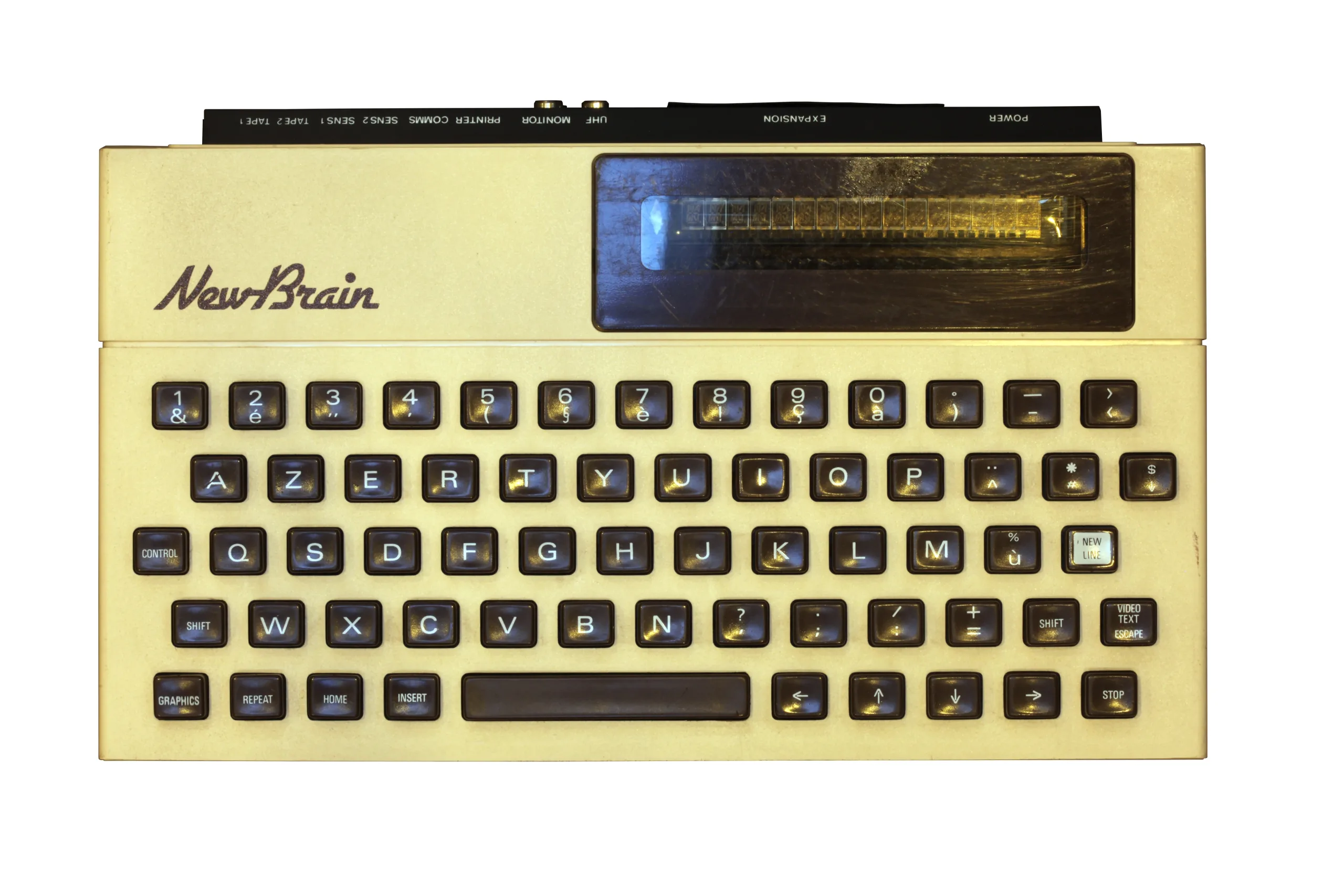
The Grundy NewBrain was a Z80A micro that began life at Sinclair Radionics, reached the shops in 1982 with 32 KB of RAM and an optional one-line display, and was gone, along with its maker, by August 1983.
Why it matters
The NewBrain was a good machine sold into a market that wanted something else. A Z80A at 4 MHz, 32 KB of RAM, a full-screen editor and a maths package good for about 12 figures made a lot of computer for about £200 in 1982, and the AD’s vacuum fluorescent display let it work without a television. Your Computer found its character set and high-resolution graphics the most extensive of any machine under £300. The trouble sat around the hardware. The design passed from Sinclair Radionics to Newbury Laboratories to Grundy, lost the BBC contract to Acorn and reached shops two years after its announcement. Grundy then promised a CP/M system and an expansion interface it could not deliver on time, while sales staff and dealers got little training or software. Production was pushed to 10,000 a month just as the money ran out. About 50,000 were reportedly sold, though no primary record confirms it, and Grundy Business Systems closed in August 1983.
What to check before you buy
- Test or replace the external power supply before connecting it. Rated outputs are about +7.5, +13.5 and -14 V, one faulty unit was seen putting about +20 V on two rails, and the RIFA mains filter capacitor can fail dramatically.
- Check which model you are buying. The A needs a TV or monitor, while the AD has the one-line vacuum fluorescent display. Switch on and see whether the display lights, because one display fault was traced to IC436, a 74LS166N.
- Ask whether it boots and whether the BASIC prompt appears. The 4116 RAM chips are reported as unreliable, and a bad chip in bank 0 stops booting, while the startup circuit around IC452 can also fail.
- Open it if you can. The three boards are joined by fragile single-core ribbon cables, nothing is socketed, and most 47 uF and 10 uF electrolytics will have dried out.
- Look for extras and paperwork. Expansion units, disk controllers, the handbook and technical manual are scarce, cassette loading is unreliable, and CP/M and disk drives need the expansion chassis.