MACHINE REFERENCE

Acorn Electron

The Acorn Electron arrived in August 1983 carrying a single, blunt promise on the box: most of what a BBC Micro could do, for roughly half the price. Acorn had built the impossible bit first — squeezing the BBC’s sprawl of support chips down into one custom Ferranti ULA — and then spent the next eighteen months finding out exactly how much that shortcut would cost them at the workbench.​​That cost showed up in two places, and both of them are still visible on a bench today. The 6502A drops from 2 MHz to 1 MHz the instant it touches RAM, because the ULA is busy stealing bus cycles for the video display — the machine gets slower exactly when the program running on it gets more demanding. And that same ULA, the chip doing all the clever consolidation, sits in a socket on the early boards that has a habit of working itself loose. Acorn’s fix, eventually, was to solder it down and pot it in epoxy. By then a lot of the damage, to reputation and to the machines that had already shipped, was done.

Why it matters

The Electron’s real significance is not the machine itself but the fight it was built for. Acorn needed a budget contender to stand against the ZX Spectrum in a UK home-computer market Sinclair was winning on price alone, and the Electron was Acorn’s answer: take the BBC Micro’s respected BASIC, its architecture, its educational credibility, and get it under £200 without simply copying Sinclair’s rubber-keyed cost-cutting. It’s a machine born of genuine engineering ambition, cramming a whole support-chip logic board onto one ULA was a serious achievement for 1983, undone almost entirely by Acorn’s own inability to build enough of them fast enough, at a price that still made money, before the market moved on without it.

What to check before you buy

  • Ask the seller to confirm it powers on and boots to the BASIC prompt — ULA socket failure is common enough that "untested" listings are a real gamble.
  • If it does boot, press gently on the ULA's metal lid while it's running; if the display glitches or the machine hangs, the socket needs attention.
  • Check the power connector for play or wobble — a loose DC socket causes exactly the same symptoms as a ULA fault.
  • Test the keyboard fully, key by key; the membrane and its ribbon connector are original 1983 parts.
  • Factor in what you'll actually use it with — a cassette-only Electron is a display piece; budget separately for a Plus 1 and a modern storage solution.
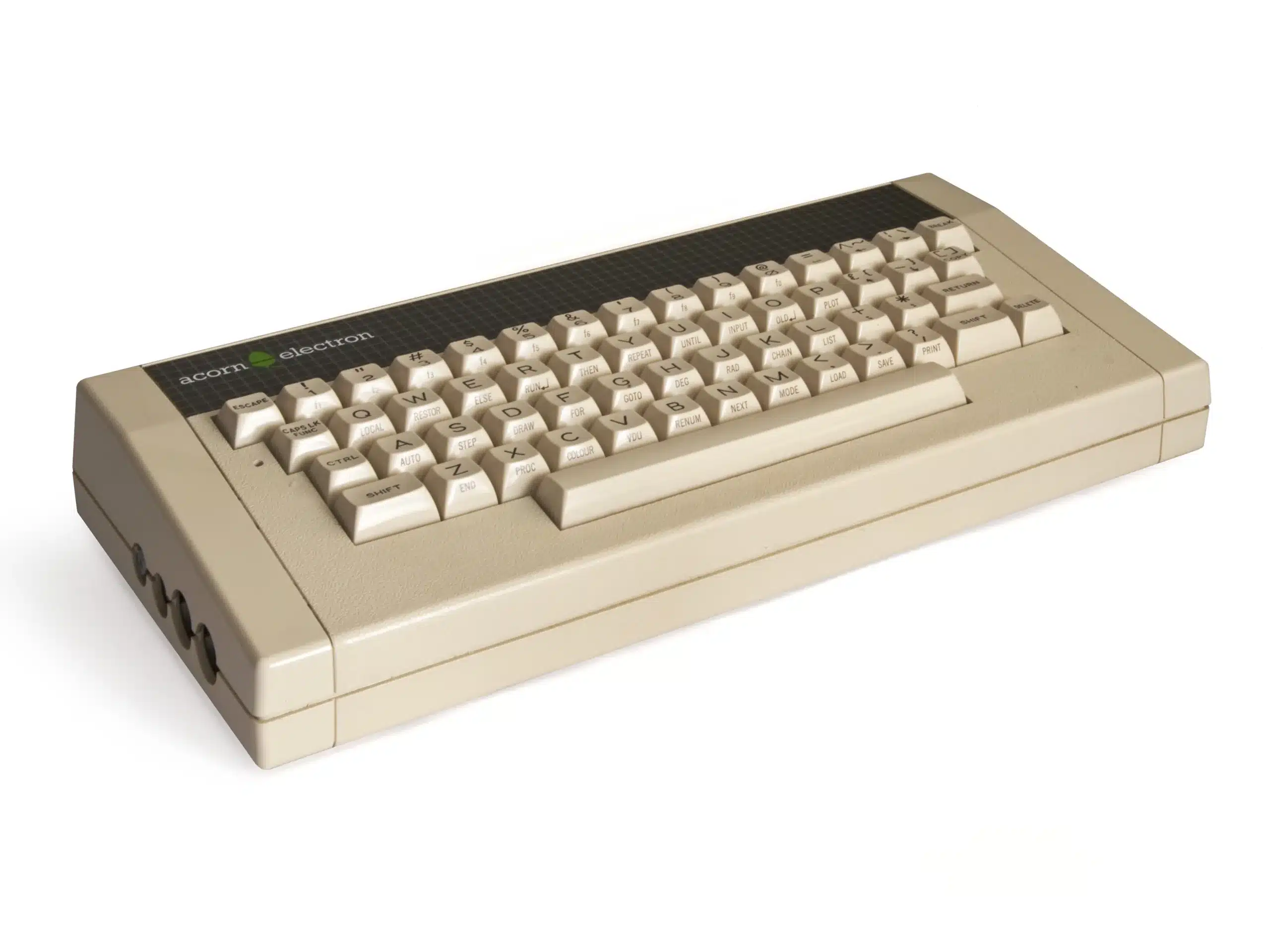
Acorn Electron

Photo: Bilby, Wikimedia Commons (CC BY 3.0)

Released

1983

RAM

32 KB

CPU

Synertek/Rockwell 6502A — 2 MHz when accessing ROM, dropping to 1 MHz when accessing RAM

Launch price

£199

Manufacturer

Acorn Computers Ltd (Cambridge, UK)

Form factor

Single-unit wedge-shaped keyboard computer, 16 x 34 x 6.5 cm

CPU

Synertek/Rockwell 6502A — 2 MHz when accessing ROM, dropping to 1 MHz when accessing RAM

Chipset

Custom Ferranti Semiconductor ULA (Uncommitted Logic Array) — consolidates work the BBC Micro spread across several support chips. Early boards (Issue 1–4) used a socketed ULA; later boards (Issue 5–6) used a resoldered, epoxy-potted revision

RAM

32 KB

ROM

32 KB (BBC BASIC II plus Acorn MOS operating system)

Graphics

Modes inherited from the BBC Micro’s MODE set: 160×256 (4/16 colours), 320×256 (2/4 colours), 640×256 (2 colours), plus 320×200 and 640×200 2-colour modes. No teletext (MODE 7). Output via RF, composite or RGB

Audio

Single-channel tone/noise generator (software-driven), versus the BBC Micro’s three-channel sound

Storage

Cassette tape (1200 baud CUTS) standard; floppy disk and ROM cartridge only via the optional Plus 1/Plus 3 expansions

Ports

Expansion bus connector (underside), RF modulator out, composite video out, RGB monitor out, cassette DIN connector

OS

Acorn MOS 1.0, in ROM alongside BBC BASIC II

PSU

External unit supplying 19V AC to an internal bridge rectifier, smoothing capacitors and 7805 linear regulator

Units sold

Estimated 200,000–250,000 over its commercial lifespan — an informed estimate rather than a precise count

Successors

No direct successor in the Electron line itself. Expanded via the Acorn Plus 1 (1984, two ROM cartridge slots, joystick interface, Centronics port) and the Acorn Plus 3 (3.5″ floppy disk interface). A rebadged variant, the Merlin M2105, saw long service with British Telecom/Interflora. The Acorn Master Compact (1986) is regarded as its spiritual successor, though a different architecture

  • ULA socket failure
    On Issue 1–4 boards the 68-pin ULA sits in a socket that can work loose from thermal expansion and contraction over repeated power cycles, causing the machine to hang, freeze or fail to boot; pressing down on the ULA's metal lid is the classic diagnostic/temporary fix.
  • Power connector wear
    The DC input socket on the mainboard is prone to becoming loose with age and use, causing intermittent power loss or a machine that won't start reliably until the barrel jack is wiggled into contact.
  • RAM-access speed penalty exposing marginal chips
    Because the ULA halves the CPU clock to 1 MHz during any RAM access, machines with marginal RAM chips or degraded solder joints on the memory ICs show corruption or crashes specifically in RAM-heavy operations, even when they boot fine from ROM.
  • 1982 Hermann Hauser publicly announces a planned £120–150 budget machine, provisionally named "Electron"
  • 1982–1983 Machine shown in the press; launch slips twice past original targets
  • 1983 Official launch at the Acorn User Exhibition on 25 August, priced £199
  • 1983 Over 150,000 pre-launch orders outstrip Acorn's production capacity, causing severe Christmas shortages
  • 1984 Acorn Plus 1 expansion released, adding cartridge slots and joystick/printer ports
  • 1985 Price cut to £129 in March as the home computer market contracts sharply