MACHINE REFERENCE

Amstrad CPC 464

Amstrad CPC 464 — launched in June 1984 with the monitor built into the price, at a time when most rivals still expected buyers to find their own screen and plug it in themselves.

Why it matters

Alan Sugar’s insistence on selling the CPC 464 as a complete, single-plug system — keyboard, tape deck and monitor, one box price, nothing else to buy — was the machine’s whole pitch, and it worked. Amstrad undercut the Spectrum-plus-TV-plus-tape-recorder route on total cost while looking like a “proper” computer rather than a toy plugged into the family telly, and the CPC line went on to become genuinely huge on the continent, particularly in France and Spain, in a way the C64 and Spectrum never quite matched there.

What to check before you buy

  • Ask whether the tape deck has been serviced — perished belts are near-universal on unrestored units and will fail a “tested working” claim within a few loads
  • Check whether the listing includes the correct matching monitor; a CPC without its monitor loses the all-in-one appeal and needs a separate video solution
  • Green-screen bundles are cheaper but text-only — decide whether you actually want the colour CTM640 monitor before buying
  • Ask about keyboard responsiveness; sticky or dead keys are usually a cheap dry-joint fix, not a written-off board
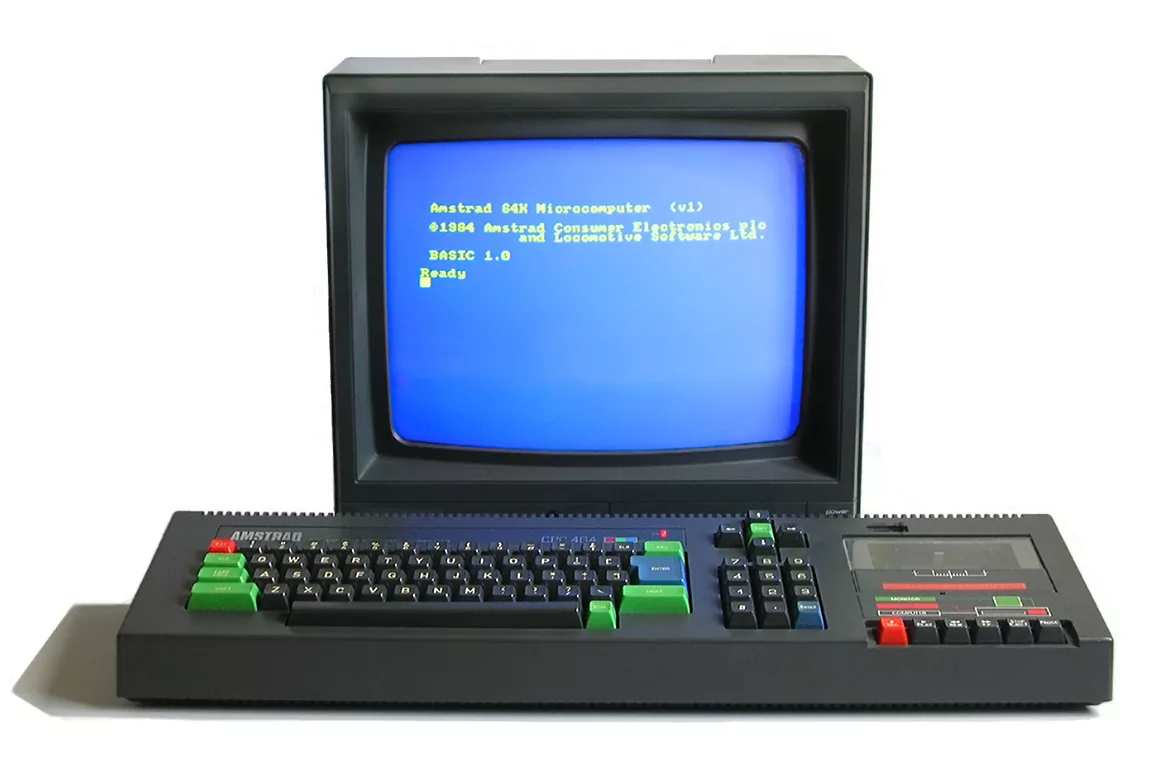
Amstrad CPC 464 keyboard with built-in cassette deck, with a monitor showing the BASIC start-up screen

Photo: Bill Bertram, Wikimedia Commons (CC BY-SA 2.5)

Released

1984

RAM

64 KB

CPU

Zilog Z80A @ 4 MHz

Launch price

£199 (with GT64 green-screen monitor); £299 (with CTM640 colour monitor)

Manufacturer

Amstrad

Form factor

All-in-one keyboard unit with an integrated cassette deck; sold as a bundle with a dedicated monitor (green-screen or colour) that housed the power supply

CPU

Zilog Z80A @ 4 MHz

Chipset

Amstrad custom gate array (ASIC) handling memory/video timing, paired with a Motorola 6845 CRT controller

RAM

64 KB

ROM

32 KB (16 KB OS + 16 KB Locomotive BASIC 1.0)

Graphics

Gate array-driven, three modes from a 27-colour palette — Mode 0: 160×200, 16 colours; Mode 1: 320×200, 4 colours; Mode 2: 640×200, 2 colours

Audio

General Instrument AY-3-8912, 3-channel + noise, through a built-in speaker with volume control

Storage

Built-in cassette deck (standard on the 464; disk drive was an optional add-on, standard on the later 6128)

Ports

50-way expansion edge connector, 34-way printer edge connector (7-bit), 15-pin D-type joystick port, 5-pin DIN stereo audio out, RGB/composite video out to the matching monitor

OS

AMSDOS (Amstrad’s disk OS) with Locomotive BASIC 1.0 in ROM

PSU

External, built into the matching monitor — a single mains lead powers the whole system

Units sold

over 2 million (CPC 464 specifically, mostly Europe); precise split of the ~3 million total CPC-line figure between the 464, 664 and 6128 is not firmly established

Successors

Amstrad CPC 664, CPC 6128, CPC 464plus

  • Tape deck belt and idler wheel perishing
    The rubber drive belt and the idler wheel's rubber washer harden with age and begin slipping, causing failed or corrupted tape loads.
  • Keyboard dry joints and membrane wear
    Individual keys behaving erratically is usually a dry solder joint on the keyboard PCB or connector rather than a faulty sound/demux chip.
  • Capacitor ageing across the board
    Refurbishment services routinely replace ageing capacitors on 40-year-old boards to resolve black/grey screen and no-power faults.
  • 1983 Development begins under the "Arnold" codename
  • 1984 CPC 464 launched in the UK on 21 June
  • 1985 CPC 664 launched, adding a built-in 3-inch disk drive
  • 1985 CPC 6128 launched, with 128 KB RAM and a built-in disk drive
  • 1990 CPC 464plus launched as the line's final, commercially unsuccessful revision