MACHINE REFERENCE

Apple II

The Apple II shipped in June 1977 with 4 kilobytes of memory, no monitor, and a cassette deck for storage, and inside eighteen months it had turned “personal computer” from a hobbyist phrase into a category a bank manager could say out loud. It looked like nothing else on the market: a moulded plastic case the colour of digestive biscuits, a proper keyboard built in rather than bolted on, and, astonishingly for 1977, colour graphics on an ordinary television set.

Why it matters

Before the Apple II, a “personal computer” generally meant a bare board, a bag of switches, and the assumption that you’d build your own case. Wozniak and Jobs sold something a person could put on a desk and switch on, and the eight internal expansion slots meant the machine didn’t have to anticipate every future use case itself, third-party card makers did that instead, which is the real reason the platform outlived nearly everything it launched alongside. That open architecture, more than the colour graphics or the switching power supply underneath it, is why the Apple II is treated as the moment the personal computer stopped being a project and started being a product.

What to check before you buy

  • Confirm it's genuinely the original 1977-79 machine and not a II+ or IIe. Check the ROM labels for Integer BASIC and the board for a pre-1979 date code, since sellers frequently blur the distinction.
  • Ask whether the power supply has been recapped. An un-recapped original switching PSU is now approaching fifty years old, and a dead electrolytic can take other components with it on power-up.
  • Test every key individually if possible. Encoder chip faults show up as double-typed or dead keys and the AY-5-3600 replacement chips are hard to source.
  • Check for corrosion or discoloration around the RAM and logic-board DIP sockets, a common and usually fixable cause of boot failures.
  • Established Rev.0 boards carry a real collector premium. Don't pay Rev.0 prices without verifying the board revision yourself.
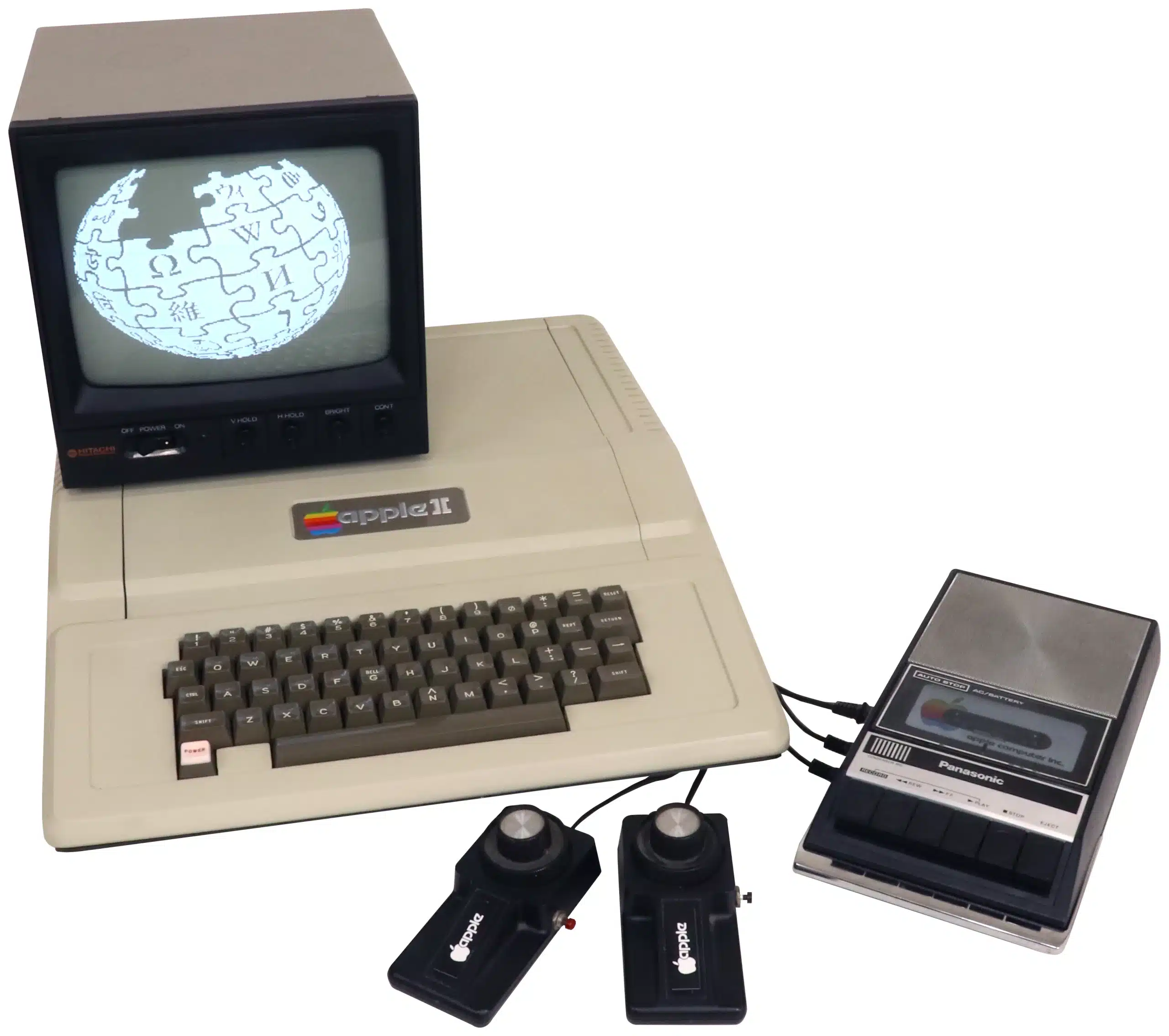
Apple II

Photo: FozzTexx, Wikimedia Commons (CC BY-SA 4.0)

Released

1977

RAM

4 KiB as shipped standard, expandable in steps up to 48 KiB on the original board (64 KiB required a later bank-switching trick)

CPU

MOS Technology 6502, 1.023 MHz

Launch price

US$1,298 for the base 4 KiB configuration; a maxed-out 48 KiB unit ran to US$2,638

Manufacturer

Apple Computer, Inc.

Form factor

Desktop, integrated keyboard, foam-moulded beige plastic case (designed by Jerry Manock) — no monitor included as standard

CPU

MOS Technology 6502, 1.023 MHz

Chipset

None — built from off-the-shelf 7400-series TTL logic rather than custom silicon; a dedicated custom ASIC didn’t arrive until the Apple IIe

RAM

4 KiB as shipped standard, expandable in steps up to 48 KiB on the original board (64 KiB required a later bank-switching trick)

ROM

8 KiB, containing Wozniak’s Integer BASIC and the system monitor

Graphics

Built into the logic board, NTSC composite video out. Lo-res: 40×48, 16 colours. Hi-res: 280×192, 6 usable colours

Audio

1-bit built-in speaker, driven entirely by software toggling — no synthesis hardware

Storage

Cassette tape interface standard at launch; the Disk II 5.25″ floppy drive (140 KB per disk) followed in 1978, sold separately

Ports

Eight internal expansion slots (the architecture’s defining feature), NTSC composite video RCA out, cassette in/out, game I/O connector for paddles/joystick

OS

None at launch in the disk-OS sense — Integer BASIC and the monitor lived in ROM; Apple DOS arrived from 1978 once the Disk II shipped

PSU

Switching (switched-mode) power supply designed by Rod Holt, ran cooler than contemporary linear supplies and needed no cooling fan

Units sold

Unknown for the original 1977-79 machine specifically — the whole Apple II line sold roughly 6 million units across its 16-year run

Successors

Apple II+ (June 1979, Applesoft BASIC in ROM), Apple IIe (1983), Apple IIc (April 1984), Apple IIc Plus (1988), Apple IIGS (September 1986)

  • Switching PSU capacitor failure
    The Rod Holt-designed switching power supply's electrolytic capacitors dry out after decades, and the AC line filter capacitor is a documented cause of dramatic failures on power-up in un-recapped units; a preventative recap is close to standard practice on an unrestored survivor.
  • Keyboard encoder chip (AY-5-3600) faults
    The keyboard's dedicated encoder IC is prone to age-related failure, commonly showing up as double keystrokes or dead keys; a degraded debounce capacitor on the chip is often the specific culprit, and original replacements are scarce enough that FPGA-based drop-in substitutes now exist.
  • RAM and logic-board socket corrosion
    Corrosion and poor contact in the DIP sockets holding the RAM and logic chips is one of the most common causes of boot failures on old boards; reseating or replacing affected chips resolves the majority of reported "dead machine" cases.
  • 1976 Steve Wozniak completes the Apple I, laying the technical groundwork for its successor
  • 1977 Apple II unveiled 16 April at the West Coast Computer Faire; general sale begins in June at $1,298
  • 1978 Disk II floppy drive released, transforming the II from a cassette-based machine into a practical business and education tool
  • 1979 Apple II+ launched with Applesoft BASIC in ROM, succeeding the original
  • 1983 Apple II series reaches peak annual sales of roughly 1 million units across then-current models