MACHINE REFERENCE

Atari 2600

The Atari 2600 arrived in September 1977 wearing a woodgrain shell that had nothing to do with computing and everything to do with living-room furniture, and it went on to sell around 30 million units before Atari finally stopped making it in January 1992.

Why it matters

Cartridge-based gaming wasn’t new when the 2600 launched, but it was the machine that made the idea stick in millions of ordinary front rooms, built on a chip design so lean it had to redraw the picture from scratch, scanline by scanline, in step with the television’s own electron beam, because there was no memory to spare for a frame buffer. That trick let a machine with 128 bytes of RAM outlast three console generations. The same commercial success that built Atari’s dominance also set up its fall: when the 2600’s library filled with rushed licensed cash-ins, E.T. and a badly compromised Pac-Man port chief among them, the flood of poor games alongside a glut of third-party shovelware curdled consumer trust fast enough to help trigger the 1983 North American video game crash. None of that is a mark against the engineering. A team squeezing usable graphics and two-channel sound out of a stripped-down 6502 and a bespoke video chip, with no operating system to lean on, earned every ounce of the console’s decade-and-a-half shelf life; the damage came later, from a boardroom chasing a holiday deadline, not from the silicon.

What to check before you buy

  • Woodgrain "Heavy Sixer" units (1977 only) carry real collector premium and genuinely heavier aluminium shielding, but budget for a capacitor and voltage-regulator check regardless of what a listing claims.
  • A stock RF connection to a modern television is genuinely poor by today's standards; factor in a composite or S-Video mod if you actually want to play on it.
  • Test both controller ports before buying if at all possible — unresponsive directions or fire buttons on a known-good joystick usually means the internal RIOT chip is on its way out.
  • "Untested" or "for parts" listings are common for a reason: a dead 7805 regulator or a leaking capacitor can look identical to a healthy console right up until you power it on.
  • Later variants (2600 Jr., Vader) are cheaper and more reliable entry points if originality matters less to you than a machine that actually boots.
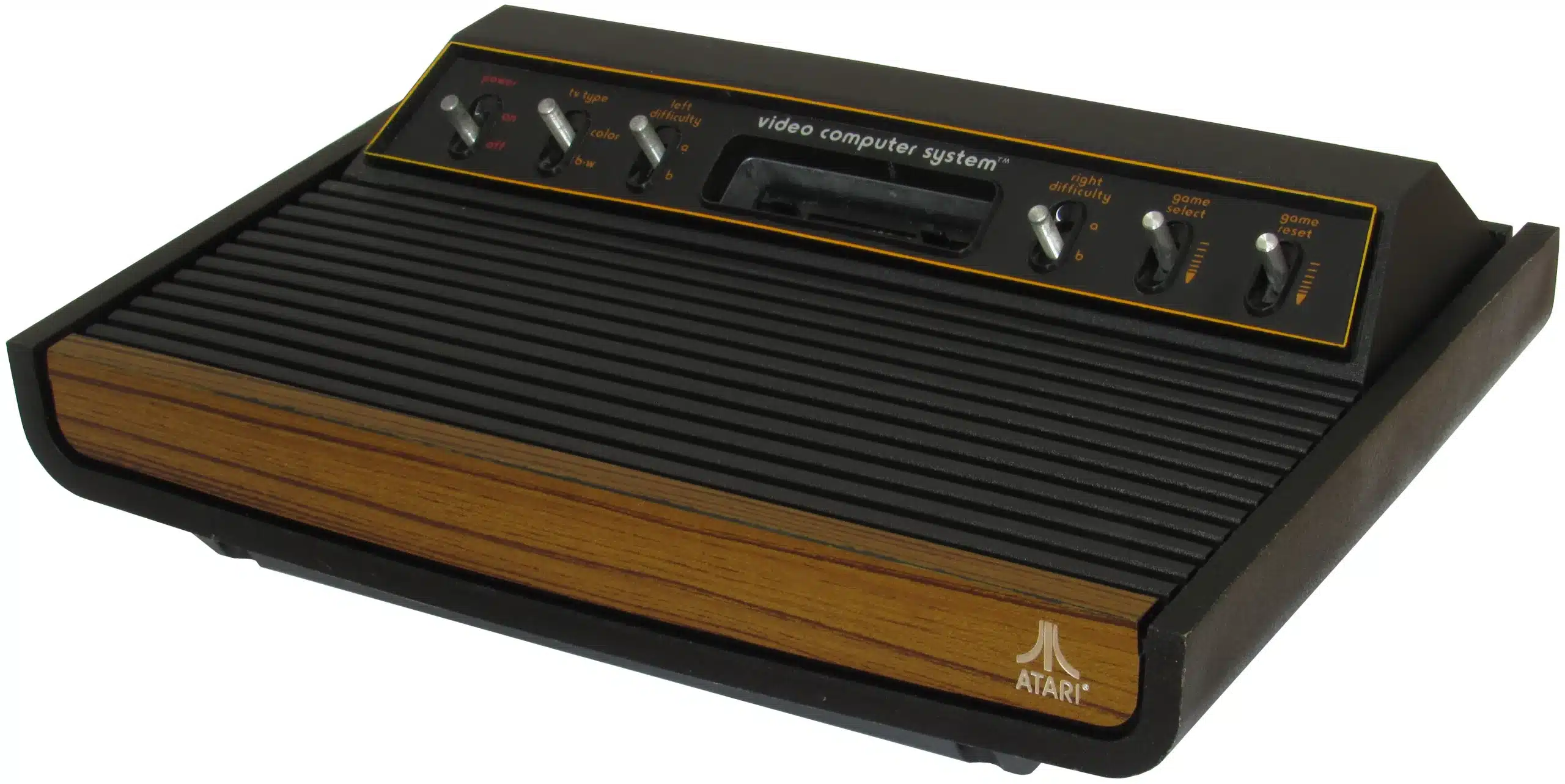
Atari 2600

Photo: Dphirschler, Wikimedia Commons (CC BY-SA 4.0)

Released

1977

RAM

128 bytes, provided by the MOS 6532 RIOT chip

CPU

MOS Technology 6507 (a cost-reduced 6502 variant with a 13-bit address bus), 1.19 MHz NTSC

Launch price

$199 (US, 1977)

Manufacturer

Atari, Inc.

Form factor

Second-generation cartridge-based home console. The original “Heavy Sixer” had a walnut-effect woodgrain shell over an aluminium RF-shielded chassis, with six front-panel switches; later revisions (Light Sixer, four-switch “Woody”, the black “Vader”, and the slimline 1986 2600 Jr.) progressively cheapened the build

CPU

MOS Technology 6507 (a cost-reduced 6502 variant with a 13-bit address bus), 1.19 MHz NTSC

Chipset

TIA (Television Interface Adaptor) — the custom video/audio chip — paired with the MOS 6532 RIOT handling RAM, controller I/O and timers

RAM

128 bytes, provided by the MOS 6532 RIOT chip

ROM

Cartridge ROM originally limited to 4 KB directly addressable; third-party bank-switching schemes later pushed titles to 8, 16 and even 32 KB

Graphics

160×192 visible pixels (NTSC; PAL 160×228 at 50Hz). 128-colour NTSC palette. Five movable objects (two player sprites, two missiles, one ball) plus a playfield register — no frame buffer, the display was hand-timed scanline by scanline (“racing the beam”)

Audio

Two independent TIA sound channels, 4-bit volume control per channel, square-wave and noise/distortion waveforms

Storage

ROM cartridges (Atari’s own “Video Computer System” cartridge format)

Ports

Two 9-pin (DE-9) controller ports on the rear; RF output via a switchbox; separate DC power input

OS

None — no BIOS or OS layer, the 6507 jumped straight into cartridge code on power-up via a hardwired reset vector

PSU

External AC adaptor, 9V DC, approximately 500mA, centre-tip-positive 3.5mm barrel connector

Units sold

Approximately 30 million over its full production life (1977–1992) — the figure most consistently repeated across sources, though a handful of secondary estimates range as wide as 25 to 40 million

Successors

Atari 5200 (1982); Atari 7800 (1986, backward-compatible with 2600 cartridges)

  • RF modulator degradation
    The internal RF modulator's shielding and connector are a common point of physical failure after decades of handling, and even an intact unit delivers a soft, colour-bleeding picture on modern displays that owners frequently mistake for a deeper fault.
  • RIOT chip and controller port wear
    The MOS 6532 RIOT chip handles both RAM and controller I/O, so a console with unresponsive joystick directions or fire buttons, even with a known-good joystick and clean ports, usually points to a failing RIOT rather than the cable or port itself.
  • Capacitor and 7805 regulator ageing
    Electrolytic capacitors and the 7805 voltage regulator (mounted to the RF shield as a heatsink) are original 1970s/80s components now well past their design life, and their failure shows up as no power, intermittent operation, or colour and audio glitches.
  • 1976 Atari sold to Warner Communications, funding the VCS project through to launch
  • 1977 Atari Video Computer System (VCS) launched in North America, September, at $199, with Combat pack-in
  • 1980 Atari's licensed home port of Space Invaders becomes the console's first killer app, multiplying hardware sales
  • 1982 Renamed "Atari 2600" after its CX2600 part number; also the year of the notoriously rushed E.T. the Extra-Terrestrial and a widely mocked Pac-Man port
  • 1986 Atari 2600 Jr. launched — a heavily cost-reduced, restyled redesign
  • 1992 Production ended on 1 January, with roughly 30 million units sold across the console's full run