MACHINE REFERENCE

ColecoVision

The ColecoVision turned up in August 1982 with a graphics chip good enough to make the Atari 2600 look like a toy, and for about eighteen months, that was exactly the point.

Why it matters

Coleco built its case on a single, brutally effective demo: an arcade-accurate port of Donkey Kong, bundled in the box, running on hardware that finally had the horsepower to do the arcade game justice rather than a flattened approximation of it. The TMS9928A video chip and SN76489 sound chip weren’t custom silicon dreamed up in-house, they were the same off-the-shelf parts Texas Instruments was already selling elsewhere, but wired together with enough RAM behind them to matter. Then Coleco doubled down with Expansion Module #1, a genuinely clever bit of engineering that let the console swallow the entire existing Atari 2600 cartridge library, turning a new machine into an instant library of hundreds of games on day one. It worked, and sales passed a million units within months. Then the 1983 crash arrived, the market that had made room for a graphics-led console evaporated almost overnight, and Coleco’s answer, the ill-fated Adam computer, dragged the whole company down with it by 1985.

What to check before you buy

  • Test the controller ports before you commit to a price. Static damage to the 74LS541 buffer chips is common, and a unit that registers phantom keypad or joystick input is a repair job, not a quirk.
  • Ask, or check yourself, whether the capacitors have been serviced. Original electrolytics are now decades past their rated life.
  • Confirm the power supply is present and original or a known-good replacement. The 4-pin connector and triple-rail output are proprietary enough that a wrong or failing PSU can damage the board.
  • Factor in Expansion Module #1 separately if Atari 2600 compatibility matters to you. It's a distinct accessory, not built in.
  • Treat "complete in box" pricing with some scepticism. A boxed Donkey Kong bundle is the most commonly reproduced or reshuffled combination on the resale market.
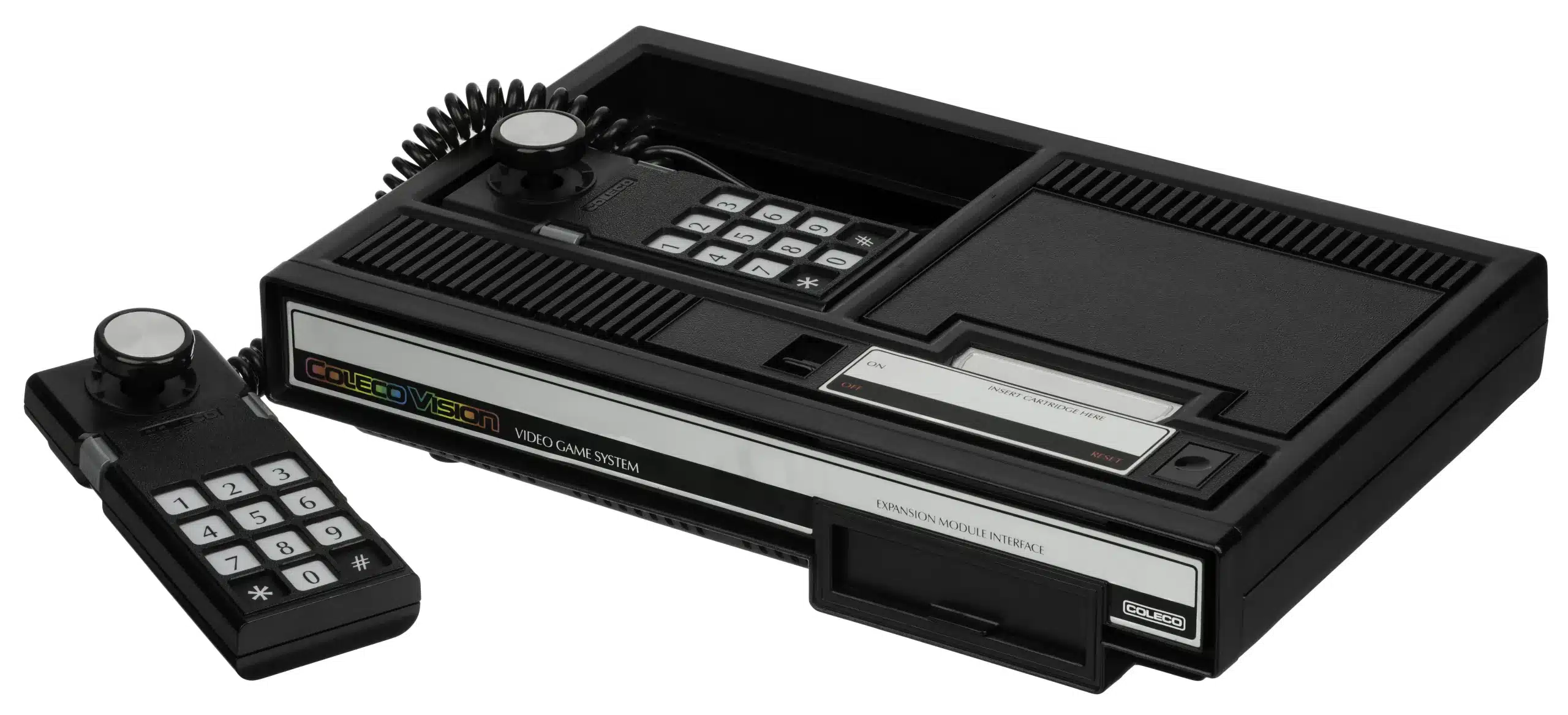
ColecoVision

Photo: Evan-Amos, Wikimedia Commons (Public domain)

Released

1982

RAM

1 KB system/scratchpad RAM plus 16 KB dedicated video RAM serving the TMS9928A

CPU

Zilog Z80A, 3.58 MHz

Launch price

$175 (one source cites $195, but $175 recurs across the most sources)

Manufacturer

Coleco (Coleco Industries, Inc.)

Form factor

Tabletop third-generation home video game console — front-loading cartridge slot, integrated two-port controller bay, expansion module port on the front face

CPU

Zilog Z80A, 3.58 MHz

Chipset

No dedicated custom ASIC — built from standard off-the-shelf parts (Z80A, TMS9928A, SN76489, TTL glue logic), part of why it was cheap to build

RAM

1 KB system/scratchpad RAM plus 16 KB dedicated video RAM serving the TMS9928A

ROM

8 KB BIOS ROM

Graphics

TMS9928A video display processor (NTSC units; PAL units used the TMS9929A) — the same VDP family used in the MSX and TI-99/4A

Audio

Texas Instruments SN76489 programmable sound generator (3 square-wave tone channels plus 1 noise channel)

Storage

ROM cartridges, typically 8/16/24/32 KB

Ports

Two front-mounted proprietary 9-pin controller ports, one front-edge expansion module port, RF switchbox output, 4-pin DC power input

OS

None in the conventional sense — cartridge-boot BIOS only

PSU

External power brick supplying +5V/4.0A, +12V/2.0A and -5V/0.5A via a proprietary 4-pin connector

Units sold

More than 2 million during the console’s commercial life, per the clearest sourced figure; some retrospectives cite figures as high as 6 million, treated as unverified

Successors

Coleco Adam (1983) — a full computer system built around ColecoVision compatibility, not a direct console successor. There was no ColecoVision 2

  • Controller port static damage
    The controller ports are unusually sensitive to static discharge, which fries the 74LS541 buffer chips that read the keypad and joystick, presenting as a game behaving as if a direction or keypad button is permanently held down.
  • Electrolytic capacitor ageing
    The console's electrolytic capacitors have an estimated service life of around 15 years and are now decades past it, causing power, video, or audio faults; a specific known symptom is the picture blacking out after a short play session, traced to capacitor C106.
  • VRAM chip overheating
    The eight VRAM chips run on three separate voltage rails, run hot in normal operation, and are a common long-term failure point, enough of an issue that +5V-only replacement memory kits exist specifically to address it.
  • 1979 Coleco begins development of what becomes the ColecoVision, aiming to beat Atari and Mattel on graphics quality
  • 1982 North American launch in August, bundled with Donkey Kong, at $175
  • 1982 Expansion Module #1 released, letting ColecoVision owners play the existing Atari 2600 cartridge library on Coleco's hardware
  • 1983 The video game crash guts the console market; Coleco pivots hard toward the Adam computer as a lifeline, a bet that fails
  • 1985 ColecoVision officially discontinued in October