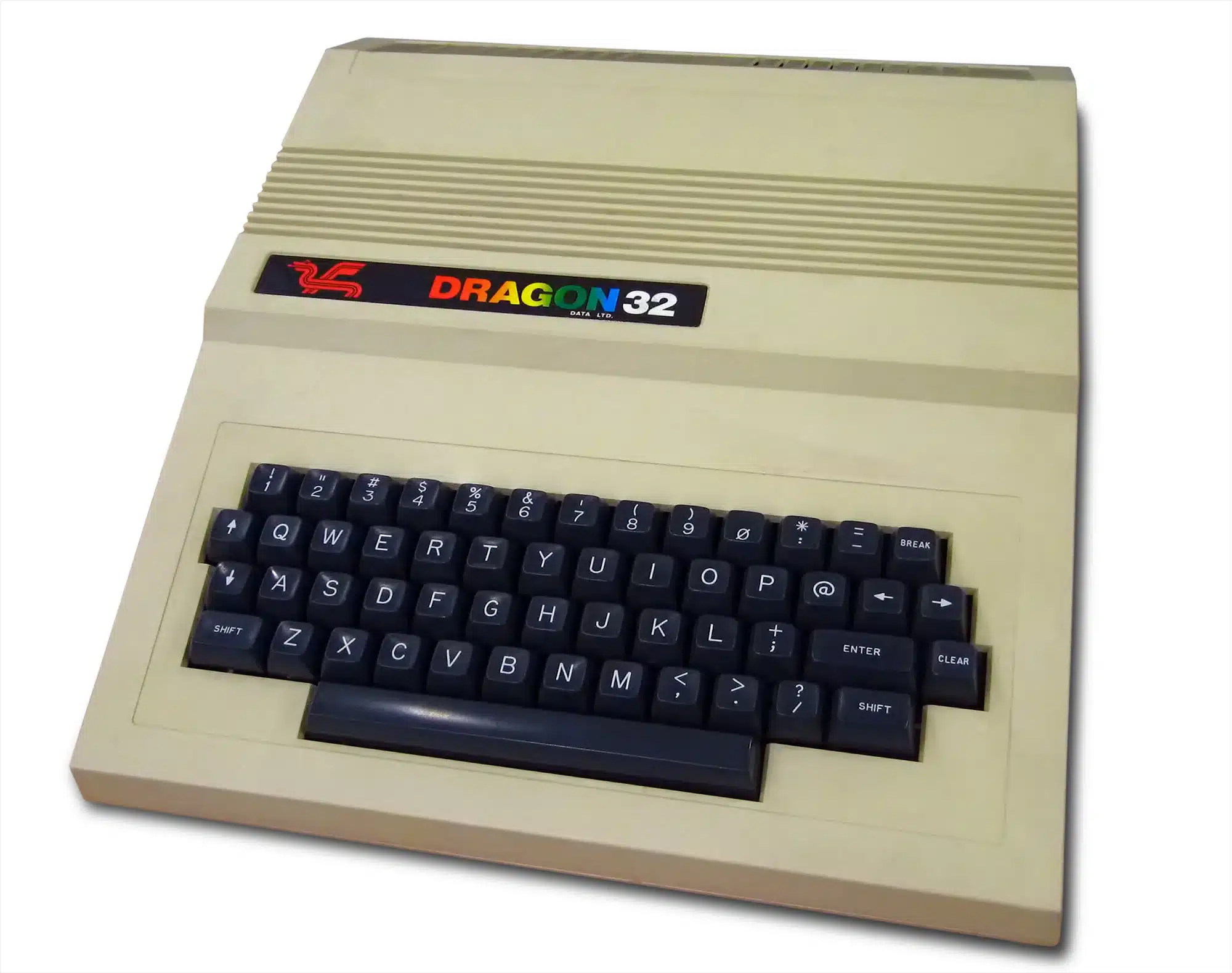
The Dragon 32 was Wales’s one serious entry in the home computer boom, built in Swansea and then Port Talbot around a Motorola 6809E rather than the Z80 or 6502 nearly everyone else was using. It’s a decision that still divides opinion: the 6809 was arguably the most sophisticated 8-bit chip of its generation, with instructions and addressing modes the Spectrum’s Z80 simply didn’t have — and almost nobody wrote software clever enough to actually use them.
Why it matters
The Dragon 32 matters less for what it did than for what it represents: a genuinely capable piece of British engineering, backed by serious investors including the Welsh Development Agency, that lost a war fought on shelf space and marketing rather than silicon. Underneath the case is a design closely related to Tandy’s TRS-80 Color Computer, sharing enough of its architecture that CoCo software would often run with minimal adaptation — a sensible piece of pragmatism from a company that, by its own admission, had no prior experience designing a computer and hired external consultants to do it. What sank Dragon Data wasn’t the 6809, it was everything around it: a 64 KB model that arrived a year late, colour graphics that topped out at four shades against the Spectrum’s mould-breaking marketing, and a disk system and OS-9 software that turned up only after the market had already decided. By June 1984 the company was in receivership with warehouses of unsold stock, sold off for a fraction of what it had cost to build.
What to check before you buy
- Ask whether the original external PSU is included and has been tested — Dragon Data's transformer-based supply is a known point of failure, and a dead or dodgy one is the single most common reason a "for spares" listing exists.
- Check the keyboard responds cleanly across all keys — cracked membrane and power-board PCBs are a documented Dragon 32 issue, and a keyboard that skips or double-types usually means a board that needs attention, not just a clean.
- Look at the screen output before buying if at all possible: colour fringing, a rolling "rainbow effect" or garbled text on power-up point to ageing capacitors and ICs around the video circuit rather than anything a cable swap will fix.
- Confirm what's actually included — a Dragon 32 without its RF/composite lead or a compatible cassette recorder is a much smaller purchase than it first looks.
- If buying for software, check whether it's cassette or cartridge-based collection you're after — DragonDOS disk software and drives are comparatively rare and command a premium over the tape-based library.