MACHINE REFERENCE

Grundy NewBrain

The Grundy NewBrain was a Z80A micro that began life at Sinclair Radionics, reached the shops in 1982 with 32 KB of RAM and an optional one-line display, and was gone, along with its maker, by August 1983.

Why it matters

The NewBrain was a good machine sold into a market that wanted something else. A Z80A at 4 MHz, 32 KB of RAM, a full-screen editor and a maths package good for about 12 figures made a lot of computer for about £200 in 1982, and the AD’s vacuum fluorescent display let it work without a television. Your Computer found its character set and high-resolution graphics the most extensive of any machine under £300. The trouble sat around the hardware. The design passed from Sinclair Radionics to Newbury Laboratories to Grundy, lost the BBC contract to Acorn and reached shops two years after its announcement. Grundy then promised a CP/M system and an expansion interface it could not deliver on time, while sales staff and dealers got little training or software. Production was pushed to 10,000 a month just as the money ran out. About 50,000 were reportedly sold, though no primary record confirms it, and Grundy Business Systems closed in August 1983.

What to check before you buy

  • Test or replace the external power supply before connecting it. Rated outputs are about +7.5, +13.5 and -14 V, one faulty unit was seen putting about +20 V on two rails, and the RIFA mains filter capacitor can fail dramatically.
  • Check which model you are buying. The A needs a TV or monitor, while the AD has the one-line vacuum fluorescent display. Switch on and see whether the display lights, because one display fault was traced to IC436, a 74LS166N.
  • Ask whether it boots and whether the BASIC prompt appears. The 4116 RAM chips are reported as unreliable, and a bad chip in bank 0 stops booting, while the startup circuit around IC452 can also fail.
  • Open it if you can. The three boards are joined by fragile single-core ribbon cables, nothing is socketed, and most 47 uF and 10 uF electrolytics will have dried out.
  • Look for extras and paperwork. Expansion units, disk controllers, the handbook and technical manual are scarce, cassette loading is unreliable, and CP/M and disk drives need the expansion chassis.
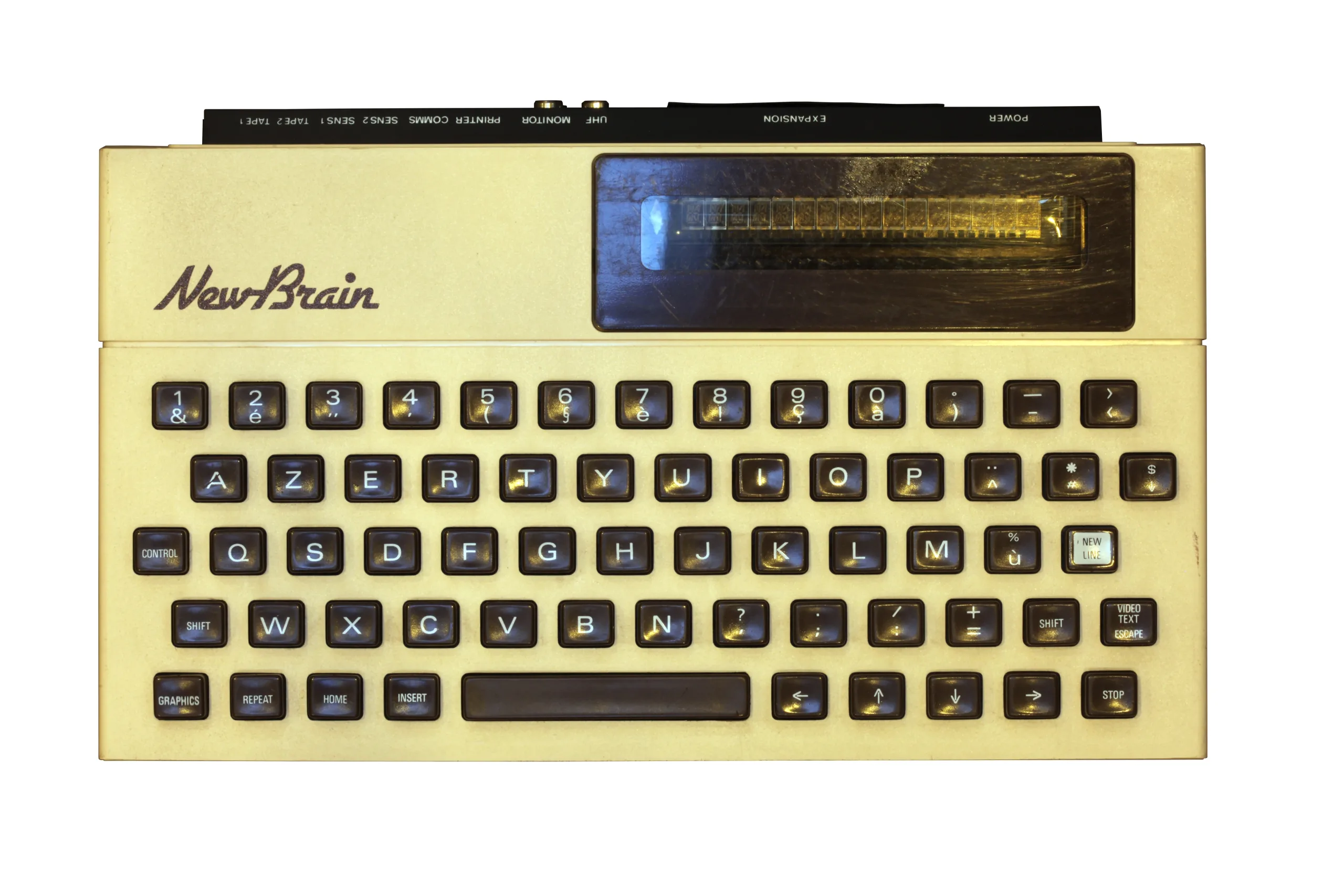
Grundy NewBrain AD computer with a French keyboard and its one-line display, photographed from above at the Musée Bolo

Photo: Rama and Musée Bolo, Wikimedia Commons (CC BY-SA 2.0 fr)

Released

1982

RAM

32 KB as standard, in two banks of 4116 DRAM chips (Binary Dinosaurs). Expansion modules add up to 512 KB each, and Your Computer said four could reach 2 MB. The disk expansion chassis adds 64 KB of bank-switched memory (Wikipedia)

CPU

Zilog Z80A at 4 MHz. A COP420 microcontroller handles the keyboard and the AD model’s one-line display (Wikipedia, Computing History)

Launch price

Sources disagree. Wikipedia and Computing History give £199 for the Model A and £229 for the AD. Your Computer (September 1982) and The Register give £233 for the A and £267.50 for the AD. Gondolin gives £159 for the A, and the UvA museum gives about 1,300 Dutch guilders. McMullon says the machine was aimed at under £200 and that marketing raised the price in February 1983

Manufacturer

Grundy Business Systems Ltd (GBS), Teddington and Cambridge, England, a subsidiary of the Grundy group. The design began at Sinclair Radionics, passed to Newbury Laboratories, and was sold to GBS in 1981 (The Register gives September 1981, Computing History gives August 1981; GBS itself was formed in November 1981 according to Gerald McMullon, who worked there)

Form factor

Compact keyboard computer, described by Binary Dinosaurs as only slightly larger than a Spectrum. No reliable dimensions or weight found (one Barcelona museum entry gives 31 x 31 x 33 cm, which probably includes accessories). 62-key chiclet-style keyboard of nearly full typewriter width. Production cases came out cream and brown; the intended colours were silver and orange, or red and grey. The AD model has a one-line vacuum fluorescent display above the keyboard. No power switch on the machine (Your Computer)

CPU

Zilog Z80A at 4 MHz. A COP420 microcontroller handles the keyboard and the AD model’s one-line display (Wikipedia, Computing History)

Chipset

No custom ULAs. Newbury’s planned ULAs never arrived, so the production machine was built from TTL logic, which ran hot (Binary Dinosaurs). Z80A CPU plus a COP420 microcontroller for keyboard and display. Three boards joined by single-core ribbon cables, all soldered in with no sockets

RAM

32 KB as standard, in two banks of 4116 DRAM chips (Binary Dinosaurs). Expansion modules add up to 512 KB each, and Your Computer said four could reach 2 MB. The disk expansion chassis adds 64 KB of bank-switched memory (Wikipedia)

ROM

Sources disagree on size: 24 KB (Wikipedia, Computing History), 28 KB (UvA Computer Museum) and 29 KB (Your Computer, Centre for Computing History). It holds BASIC, a maths package, a graphics package, a full-screen editor and device drivers

Graphics

Monochrome (two colours). Text modes from 32 x 25 up to 80 x 30 (Your Computer quotes 40 x 24 and 80 x 30). High-resolution graphics at 256, 320, 512 or 640 pixels across and up to about 250 high. Your Computer counted four character sets drawn from 512 characters, including over 150 graphic symbols and the Greek alphabet. Output on UHF, composite video and monitor. Multiple screen pages use a lot of RAM, over 10 KB for one 40 x 200 page

Audio

None. Your Computer noted the NewBrain had no sound and no colour

Storage

Two cassette ports at 1,200 baud. Disk drives via the expansion chassis and disk controller: 5.25-inch drives of 200 KB (single-sided) and 800 KB (double-sided), and from 1983 Sony 3.5-inch drives (Wikipedia). CP/M 2.2 was available, though it arrived months after the announced January 1983 date

Ports

Two cassette sockets, UHF TV out, composite video / monitor, two RS-232 serial ports (up to 19,200 baud), a printer port, a modem socket on the rear panel (Your Computer) and a 50-pin expansion bus. The expansion chassis adds a parallel printer port and two further hardware serial ports. Binary Dinosaurs also lists a Centronics port

OS

ROM-resident NewBrain BASIC, an extended ANSI-standard BASIC similar to Microsoft BASIC, which Your Computer described as compiled. The maths package uses six-byte base-256 floating point for about 12 figures of accuracy (Wikipedia). CP/M 2.2 was an option with disks, with the BASIC ROM paged out

PSU

External linear mains supply on a multi-pin connector (the Centre for Computing History lists a unit coded NB 11000). Binary Dinosaurs gives the ratings as +7.5, +13.5 and -14 V DC. One 1998 owner measured roughly +6, +12 and -13 V on a working design and about +20 V on two rails from a faulty one (classiccmp thread)

Units sold

About 50,000 is the commonly quoted figure (Wikipedia says over 50,000 in the body and approximately 50,000 in the lead, and The Register says about 50,000 were thought to have sold). Both appear to rest on the same unattributed claim, and no primary sales record was found, so treat it as an estimate

Successors

None. Grundy Business Systems shut in August 1983 (McMullon). Leftover stock and incomplete machines went to the Dutch firm Tradecom, which supplied them to schools and training centres in the Netherlands. Upgraded Series 2 ROMs were considered but never released

  • Failing power supply and mains filter capacitor
    A 1998 owner of an AD found the display flickered and went blank at switch-on with a white screen on the TV. His supply read about +20 V unloaded on two rails, which he suspected was a regulator fault. Tony Duell advised checking the +5, +12 and -5 V rails at the 4116 RAM chips. Binary Dinosaurs adds that the RIFA mains filter capacitor in the PSU can fail dramatically.
    Grundy NewBrain wont power up (classiccmp thread) →
  • Dead RAM, startup circuit and video shift register
    Binary Dinosaurs lists the 4116 RAM chips as unreliable, with a bad chip in bank 0 stopping the machine booting, and gives BASIC POKE and PEEK tests to find it. The startup circuit (capacitors 125 and 127 and IC452) can fail so the machine will not boot, and IC436, a 74LS166N, can cause no screen output or garbled text. Most 47 uF and 10 uF electrolytics are likely to have dried out.
    Grundy NewBrain (Binary Dinosaurs Computer Museum) →
  • Unreliable cassette loading
    Gerald McMullon, who worked at Grundy, says the original NewBrain had trouble loading from some cassette recorders. A fix was designed but never put into production, because the complaints did not reach production. The Register also reports cassette port problems from users. Binary Dinosaurs documents a Gotek floppy emulator being used to boot one into CP/M.
    Gerald McMullon on the NewBrain (Binary Dinosaurs) →
  • 1978 The National Enterprise Board funds a personal computer project at Sinclair Radionics, with Mike Wakefield designing the hardware and Basil Smith writing the software
  • 1980 Newbury Laboratories shows three prototypes, the M, MB and MBS, and the machine is announced as the NewBrain but not released
  • 1981 Acorn wins the BBC computer contract in February, and Newbury sells the NewBrain to Grundy Business Systems in August or September (sources differ)
  • 1982 Grundy launches the Model A and the AD in July, with Your Computer reviewing the AD in September
  • 1983 Production is raised towards 10,000 units a month after a Christmas 1982 rush, but Grundy Business Systems shuts in August and Tradecom buys the stock for Dutch schools