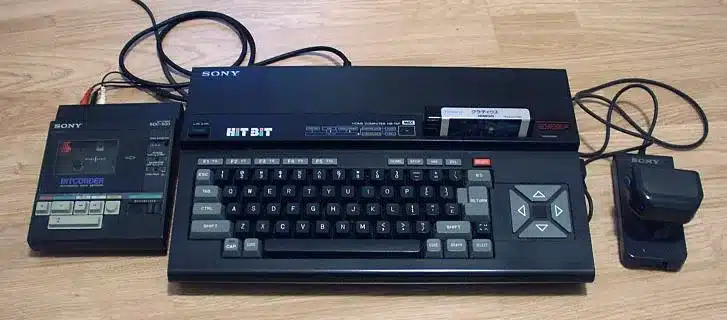
MSX1 was Microsoft’s only serious attempt to define a hardware standard for anyone besides itself, and for a few years in the mid-1980s it actually worked. Announced jointly with Japan’s ASCII Corporation in June 1983, the specification let Sony, Panasonic, Philips, Sanyo, Toshiba, Canon, JVC and a dozen more manufacturers each build their own machine around a shared Zilog Z80A, a shared Texas Instruments video chip and a shared cartridge slot, so a game bought for a Sony HitBit would run, unmodified, in a Philips VG-8020 sitting in a shop two doors down.
Why it matters
MSX is the closest the 8-bit era came to a VHS moment for computers: one licensed specification, many manufacturers, genuine cross-vendor compatibility at a time when almost every other home computer was a closed, proprietary island. It worked spectacularly in Japan, where it briefly rivalled NEC’s PC-8800 series for shelf space, and it found real, lasting audiences in the Netherlands, Brazil and other South American markets where Sinclair and Commodore hadn’t already locked up the territory. In the UK and the US it barely registered. The Spectrum and the C64 had a year’s head start and a fierce price war already underway by the time the first MSX machines reached British shops in 1984, and a standard whose biggest strength was “lots of companies make it” turned out to be a difficult thing to put a face to on a shop shelf next to Sinclair’s very singular brand identity.
What to check before you buy
- Confirm the video chip variant for your region. TMS9918A (NTSC) and TMS9928A/9929A (PAL) machines aren't interchangeable if you care about a correct picture on a PAL television.
- Ask which PSU is included, and don't mix and match. The MSX standard never fixed a power supply voltage, and the wrong adapter can damage the machine.
- Test the keyboard membrane and cartridge slot before you commit, or budget for a repair. Both are among the most commonly reported faults across the whole MSX1 range.
- Work out whether you're buying a cassette-only machine or one with disk support, since MSX-DOS software needs the latter.
- Expect the RAM to vary wildly between models wearing the same "MSX1" badge, and factor in regional differences in manuals and keyboard layout.