MACHINE REFERENCE

Robotron KC 85/1

The Robotron KC 85/1 started life under a different name entirely: it launched in 1984 as the Z 9001, and only became the KC 85/1 a year later when East German planners decided a home computer sounded too much like a consumer indulgence for a state that would rather it be seen doing something useful in a classroom.

Why it matters

The KC 85/1 is a rare, direct artefact of computing built entirely outside the Western supply chain: its CPU is a U880, an unlicensed East German clone of the Z80, built because the GDR had no access to Zilog’s actual silicon. Everything downstream of that chip was designed to be built and serviced entirely within Kombinat Robotron’s own factories, and it shows: this was industrial and educational infrastructure first, hobbyist toy a distant second. It also sits at the centre of one of the more baffling naming accidents in retro computing. The near-simultaneous, completely incompatible HC 900 from a rival Robotron plant in Mühlhausen was renamed KC 85/2 the same year the Z 9001 became the KC 85/1, two unrelated machines sharing a product family name by administrative coincidence rather than shared engineering, which still trips up unwary buyers decades later.

What to check before you buy

  • Confirm exactly which name is on the badge and the board — Z 9001, KC 85/1 or KC 87 — since the KC 87's ROM-resident BASIC makes it a meaningfully different machine to buy.
  • Don't confuse this with a KC 85/2, /3 or /4 listing — despite the shared numbering, that's a completely different, incompatible architecture from a different factory.
  • Expect to buy from Germany. These were sold almost exclusively within the GDR's domestic and institutional market.
  • Get the power supply checked before powering on for the first time in years — GDR-era electrolytic capacitors on the primary side are a documented failure point.
  • Ask about the keyboard specifically. The rubber-mat elastomer design was never plush to begin with, and decades of ageing conductive pads make patchy key response likely on a well-used example.
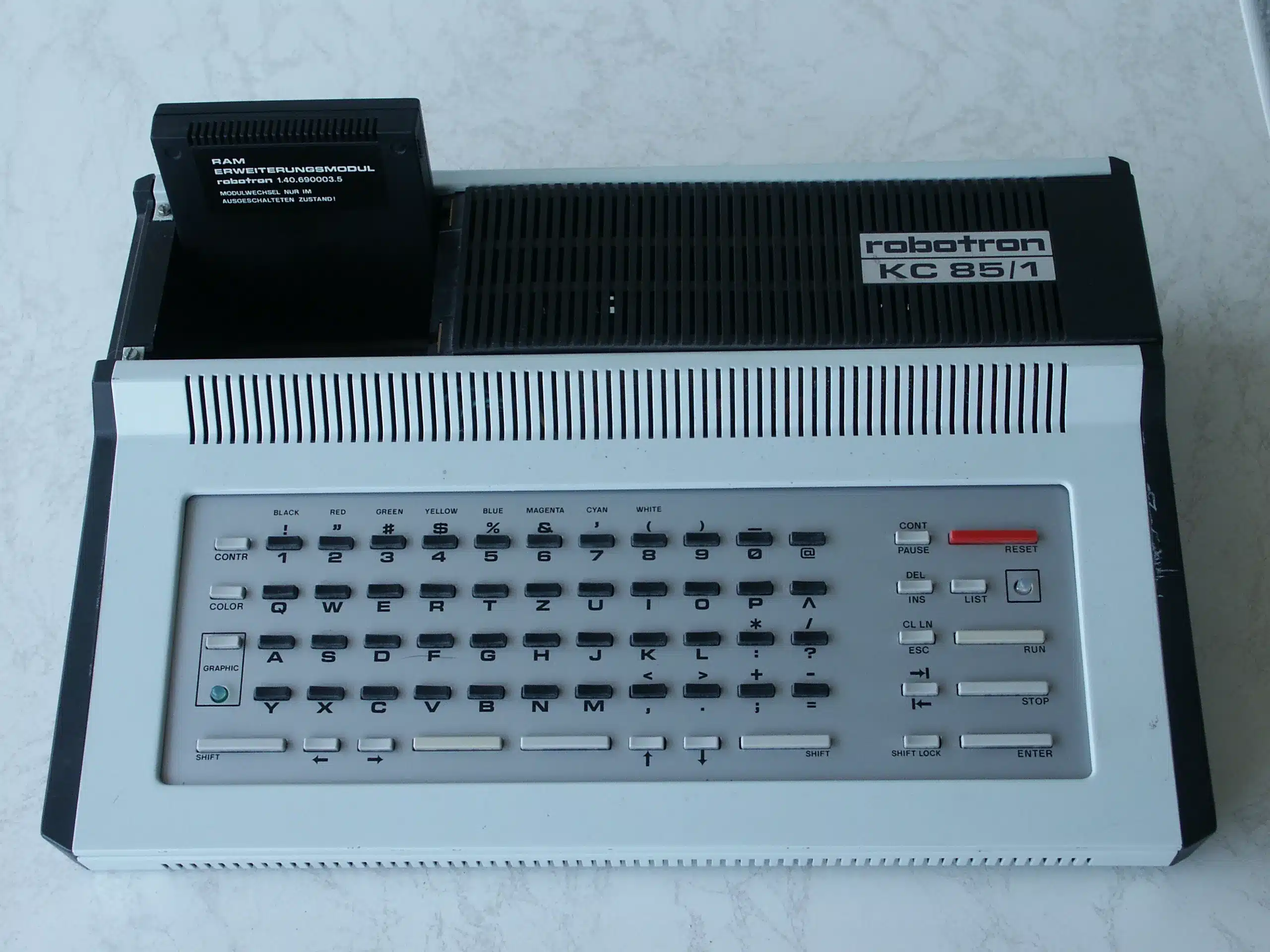
Robotron KC 85/1

Photo: Enrico Grämer, Wikimedia Commons (Attribution 3.0)

Released

1985

RAM

16 KB standard, expandable to 64 KB via plug-in memory modules

CPU

U880 (unlicensed East German clone of the Zilog Z80), 2.5 MHz

Launch price

1,550 Mark der DDR (KC 85/1.10, monochrome); 1,940 M (KC 85/1.11, colour) — 1985

Manufacturer

VEB Robotron-Meßelektronik “Otto Schön” Dresden (part of Kombinat Robotron)

Form factor

All-in-one keyboard-case home/educational computer, approx. 40 x 30 x 8.5 cm, ~4 kg — separate monitor/TV required

CPU

U880 (unlicensed East German clone of the Zilog Z80), 2.5 MHz

Chipset

U880 CPU plus U855 PIO (parallel I/O) for keyboard/peripheral handling; exact CTC/timer and video-generation IC part numbers unknown

RAM

16 KB standard, expandable to 64 KB via plug-in memory modules

ROM

4 KB (Z9001/KC 85/1 monitor/OS); BASIC loaded from tape or an external module, not resident in ROM on this model

Graphics

Text-mode 40×20 or 40×24 characters (8×8 pixel cells), 128 pseudo-graphic symbols; monochrome standard, optional colour card (8 fg/bg colours); optional graphics module added 256×192 monochrome pixel mode

Audio

Built-in piezo buzzer/beeper only, no dedicated sound chip

Storage

Cassette tape interface (~1,000 bits/sec) as standard; 5.25″ floppy disk drives available as a late add-on (from around 1988), up to 800 KB/disk

Ports

RF/composite video out (mono) or RGB out (colour models), cassette in/out, 5-pin DIN joystick connector, parallel user I/O port, four K 1520-bus expansion module bays

OS

Z9001-OS (a CP/M-80-derived monitor/OS, 4 KB, resident in ROM); SCP (CP/M 2.2-compatible) available later for floppy-equipped systems

PSU

Internal, 220V/50Hz mains input, roughly 25–30W

Units sold

Unknown for the KC 85/1 name specifically — the only available figure, approximately 30,000 units, covers the combined Z9001 + KC 85/1 + KC 87 production run (1984–1989) as a whole

Successors

KC 87 (1987) is the direct, same-architecture successor — essentially the KC 85/1 with BASIC moved into ROM — built by the same Dresden factory until March 1989. Note: the contemporaneous “KC 85/2”, “KC 85/3” and “KC 85/4” machines share the KC85 name but are a completely different, incompatible architecture (originally the HC 900) built by VEB Mikroelektronik Mühlhausen

  • Primary-side power supply capacitor failure
    A documented failed unit showed a defective primary-side electrolytic filter capacitor, causing audible high-pitched chirping, visible smoke and badly sagging output rails; in the reported case a failed load resistor and an overheated diode were also implicated.
    Robotrontechnik forum thread →
  • ROM reliability over time
    East German-manufactured ROM chips on this machine and its siblings are noted by retro-computing reference sources as more failure-prone with age than Western equivalents, a recurring theme in GDR-era silicon quality generally.
    oldcomputer.info reference →
  • Elastomer keyboard degradation
    The KC 85/1 used a rubber-mat elastomer keyboard, described even by contemporary sources as small, stiff and lacking tactile feedback; keyboards of this general construction are well known to develop poor or intermittent contact as the conductive rubber pads and carbon pills age and oxidise.
  • 1980 U880 (the Z80 clone CPU this machine is built around) enters production at VEB Funkwerk Erfurt
  • 1984 Robotron Z 9001 launched as a home computer, built by VEB Robotron-Meßelektronik Dresden
  • 1985 Renamed Robotron KC 85/1, repositioning it toward education and commerce rather than the consumer market
  • 1987 Renamed again to KC 87, now with BASIC integrated into ROM
  • 1989 KC 87 production ends at the Dresden plant in March