MACHINE REFERENCE

Sega Master System

The Sega Master System arrived in America in September 1986 carrying a Zilog Z80A running at 3.58 MHz, a graphics chip descended from the same TMS9918 family Texas Instruments had been licensing out for years, and a straightforward promise: better hardware than the machine that had already won.

Why it matters

On paper, the Master System should have beaten the NES outright. Its VDP could put more colours on screen, its cartridge slot took bigger games, and Sega backed it with a genuinely strong library once Alex Kidd and, later, Sonic arrived to carry the flag. What it didn’t have was Nintendo’s stranglehold on Western retailers and third-party publishers, and no amount of silicon fixes a distribution problem. The Master System’s real legacy isn’t the sales column against the NES, it’s what happened in Brazil, where Tectoy kept building and selling the thing well into the 2000s, and in Europe, where it quietly outsold the NES in several markets and gave Sega a foothold it would spend the Mega Drive years cashing in on.

What to check before you buy

  • Ask whether the unit outputs RF only or has been modded for composite/RGB — an unmodified RF-only Master System will look genuinely rough on a modern television.
  • Check the cartridge and Sega Card slots for worn or bent pins, especially on well-used units.
  • Confirm the seller has actually tested the console with a game, not just powered it on — a lit power LED with no picture is a classic sign of RF modulator or capacitor trouble.
  • Bring your own known-good 9V power adaptor if you can, or at least ask what's included.
  • If buying a PAL VA3-revision board (common in Europe), ask specifically about trace corrosion under the RF can, a documented weak point on that revision.
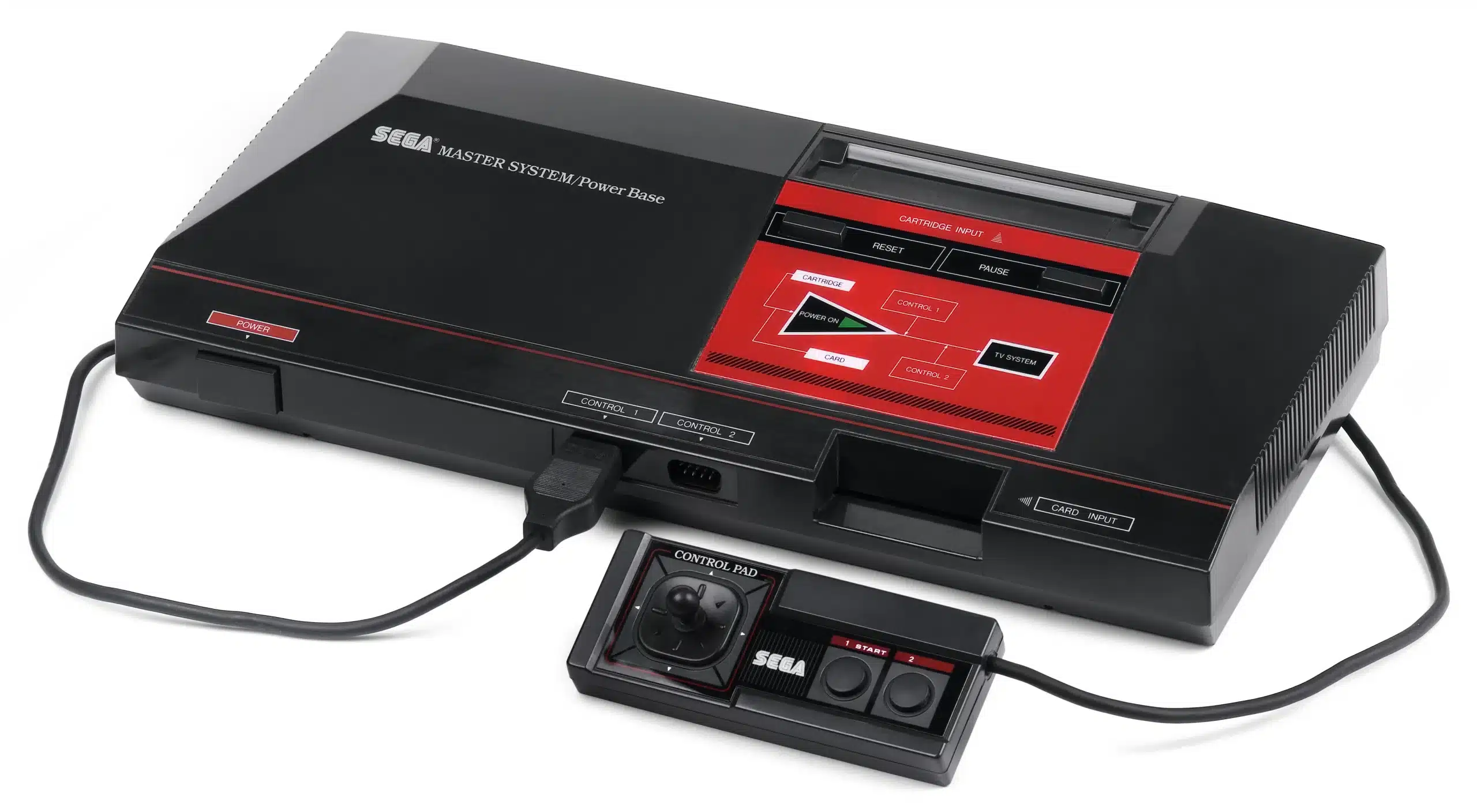
Sega Master System

Photo: Evan-Amos, Wikimedia Commons (Public domain)

Released

1986

RAM

8 KB system RAM (plus 16 KB separate VRAM)

CPU

Zilog Z80A, 3.58 MHz (chip rated to 4 MHz, underclocked to sync with the NTSC/PAL colour clock)

Launch price

$200 (North America, September 1986); £99.95 (UK, August 1987); ¥15,000 (Japan, Mark III, October 1985); ¥16,800 (Japan, Master System, October 1987)

Manufacturer

Sega

Form factor

Third-generation home console — black rectangular console with top-loading cartridge slot plus a separate “Sega Card” slot

CPU

Zilog Z80A, 3.58 MHz (chip rated to 4 MHz, underclocked to sync with the NTSC/PAL colour clock)

Chipset

Custom Sega VDP (315-5124) plus Texas Instruments SN76489 PSG; Japanese units also carried a Yamaha YM2413 FM chip as standard from later revisions, generally omitted from Western units

RAM

8 KB system RAM (plus 16 KB separate VRAM)

ROM

8 KB boot ROM (BIOS)

Graphics

Sega VDP 315-5124 (derived from the TI TMS9918 family), 256×192 resolution, 32 colours on screen from a 64-colour palette

Audio

Texas Instruments SN76489 PSG — 3 square-wave channels plus 1 noise channel (Japanese/later units add Yamaha YM2413 FM synthesis)

Storage

ROM cartridges (up to 512 KB) and the smaller “Sega Card” format (up to 32 KB), both via separate slots

Ports

Two DB9 controller ports, cartridge slot, Sega Card slot, rear expansion port, RF switch output (composite/RGB on some regional revisions), DC power input

OS

None — boots straight from the 8 KB BIOS ROM into cartridge/card code

PSU

External AC adaptor, 9V DC, barrel connector (5.5mm/2.1mm, centre-negative); current rating varies by official PSU model, commonly 850mA to 1.5A

Units sold

Approximately 13 million worldwide (excluding Brazil), plus a further estimated 8 million Tectoy-manufactured units sold in Brazil

Successors

Sega Master System II (1990 — cost-reduced redesign, same generation); true next-generation successor is the Sega Genesis/Mega Drive (1988/1989)

  • Leaking or bulging electrolytic capacitors
    Sega used Nichicon PR/MW-series electrolytics rated for 85°C; after three-plus decades their ESR has often nearly doubled, causing video noise, audio hum, power instability or a dead board. Bulging tops or leaked residue at the leads are the visible tell.
  • RF modulator and trace failure
    The RF modulator can fail outright, and on some PAL board revisions (VA3) flux residue combined with decades of humidity has been known to eat through the thin copper traces under the RF can, causing intermittent or total picture loss.
  • Cracked solder joints on the AV and power jacks
    The physical strain of plugging and unplugging cables over the years commonly cracks the solder joints under the DIN AV and DC barrel jacks, producing intermittent video dropout or random resets that can look like a deeper fault until the joints are reflowed.
  • 1985 Sega Mark III launches in Japan (20 October) as the Master System's direct predecessor
  • 1986 Rebranded "Master System" launches in North America (September) at $200
  • 1987 Launches in Europe (August, £99.95) and, rebranded again with a new BIOS/case, in Japan (18 October)
  • 1989 Launches in South Korea (April) and Brazil (September, via Tectoy)
  • 1990 Sega Master System II released — the machine's only major hardware revision
  • 1991–1996 Discontinued in most territories; Tectoy continued Brazilian production for years afterward