MACHINE REFERENCE

Sharp MZ-700

The Sharp MZ-700 arrived in November 1982 with a deliberate gap where its rivals put a BASIC interpreter: no operating system lived in ROM at all, so the machine booted from cassette into whatever you chose to load, Sharp’s own environment or CP/M.

Why it matters

Sharp called this the “Clean Computer” philosophy, and it was a genuine design stance rather than a cost-cutting shortcut: ship the hardware with nothing assumed, and let the owner decide what it runs. That put the MZ-700 at odds with nearly everything else on a 1983 shelf, where Commodore and Sinclair machines sold a BASIC dialect baked into silicon whether the buyer wanted it or not. The approach came with a real trade-off. With no bitmap graphics mode at all, just 512 fixed 8×8 characters doing double duty as block graphics, the MZ-700 looked plain next to a Spectrum or a CPC. What it earned instead was a reputation, in the UK press and in West Germany’s crowded computer market, for being solidly built and reliable enough at cassette loading to be worth the asking price, which is how a machine with no graphics chip to speak of still finished 1983 ranked above the Apple IIe and the Atari 800 in UK sales.

What to check before you buy

  • Ask for a power-on test before buying, or budget immediately for a capacitor service. The PSU and board electrolytics are now over 40 years old and failure is closer to the rule than the exception.
  • Check which variant you are actually being offered: MZ-711 (bare), MZ-721 (built-in tape deck) or MZ-731 (deck plus four-colour plotter). The plotter models are worth more but also have more that can go wrong.
  • Confirm the keyboard responds across all keys; unresponsive keys are usually a cheap membrane clean rather than a dead unit.
  • If buying for software use, check whether a working data recorder or cassettes are included. The MZ-700's cassette interface is proprietary enough that a generic tape deck will not simply plug in.
  • UK and West German market units are more commonly available than Japanese-market examples; factor in that original documentation and software for Japanese units will be in Japanese.
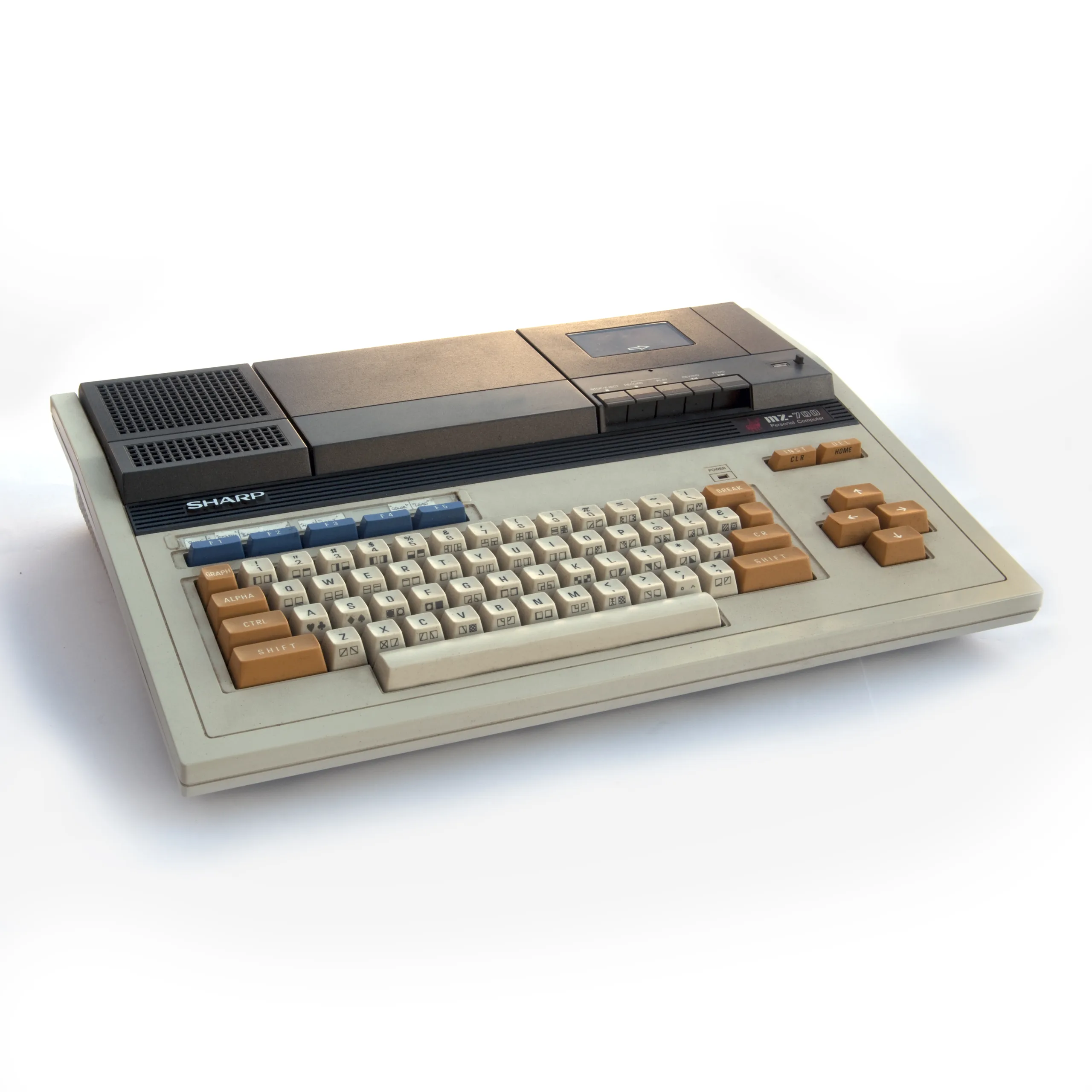
Sharp MZ-700 home computer keyboard unit

Photo: Bilby, Wikimedia Commons (CC BY 3.0)

Released

1982

RAM

64 KB main DRAM, plus 4 KB video SRAM

CPU

Sharp LH0080A (Zilog Z80A-compatible), 3.5 MHz

Launch price

Approximately 80,000 yen in Japan without recorder/plotter (around 130,000 yen fully equipped); £250 in the UK (1984, inc. VAT) for the base unit

Manufacturer

Sharp Corporation

Form factor

Keyboard-unit with separate TV/monitor (no built-in display, unlike the earlier MZ-80K)

CPU

Sharp LH0080A (Zilog Z80A-compatible), 3.5 MHz

Chipset

Discrete TTL logic, no custom gate array; 8253 programmable interval timer for sound/timing

RAM

64 KB main DRAM, plus 4 KB video SRAM

ROM

4 KB monitor program ROM, 4 KB character generator ROM

Graphics

Text mode only, 40×25 characters, 8 colours, fixed 512-character set (8×8 pixel cells); block/semigraphic characters simulate an effective 80×50 pseudo-graphics resolution. No true bitmap mode

Audio

Single-channel square-wave beeper driven by the 8253 timer through a built-in 0.5W speaker

Storage

Cassette tape (1200 baud), either an external data recorder or (on the MZ-721/MZ-731) a built-in deck; later adaptable to a Quick Disk drive

Ports

External printer interface (supporting the MZ-1P01 four-colour plotter-printer or MZ-80P5 dot-matrix printer), external tape recorder connector, two analogue joystick ports, Z80 expansion bus

OS

None built into ROM by design; boots entirely from tape into whichever environment is loaded (Sharp’s Clean Computer concept), commonly a BASIC interpreter loaded from cassette, or CP/M

PSU

Internal linear PSU (original units used a PSP253-00 board); a known weak point, see Known Faults

Units sold

Unknown; no manufacturer total has turned up in surviving sources. What is documented: it sold well enough in the UK to rank 10th among the 20 best-selling home computers in 1983, ahead of the Apple IIe, Atari 800 and TI-99/4A, but no cumulative production figure is available

Successors

Sharp MZ-800 (1984) was the direct successor in the European line. The Japan-only MZ-1500 (1984) sat alongside it with different graphics/sound hardware rather than replacing the MZ-700 outright

  • PSU capacitor failure
    The original PSP253-00 power supply is a well-documented failure point: aged reservoir capacitors and the mains-side suppression capacitor degrade with age, producing symptoms from an oscillating shriek on power-up to a loud bang and smoke, sometimes blowing the mains fuse.
    leadedsolder.com — PSU repair and tape loading →
  • Corrupted display from aged electrolytics
    Noise on the 5V rail from degraded electrolytic capacitors on the main board causes corrupted or garbled character display that changes pattern on reset; a full recap of the board's electrolytics typically resolves it.
    Sharp MZ-700 (MZ-711) repairs and renovations →
  • Unresponsive keyboard contacts
    Keys that stop registering are usually down to dirty or oxidised contacts on the rubber dome membrane rather than a dead key switch; the keyboard can be opened and the membrane traces cleaned with isopropyl alcohol to restore function.
  • 1982 Sharp launches the MZ-700 in Japan in November, the first MZ-series machine sold without a built-in monitor, splitting the line into MZ-711 (base), MZ-721 (built-in tape deck) and MZ-731 (tape deck plus four-colour plotter)
  • 1983 The MZ-700 reaches the UK and West German markets, where it becomes a genuine seller against Commodore, Sinclair and Atari competition
  • 1983 In UK sales rankings for the year the MZ-700 places 10th among 20 home computers considered, ahead of the Apple IIe, Atari 800 and TI-99/4A
  • 1984 PCW Magazine reviews the UK release in February; Sharp introduces the MZ-800 as the successor the same year