MACHINE REFERENCE

Videoton TVC

The Videoton TVC turned up in Hungarian classrooms priced at roughly three months of a teacher’s wage, and around 12,000 of them were sold almost entirely through the state’s own school computer programme rather than shops. It ran a Z80 at 3.125 MHz, clock-locked to the video timing, and inherited its architecture from a 1984 licence of the British Enterprise computer.

Why it matters

The TVC was Hungary’s answer to the Commodore and Sinclair machines arriving from the West, built on a 1984 licence of Britain’s own Enterprise computer architecture. Between 1986 and 1988 the government’s school programme placed about 3,000 of the 32K model and 9,000 of the 64K model into classrooms, so most of the TVC’s sales were to schools, and few to private buyers. It lasted about three years on the market before the Commodore 16 and Plus/4, the domestic Primo, and a steady trickle of privately imported Western machines squeezed it out.

What to check before you buy

  • Listen before you plug it in: a faint hiss on power-up or crackling during use points to a dying PSU, and the ±12V rail has no protection circuit, so a failing transformer can take the board down with it.
  • Test every key. The conductive rubber contacts degrade with age and cause missed or erratic presses; a graphite recoat fixes it, full replacement usually is not needed.
  • Open the case and look for resin-like residue around the sockets. Leaking electrolytic capacitors are common enough on unrestored units that most specialists re-cap as standard.
  • Confirm which variant you're looking at. A 32K, a 64K and a 64K+ look near-identical from outside but differ in RAM, video RAM and BASIC version, and that affects what software will run.
  • Ask about the power supply specifically. Given how well documented its failure mode is, a unit with a modernised, rather than merely re-capped, PSU is worth paying a bit more for.
  • Expect Hungarian-language everything: manuals, forums, spare parts and most sellers. Budget the extra effort that comes with buying a machine that barely left its home country.
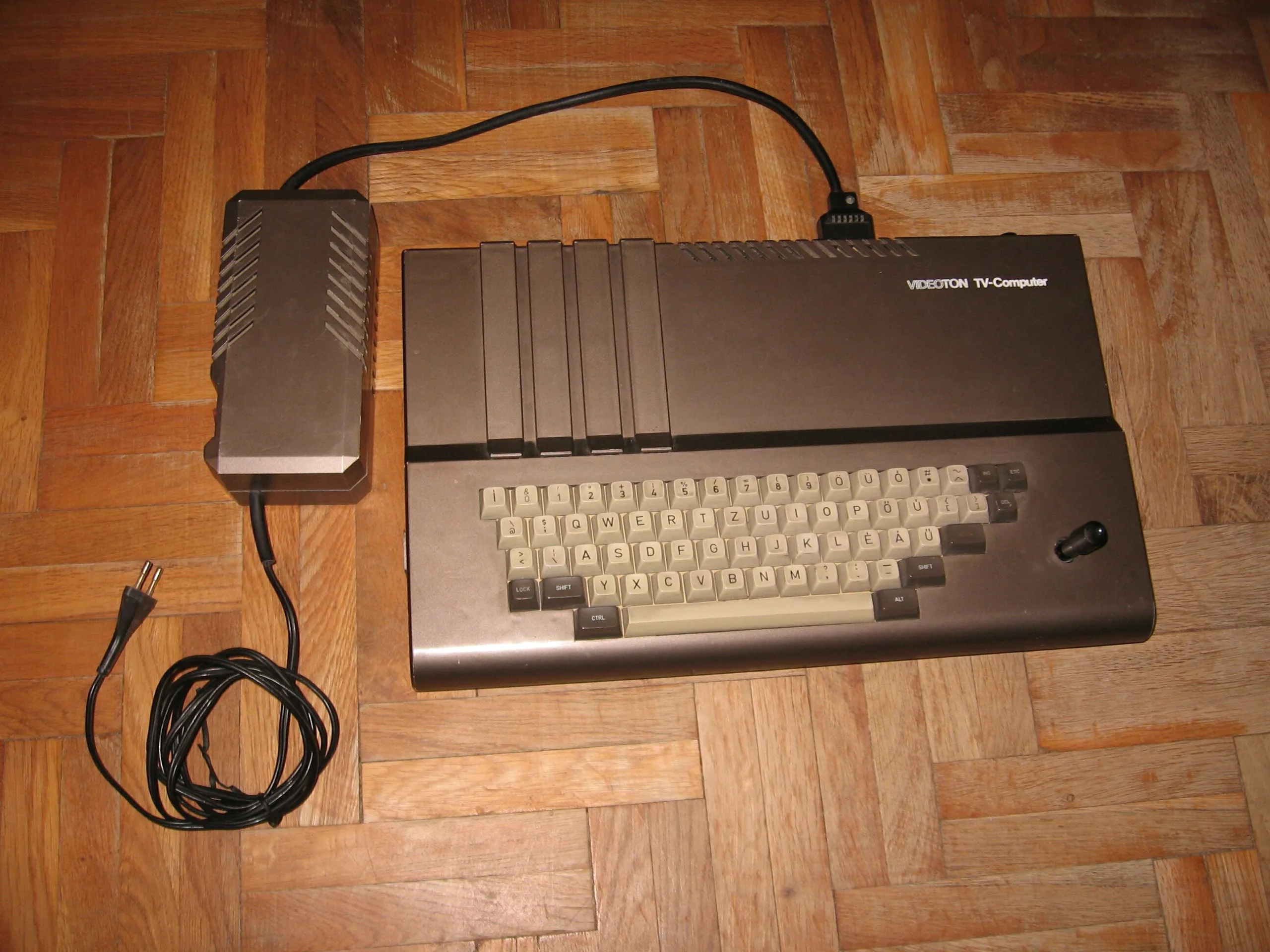
Videoton TVC

Photo: VillanyGabi, Wikimedia Commons (Public domain)

Released

1986

RAM

32 KB (TVC 32) or 64 KB (TVC 64 and TVC 64+) main RAM. Video RAM is separate: 16 KB (15 KB usable) on the 32K/64K models, 64 KB on the 64K+ model

CPU

Zilog Z80 (or compatible), 3.125 MHz, notably below the Z80’s rated 4 MHz maximum, clock-derived from the video timing

Launch price

12,000-15,000 forint, described consistently by Hungarian sources as roughly three months of a teacher’s salary at the time

Manufacturer

Videoton (Székesfehérvár, Hungary)

Form factor

Single-unit keyboard computer (all-in-one case, no separate base unit), external switch-mode power supply, connects to a domestic television or an RGB monitor

CPU

Zilog Z80 (or compatible), 3.125 MHz, notably below the Z80’s rated 4 MHz maximum, clock-derived from the video timing

Chipset

No individually named custom ASIC turns up in accessible sources. The display is driven by a 6845-compatible CRT controller, as used across many contemporary micros; the rest of the video and memory logic is board-level circuitry Videoton adapted from the Enterprise design rather than a single documented custom chip

RAM

32 KB (TVC 32) or 64 KB (TVC 64 and TVC 64+) main RAM. Video RAM is separate: 16 KB (15 KB usable) on the 32K/64K models, 64 KB on the 64K+ model

ROM

20 KiB, containing the TVC OS and the BASIC interpreter (v1.2 on the 32K/64K models; v2.2 on the 64K+, adding graphics commands such as POLYGON, RECTANGLE and ELLIPSE)

Graphics

Three selectable modes, 512×240 in 2 colours, 256×240 in 4 colours, 128×240 in 16 colours, scaled from an internal logical resolution of 1024×960. No dedicated text mode. A 10×8-bit character matrix accommodates Hungarian accented letters

Audio

A single sound channel with 16 volume levels, its tone frequency derived from the 3.125 MHz system clock, plus crude 4-bit D/A conversion for digitised sound playback. Proper multi-channel sound came later, only via aftermarket expansion cards, not standard

Storage

Cassette tape as standard, via two tape ports. Floppy disk was available as an expansion, running UPM or VT-DOS. Software also shipped on cartridge (slot capacity up to 16 KB)

Ports

Two cassette ports, two 9-pin joystick ports (Atari-compatible), a Centronics parallel port, four expansion slots, a cartridge slot, RF/TV, RGB and video outputs

OS

TVC OS with BASIC in ROM (v1.2 or v2.2); UPM (a CP/M-like DOS) and VT-DOS were available for disk-based use with the floppy expansion

PSU

External switch-mode power supply, 230V mains input; exact wattage not found in the sources checked. Well documented as the machine’s weak point

Units sold

Approximately 12,000 in total (around 3,000 of the 32K model and 9,000 of the 64K model), the great majority sold by 1988 through the government’s school computer programme rather than to private buyers

Successors

None in a meaningful sense. The TVC 64+ was an enhanced revision of the same machine (newer BASIC, more video RAM), not a successor model. The TVC’s roughly three-year production run (1986-1989) ended as it was squeezed by the Commodore 16/Plus4, the domestic Primo computer, and grey-market Western imports

  • Power supply degradation and an unprotected ±12V rail
    The original switch-mode PSU is well documented as failing progressively: a faint hiss when switching on or off signals a dying unit, followed by crackling during operation. The ±12V rail has no protective circuit and can drift to ±13-14V (or sag to ±11V), while the +5V rail stays comparatively stable; a badly failing transformer can overheat and damage the PCB itself.
  • Keyboard contact wear
    The keyboard uses conductive rubber contacts that degrade with age, causing missed or erratic keypresses. Restorers commonly fix this with a custom graphite recoating of the rubber domes rather than full replacement.
  • Corroded IC sockets and leaking electrolytic capacitors
    Ageing electrolytic capacitors leak fluid that leaves resin-like deposits on the board and corrodes nearby IC sockets, common enough that full capacitor replacement is treated as standard restoration procedure rather than an occasional fix.
  • 1984 Videoton licenses a variant of the Enterprise computer's architecture as the basis for a Hungarian-made home and school computer
  • 1986 The TVC launches in three variants (32K, 64K, 64K+), priced 12,000-15,000 forint, sold through Centrum department stores and the state school computer programme
  • 1988 Roughly 12,000 units have been sold under the school programme (about 3,000 32K, 9,000 64K), the machine's commercial high point
  • 1989 Production ends after about three years, undercut by the Commodore 16/Plus4, the domestic Primo, and private Western imports
  • 1990 TVC-újság, a dedicated monthly user magazine, begins a 34-issue run that outlasts the machine's commercial life