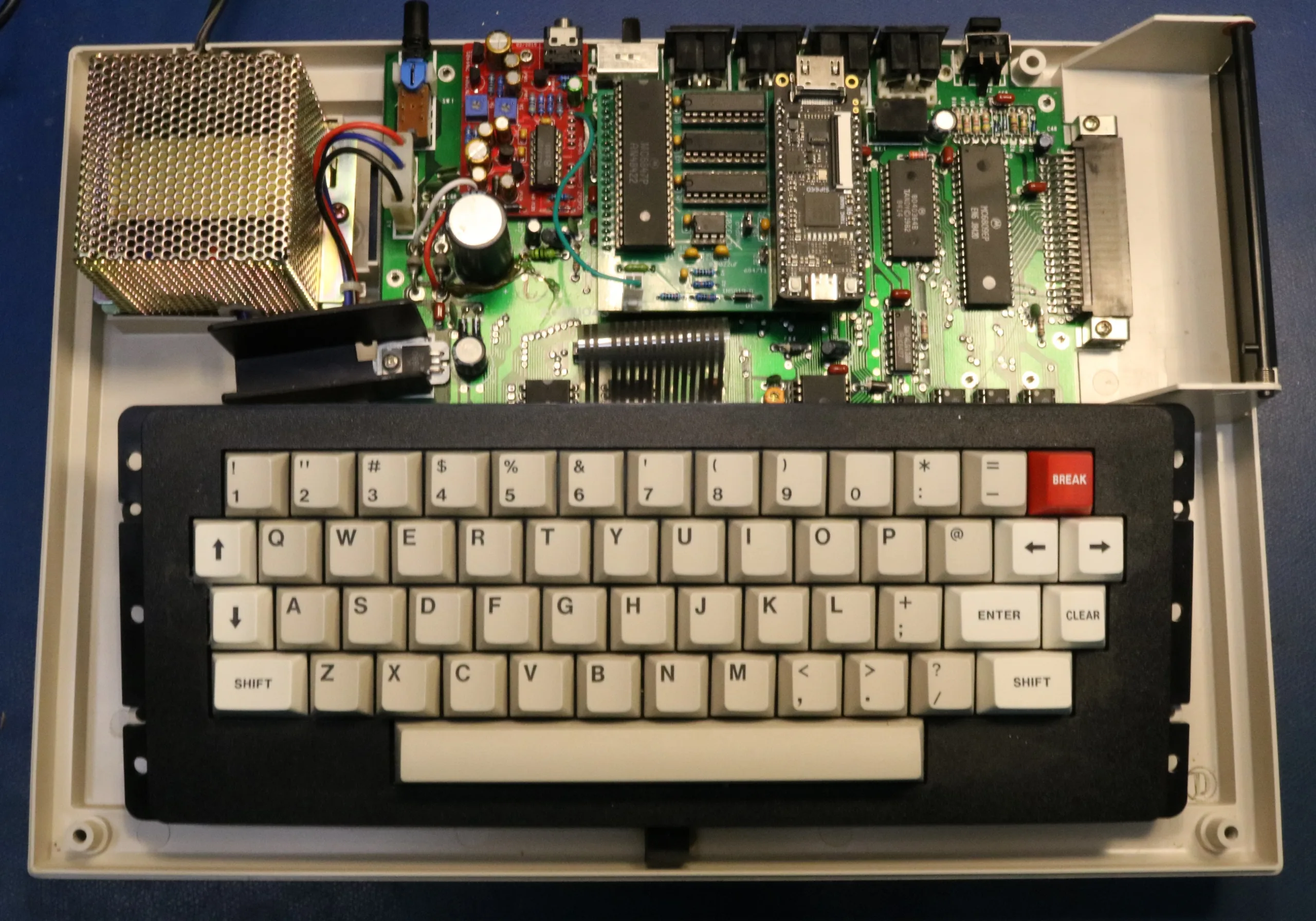
Scott Baker wanted HDMI on his CoCo 2. The two commercial options, CoCoVGA and CoCoDV, were both sold out with waitlists going nowhere, so he built his own rather than keep refreshing a stock page. CoCo-HDMI works differently to most retrofits. Rather than scale up the machine’s existing composite signal, it rebuilds the picture from scratch, digitally, from the same data the original video chip was already reading.
Reading the bus instead of the screen
The approach is an interposer: a small board that sits between the CoCo 2’s motherboard and its MC6847 video chip, with the 6847 itself resocketed on top so it keeps doing its job undisturbed. Nothing on the board is removed. A Tang Nano FPGA module taps seventeen of the signals running to that chip, including all eight data lines, sync and the address line the memory fetch uses, then rebuilds the frame in the FPGA’s own logic and pushes it out as clean, pixel-accurate HDMI. Three 74LVC245 chips handle the level-shifting between the CoCo’s 5-volt logic and the Tang Nano’s 3.3-volt FPGA, and an MCP3201 analogue-to-digital converter grabs the machine’s audio so it travels down the same HDMI cable rather than needing a separate lead.
The neat part is the timing. Baker solved it without a single calibration constant: one of the tapped lines, DA0, toggles every time the video chip reads a byte from memory, so the FPGA uses that toggle itself as the fetch strobe, gating capture to exactly the visible display area with no guesswork and no tuning. It is the kind of solution that looks obvious once someone else has already found it and looks like nothing else beforehand.
Open, cheap and not a product
Baker put the whole project, Gerbers, schematics and firmware, on GitHub rather than sell it, and the bill of materials comes to roughly $30 to $50: $15 to $30 for the Tang Nano itself, about $5 for the interposer PCB and $10 or so for the level shifters, ADC, sockets and passives. Anyone comfortable with through-hole soldering can build one without needing Baker to restock anything.
That’s really the story here. CoCoVGA and CoCoDV went out of stock and stayed that way, and rather than wait on a company to run another batch, one owner with a spare Tang Nano solved his own problem and handed the solution to everyone else with the same dead-end waitlist. Whether that becomes the norm for this generation of retro accessories, or whether commercial upgrades eventually catch back up, is worth watching the next time a popular retrofit board vanishes from stock for months on end.