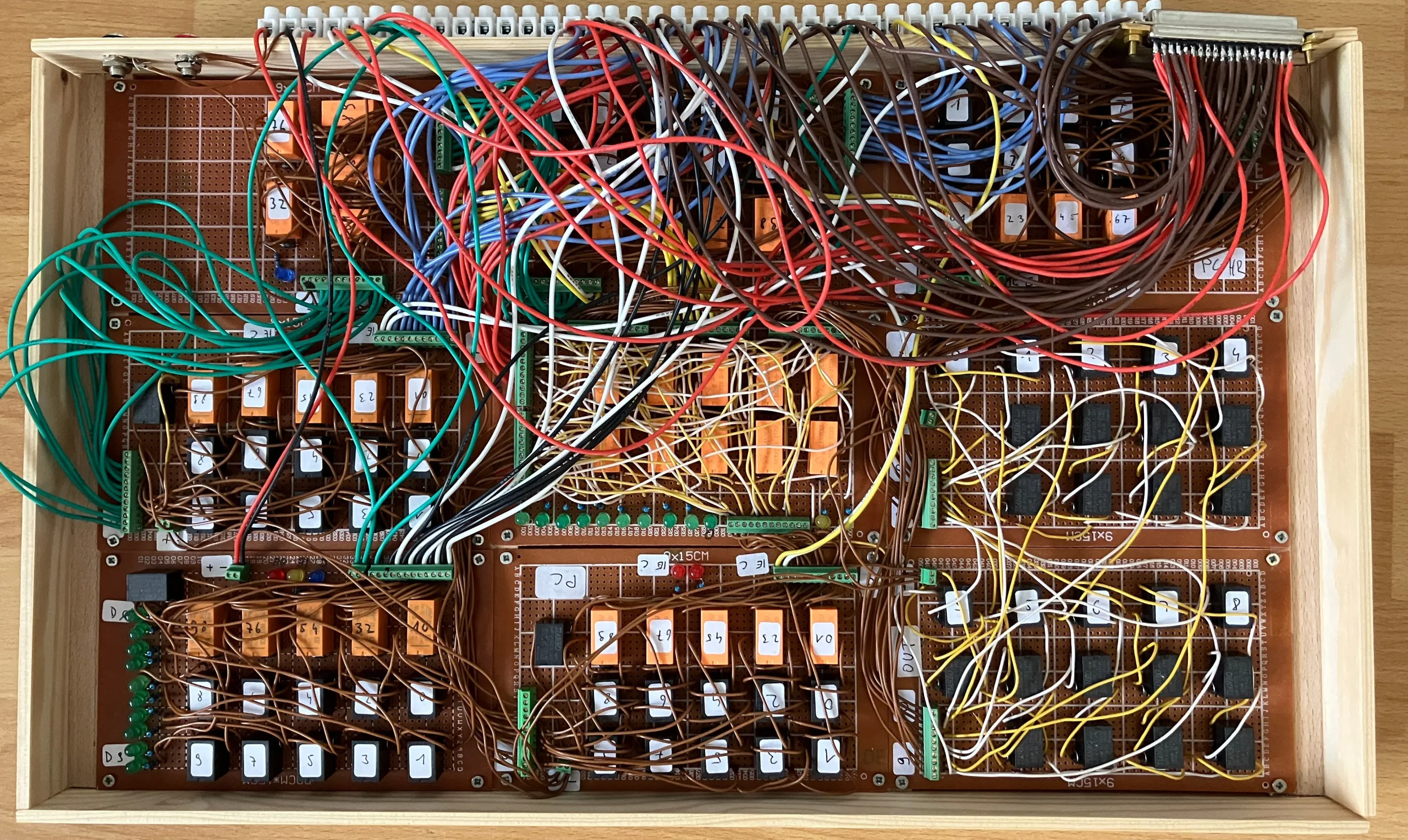
Eight minutes of clattering electromechanical relays to produce three digits of pi is not, by any conventional measure, a fast computer. It’s also exactly the point. A builder going by Peter has entered a 16-bit relay computer, three years in the making, into this year’s Hackaday Retrocomputing Challenge, and it does long division the way computers did it before anyone thought to trust a transistor with the job.
One register, nineteen instructions, no shortcuts
The design is deliberately minimal. A single accumulator register handles every arithmetic and load/store operation. A program counter has its own dedicated relay adder, so it can increment itself in one step rather than needing to be cleared and rebuilt, and a separate return-address register allows exactly one level of subroutine nesting. One instruction, no reset. Three addressing modes are wired in: direct, indirect and double-indirect, giving the 19-instruction set enough flexibility to do real work despite the tiny register count. Built from 24-volt relays clicking through each operation in turn, it is unmistakably a machine you can watch think.
This isn’t Peter’s first outing with the design. An earlier version of the same relay CPU turned up in last year’s One Hertz Challenge, where its entire job was blinking a single indicator lamp once a second, proving even a relay computer starts with the electromechanical version of a blinking LED before it earns the right to attempt long division.
A stubbornly slow light show
For this year’s entry, Peter wired the machine up to a 32×32 LED matrix display, with results about as fast as you’d expect from a CPU built out of parts designed to switch a doorbell circuit. It is not quick. Pushing a full frame update to the matrix was never going to happen fast, and nobody involved seems to be under any illusion otherwise. What it can do is calculate pi to three digits, in a shade over eight minutes, using nothing but relay contacts opening and closing in sequence, which is a considerably higher bar than blinking a lamp.
The 2026 Retrocomputing Challenge runs until 27 October, which leaves plenty of time for someone to try to beat eight minutes with a design that has even fewer transistors in it, or, more realistically, no transistors in it at all. That’s rather the standing challenge relay computing sets for itself: not being fast, but proving it never needed to be, to count as a real computer in the first place.