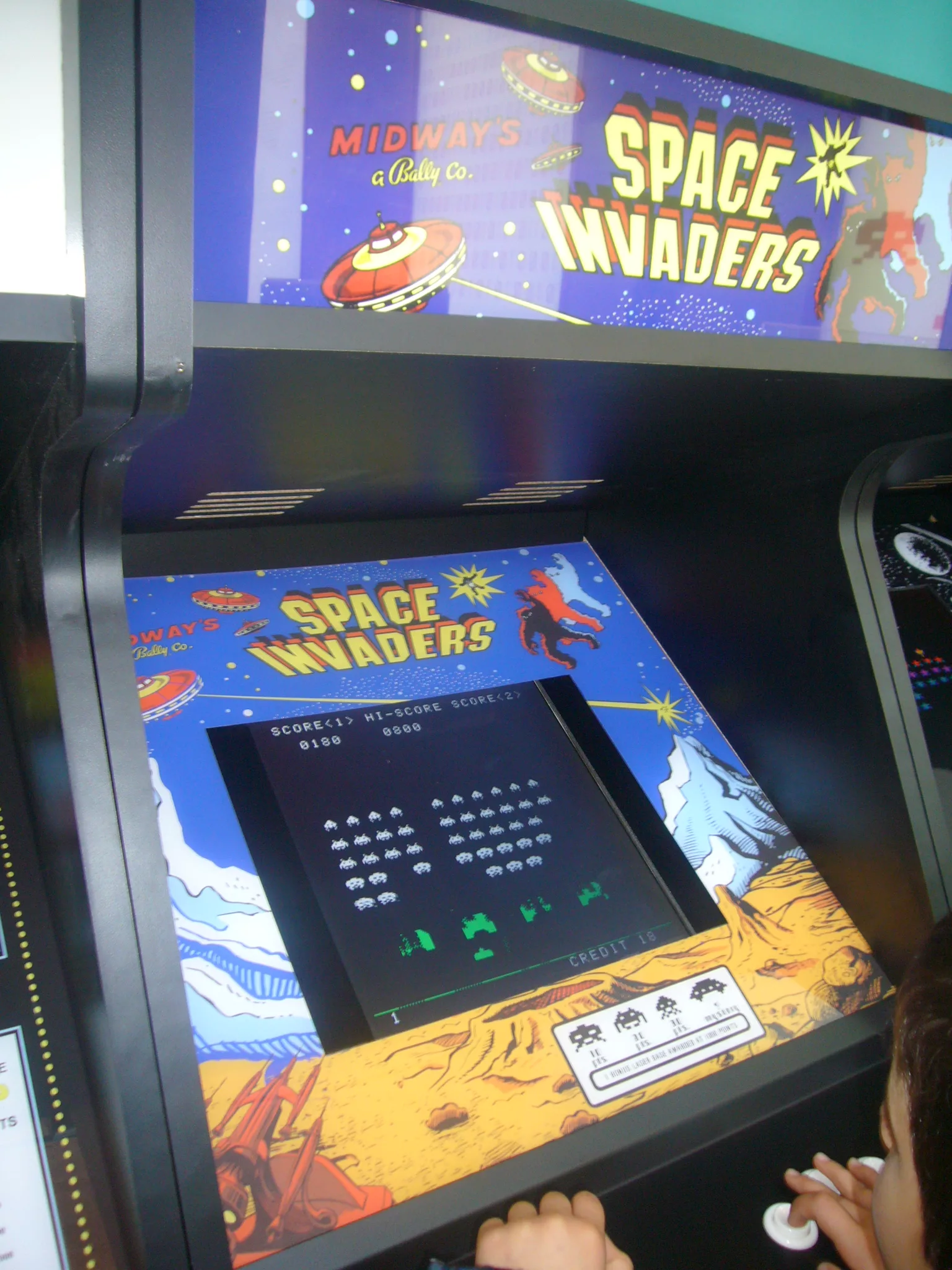
Space Invaders is a 1978 arcade game designed by Tomohiro Nishikado for Taito, running on a custom Intel 8080 board with a 7KB monochrome frame buffer and no sprite hardware of any kind. Everything you see on screen is written into RAM one byte at a time by a processor running at under 2 MHz.
- CPU: Intel 8080 at 1.9968 MHz (19.968 MHz master clock, divided by ten)
- Video: 256 x 224 pixels, 1 bit per pixel, monochrome CRT rotated 90 degrees anticlockwise into portrait
- Memory: 8KB ROM (0x0000-0x1FFF), 1KB work RAM (0x2000-0x23FF), 7,168 bytes of video RAM (0x2400-0x3FFF)
- Sound: TI SN76477 for the flying saucer; discrete op-amp circuits for everything else
- Released: Japan, July 1978 (copyright April 1978); North America via Midway, November 1978
Stand in front of an original upright and the first thing you notice is that the colour is a lie. The aliens are white. The four shields along the bottom are green, and so is the cannon you are driving, and they’re green because somebody stuck a strip of coloured cellophane to the inside of the glass. Get your eye far enough round to the side and you can see the edge of it, a hard horizontal line where green stops and white starts, sitting a few millimetres in front of a perfectly monochrome tube.
I have heard that called a cheap trick more than once. It isn’t. It is the correct answer to a question nobody had a better answer to in 1978, and the same clear-eyed practicality runs through every board in the stack.
Nishikado had to build the computer before he could build the game

Photo: Jordan, Wikimedia Commons (CC BY-SA 4.0)
Taito didn’t hand Tomohiro Nishikado a development system. A professional one cost around ten million yen at the time, somewhere near $100,000, and the company wasn’t spending that on a video game. So he bought the chips and made his own. “I bought the LSI chips myself, then soldered them to a board, and programmed directly to them in assembly,” he told shmuplations in a translated 2000 interview. He wrote the code, drew the sprites with a light pen using a tool he also wrote, and did the sound.
He puts the game programming itself at three or four months, and the business of building somewhere to program at around six. Other accounts of the project run to about a year and a half all in. Either way, most of the effort went into the workshop rather than the game, and that is a sentence worth sitting with before anyone calls this a simple piece of software.
The 8080 wasn’t a sentimental choice. Nishikado had built Western Gun in 1975 out of discrete logic, and Midway had rebuilt it in America around an 8080 as Gun Fight, with Dave Nutting doing the microprocessor work. Nishikado saw what a CPU did to his own design and went and got one.
Why the Intel 8080 needed a Fujitsu shift register to draw a sprite
There is no sprite hardware on this board. None. There are 7,168 bytes of RAM from 0x2400 to 0x3FFF, one bit per pixel, and if you want an alien on screen you write that alien into RAM yourself, byte by byte, and then rub it out again next time it moves.
Fine, as long as your alien lands on a byte boundary. It almost never does. An eight-pixel-wide shape at an arbitrary horizontal position straddles two bytes, so before you can write it you have to shift it into position, and the 8080 has no barrel shifter and no multi-bit shift instruction at all. Rotating a 16-bit value seven places, one bit per instruction, per byte, per alien, fifty-five times over, isn’t something a 2 MHz 8080 is going to do while also running a game.
So Taito put the shift in hardware. The Fujitsu MB14241 is a 16-bit shifter sitting on the I/O ports: push a byte to port 4, tell port 2 how far you want it moved, read the result back from port 3. Two OUTs and an IN, and the alien lands exactly where you wanted it. The same part had already done the same job for Gun Fight and Sea Wolf. It is the cheapest possible answer to the gap between what the CPU could do and what the game needed, and it is the reason the game exists at all.
Two interrupts a frame, and a screen turned on its side
The master clock is 19.968 MHz. Divide by ten for the CPU, giving that oddly precise 1.9968 MHz, and by four for the pixel clock at 4.992 MHz. Feed that through a 320 by 262 total raster and you get a refresh of about 59.54 Hz, which everybody rounds to 60. Near enough that nobody has ever complained.
The vertical counter fires two interrupts per frame: RST 8 at roughly line 96, partway down the screen, and RST 10 as vertical blanking starts. That gives the code two known points per frame at which it knows where the beam is, so it can work on the part of the screen the beam has already passed and stay out of its way. Around 119 interrupts a second is the entire timebase for the game.
The monitor is rotated 90 degrees anticlockwise in the cabinet. The hardware has no idea. As far as the frame buffer is concerned it is drawing a picture wider than it is tall; the cabinet simply turns it on its side, so the byte order in video RAM runs vertically up the screen from the player’s point of view, and the cannon slides along what the electronics think of as the left-hand edge. Every drawing routine in the ROM is written with that rotation baked in.
Why the aliens speed up as you kill them
Here is the famous bit, and the usual explanation of it is wrong in a way that is more interesting than the myth.
The frame rate doesn’t climb. The board is locked to its raster at a shade under 60 Hz whether there are fifty-five aliens on screen or one. Nothing about the video timing changes when you shoot something.
What changes is how many screens it takes to get all the way round the table. The game tracks a single reference alien, the one at the bottom left, and every other alien is drawn relative to that one position. Each pass of the end-of-screen interrupt draws exactly one alien and no more. A cursor walks a 55-byte table, one entry per alien slot, and dead slots get skipped. When the cursor falls off the end of the table, the reference alien moves, the animation frame toggles, and the whole rack moves with it.
So the rack’s speed is a straight division. Fifty-five alive, fifty-five screen paints, about nine tenths of a second per step of the formation. Kill half of them and the table gets walked in half the time. Kill all but one and that survivor steps every single frame: two pixels left, three pixels right, sixty times a second. That asymmetry is real and it’s in the code, which is why the last alien has always felt like it was cheating. It was.
There is no difficulty table anywhere in the ROM. Nothing says “go faster”. The acceleration falls straight out of the arithmetic of the drawing loop, and it does so because the 8080 was too slow to redraw fifty-five aliens in a single frame in the first place.
Nishikado noticed, and left it alone. That is the part that deserves the credit, and it is not the part people usually praise. Noticing the behaviour is easy; anyone play-testing the thing for ten minutes would notice. Recognising that the shortfall was better than the design, that the panic in the last thirty seconds of a wave was worth more than a constant metronomic march, and then defending that decision to a company that had just paid for a year of your time, is a different skill entirely. He said afterwards that it made the game more interesting and helped compensate for the hardware’s limits. A tidier engineer fixes it. Nishikado shipped it, and the difficulty curve of the next fifteen years of arcade games came out of that single call.
What the SN76477 actually did, and what it did not
The SN76477 gets the credit for the Space Invaders sound. It earned about an eighth of it.
Ken Shirriff, who reverse-engineered the chip from die photographs, notes that the 76477 generated the UFO sound and that the rest of the effects, the explosion, the shot, the invader hit, the saucer kill, came out of collections of op-amps on the sound board. Seven or eight separate circuits depending on how you count them, one per noise, each built out of ordinary parts.
The chip itself is a peculiar animal: a voltage-controlled oscillator, a super-low-frequency triangle oscillator, a digital noise source, a one-shot and an envelope generator, all on one die in integrated injection logic, and almost none of it under processor control. You set it with resistors, capacitors and voltages soldered around it. It’s a hardwired instrument rather than a sound chip in the sense anybody means today, and that warbling saucer is simply the SLF dragging the VCO up and down.
The marching bass, those four descending notes, is a separate discrete circuit on the same board. The 8080 kicks it each time the rack advances. Which means the tempo of the most famous piece of audio tension in games is the same counter you have just watched: as the table of live aliens shortens, the notes come quicker. The bassline is a drawing loop being read out loud.
The colour was a strip of cellophane, and that was the right call
Colour CRTs in 1978 were expensive, heavy, and a nuisance to converge. Taito’s answer was to not buy one. Print the background art, light it from inside the cabinet, bounce the monochrome tube off a half-silvered mirror so the white sprites float over a painted lunar backdrop with a plastic moon bolted to it, and then tape coloured gel across the parts of the tube where you want colour. Green across the bottom for the shields and the cannon. A red or orange band across the top where the score and the flying saucer live.
The exact colours varied by cabinet run. Taito’s own machines lean magenta at the top; the Midway cabinets came out orange; later versions used a wider rainbow gel.
It looks like what it is. The green is not a green a colour tube would ever produce, it is white phosphor light through a filter, washed out and slightly sickly, and the white areas carry a blue cast from the phosphor underneath. But it is fixed colour in exactly the places the game needs fixed colour, and it cost pennies against a colour monitor and the memory needed to drive one. That is not a corner cut. That is somebody knowing exactly which pound was worth spending.
The 100-yen coin shortage never happened
The story everybody repeats is that Space Invaders was so popular it drained Japan of 100-yen coins. It is marketing, and it is not even careful marketing, because the mintage figures are public. Japan struck 440 million 100-yen coins in 1977, 292 million in 1978, the year the game launched, 382 million in 1979 and 588 million in 1980. Production fell in the year of the supposed shortage and did not climb past the 1977 figure until two years after the game had swept the country.
The maddening thing is that the game never needed the help. Taito took around $670 million from Japan alone by the end of 1978, and the machine had grossed over a billion dollars by 1979. That’s real, checkable, and considerably more impressive than a fairy tale about coins. Somebody in a marketing department decided the fairy tale was easier to print, and forty-eight years on the fairy tale is what most people can tell you about the game, while almost nobody can tell you what an MB14241 does. That is the relative durability of engineering and press releases, in one sentence.
What fails on a Space Invaders board today
The Taito set is a three-board stack, ribbon-linked, and the failure modes aren’t subtle.
The RAM is 2107-family dynamic RAM, 4,096 bits each, and it was never good. Sixteen of them make up the 8KB block. They fail with age, they fail with heat, and the fault they give you is usually a plausible-looking picture with something quietly wrong in it rather than a dead screen, which is worse.
The clock is a 74S04 driving the 8080’s two-phase clock off the 19.968 MHz crystal. Schottky, not LS, not HC. JAMMArcade’s repair log on a three-layer Taito set found exactly that chip with most of its pins floating and the CPU therefore never starting, and notes that a 74HC04 dropped into the socket won’t do the job. The board wants the Schottky part’s drive and its edge rate, and the modern equivalent that looks right on paper simply doesn’t run it.
Further down the chain, the same log turned up a 74161 counter in the video timing with pins 11 to 15 stuck high, and a 74LS83 adder in the address generation with three outputs stuck low, that last one producing a doubled, mangled picture. Before any of it, the symptom that greets you when you first power the thing up is the watchdog barking: a rhythmic click out of the speaker as the board resets itself, over and over, which is a sound anybody who has worked on 1970s Taito hardware learns to recognise from across a workshop.
MB14241s die too, and Fujitsu stopped making them a very long time ago. There is a healthy trade in reproduction shifters built out of modern logic, which is about the sincerest compliment a 1978 custom chip has ever been paid.
The verdict
Space Invaders is the best-documented case in arcade history of an engineer being right about his own mistake. The hardware couldn’t do what the design wanted, the shortfall produced a behaviour nobody asked for, and rather than spend silicon he didn’t have on hiding it, Nishikado looked at the result and concluded that the machine had a better idea than he did.
Everything else on the board runs on the same instinct. No sprite hardware, so hang a shifter off the I/O bus. No colour tube, so filter the light. No sound chip worth the name, so build the effects out of op-amps and let the CPU pull the triggers. It’s a machine assembled entirely from the cheapest thing that actually works, built by one man who had to solder his own development system before he could write a line of it, and it works so well that the arcade industry spent the following decade copying its difficulty curve without ever quite realising it had come out of a counter.
The cabinet is still on the floor at half the museums in Europe. Go and get close to the glass. Find the edge of the cellophane. It is the most honest thing in the room.