MACHINE REFERENCE

Sinclair ZX Spectrum 48K

Sinclair ZX Spectrum 48K — the machine that took Britain’s home computer market by the throat in 1982, with a keyboard so notoriously unpleasant to type on it earned the nickname “dead flesh.”

Why it matters

Clive Sinclair’s relentless focus on price over comfort — a rubber keyboard instead of proper keys, a single ULA doing double duty instead of a full custom chipset — got the 48K Spectrum to market at £175 when rivals were charging two or three times as much, and it worked: by the mid-1980s the Spectrum reportedly held around 40% of the British home computer market. That price-first philosophy also shaped an entire generation of bedroom-coded British games, since a machine cheap enough for a teenager’s Christmas present is a machine teenagers went on to spend years learning to push to its limits.

What to check before you buy

  • Assume the keyboard membrane needs replacing unless a seller specifically says otherwise — it’s the single most common fault on an unrestored unit
  • Check the power connector polarity before plugging in any non-original PSU; the Spectrum’s barrel connector is reversed from the usual convention, and a wrong-polarity supply kills the onboard regulator
  • Garbled or “static” screen output on power-up usually points to RAM or the video ULA, not a write-off
  • Confirm which board issue you’re being offered, since repair approach and part availability vary between revisions
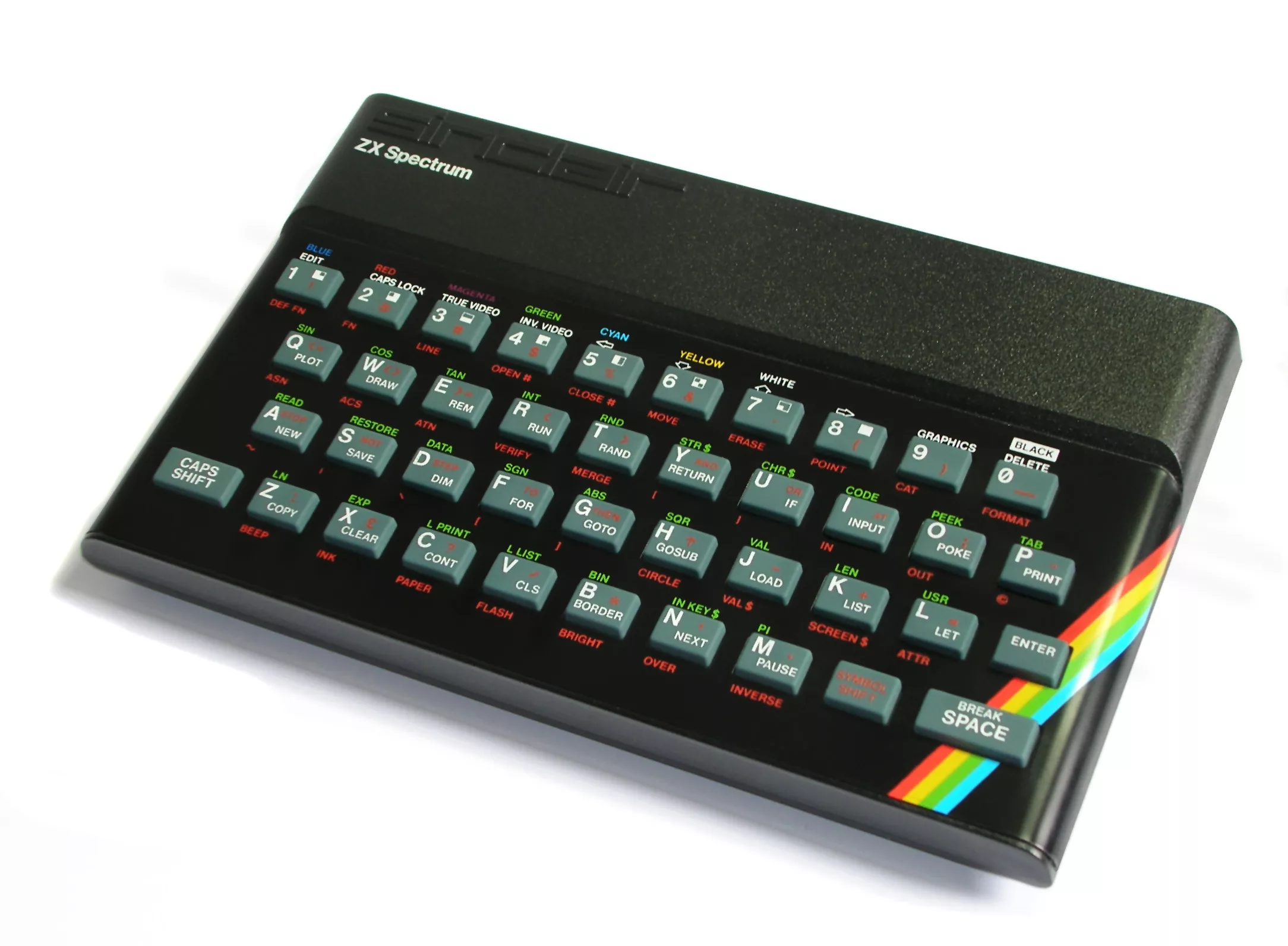
Sinclair ZX Spectrum 48K with its black rubber keyboard and rainbow stripe

Photo: Bill Bertram, Wikimedia Commons (CC BY-SA 2.5)

Released

1982

RAM

48 KB

CPU

Zilog Z80A @ 3.5 MHz

Launch price

£175 (48K model)

Manufacturer

Sinclair Research (manufactured by Timex Corporation, Dundee, Scotland)

Form factor

Slim wedge-shaped case with a flat rubber keyboard, connects to a TV via RF

CPU

Zilog Z80A @ 3.5 MHz

Chipset

Ferranti ULA (uncommitted logic array) handling video and system timing

RAM

48 KB

ROM

16 KB (Sinclair BASIC)

Graphics

256×192, 15-colour palette, with the well-known “attribute clash” limitation (one foreground/background colour pair per 8×8 cell)

Audio

Single-channel piezo beeper via the internal speaker, roughly 10 usable octaves

Storage

Compact cassette (standard); ZX Microdrive add-on available later

Ports

Edge-connector expansion bus, RF TV output, MIC/EAR 3.5mm cassette jacks

OS

Sinclair BASIC, in ROM

PSU

External unregulated 9V DC brick feeding an onboard 7805 regulator (early units recalled March 1983 over overheating/safety concerns)

Units sold

over 5 million across the whole Spectrum range; a 48K-only figure is not separately disclosed in surviving Sinclair records

Successors

ZX Spectrum+; ZX Spectrum 128; Spectrum +2/+3

  • Rubber keyboard membrane wear
    The flexible membrane beneath the rubber keys degrades with age, causing dead or intermittently registering keys across whole rows or columns — the single most common Spectrum fault.
  • 7805 voltage regulator failure
    The onboard 5V regulator is easily destroyed by an incorrect-polarity or faulty PSU — the Spectrum's barrel connector reverses the usual positive/negative convention — and a dead regulator can take other chips down with it.
  • RAM/video ULA picture corruption
    Garbled or "static" screen output, especially at power-up, generally traces back to a failing RAM chip or the video ULA rather than a write-off board.
  • 1982 Unveiled and launched in the UK on 23 April, alongside the 16K model
  • 1983 PSU recalled in March over overheating concerns; millionth Spectrum built in December
  • 1984 Becomes the dominant UK home micro, reportedly holding around 40% of the British home computer market
  • 1985 ZX Spectrum 128 launched, adding an AY-3-8912 sound chip and more RAM
  • 1992 Production ends after a decade on sale