The plane touched down on cracked concrete two miles short of the terminal buildings, and Keith Pomfret’s first thought was that something had gone badly wrong. All he could see out of the window was flat, empty ground broken up by military aircraft parked behind chequered hangars. There was no airport bus. A KGB officer smiled at him as he collected his luggage. It was January 1991, he was a hardware journalist for Your Sinclair, and he had flown to Leningrad because a couple of Soviet engineers had made a Spectrum clone so interesting that his magazine had already sent him to Bath once to look at it and now he wanted to see where it came from.
Two computer designers get on a train called Perestroika
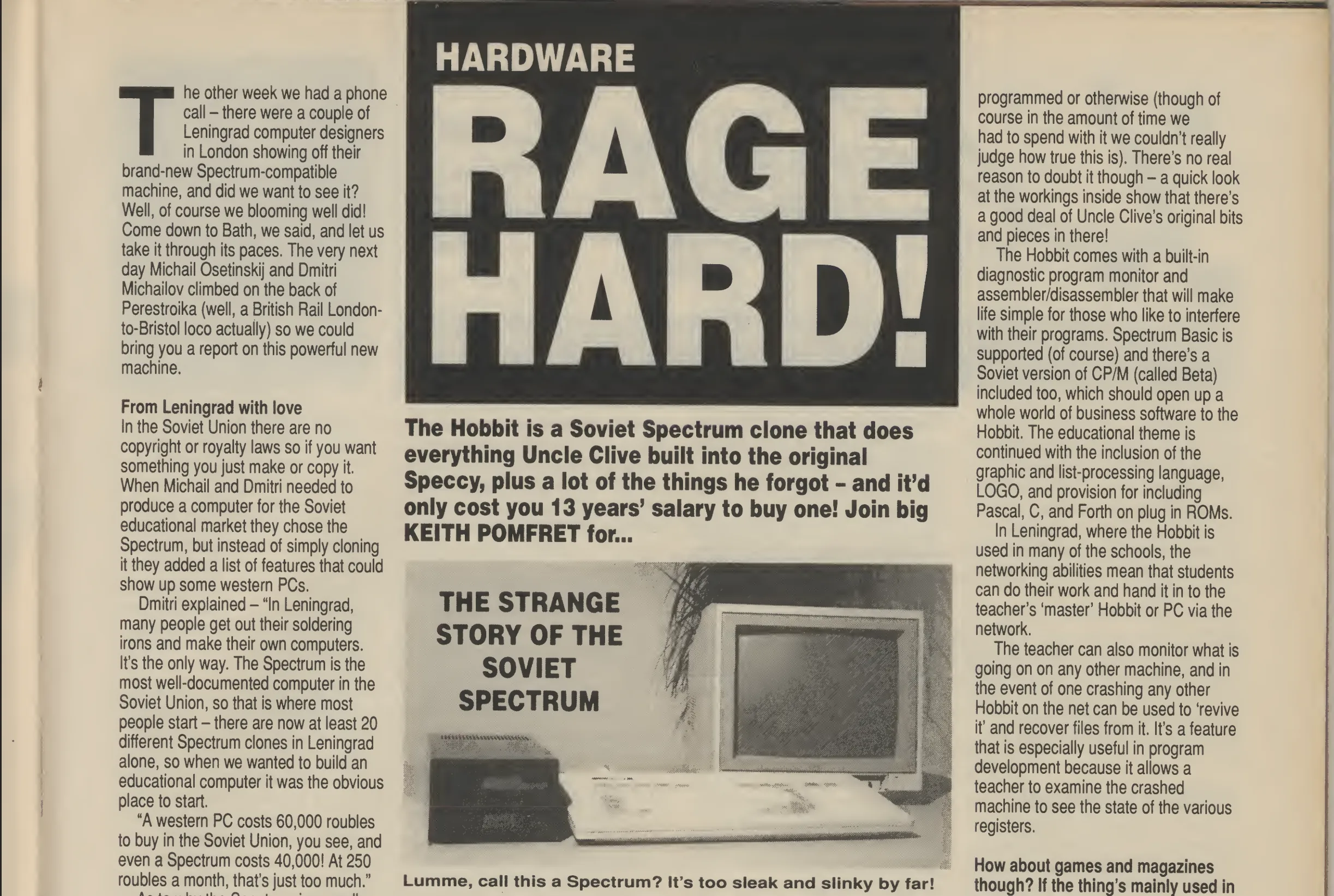
The story properly starts a few months earlier in September 1990, when Your Sinclair’s office phone rang with the kind of call a hardware desk dreams about: two Leningrad computer designers were in London with a brand-new Spectrum-compatible machine, and did anyone want to see it? Michail Osetinskij and Dmitri Michailov got on a British Rail service from London to Bristol that Your Sinclair’s writers, with the gleeful licence of the trade press, nicknamed Perestroika, and turned up to demonstrate their computer.
It was called the Hobbit, and there was nothing modest about what it tried to do. Dmitri explained the thinking behind it plainly: “In Leningrad, many people get out their soldering irons and make their own computers. It’s the only way. The Spectrum is the most well-documented computer in the Soviet Union, so that is where most people start; there are now at least 20 different Spectrum clones in Leningrad alone.” When the Soviet education ministry needed a computer for schools, Osetinskij and Michailov didn’t just want to build another one. They wanted to build the best one.
The economics were as blunt as the engineering was ambitious. “A western PC costs 60,000 roubles to buy in the Soviet Union,” Dmitri told the magazine, “and even a Spectrum costs 40,000! At 250 roubles a month, that’s just too much.” A Soviet teacher’s monthly wage wouldn’t touch a tenth of what an imported Spectrum cost. So they built their own, and by the time they crossed the Channel to show it off, over 15,000 Hobbits had already gone into Soviet classrooms.
A Spectrum with everything Sinclair forgot
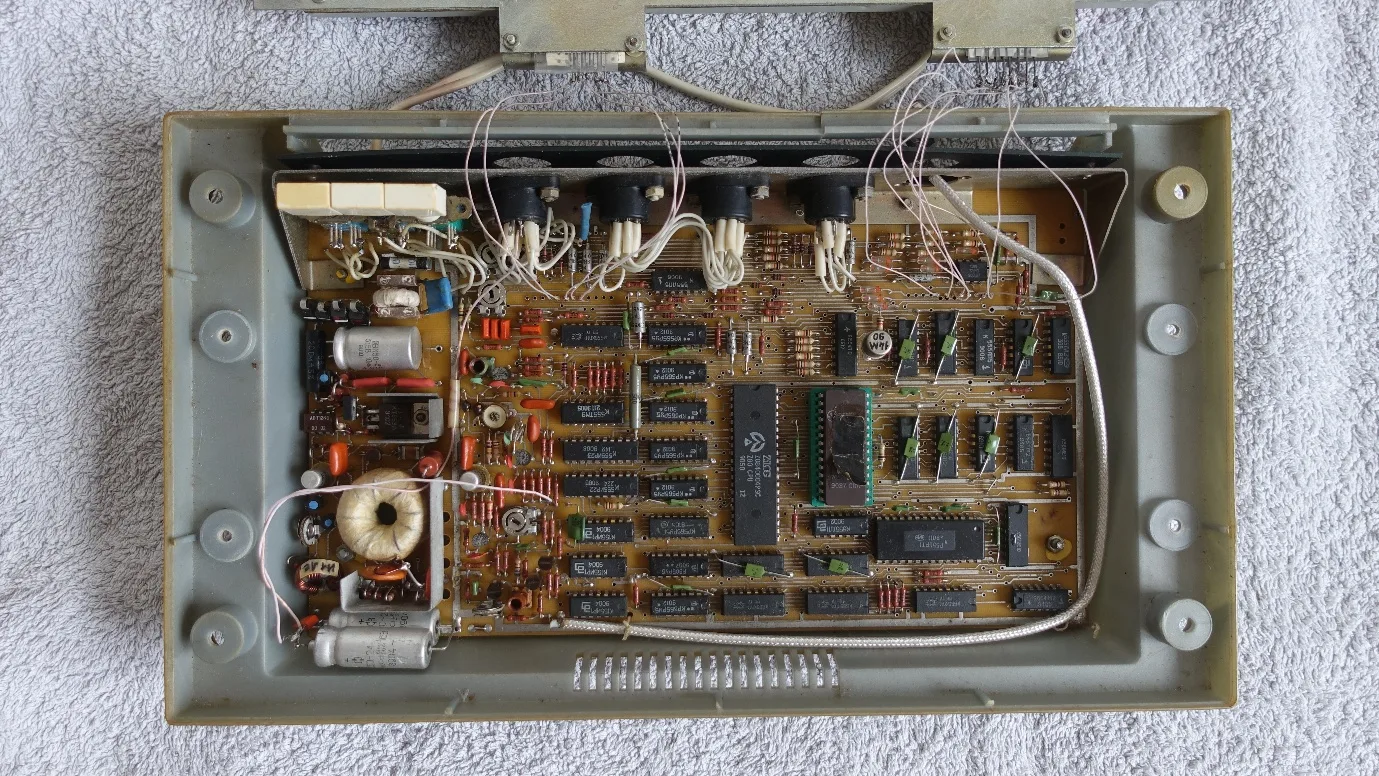
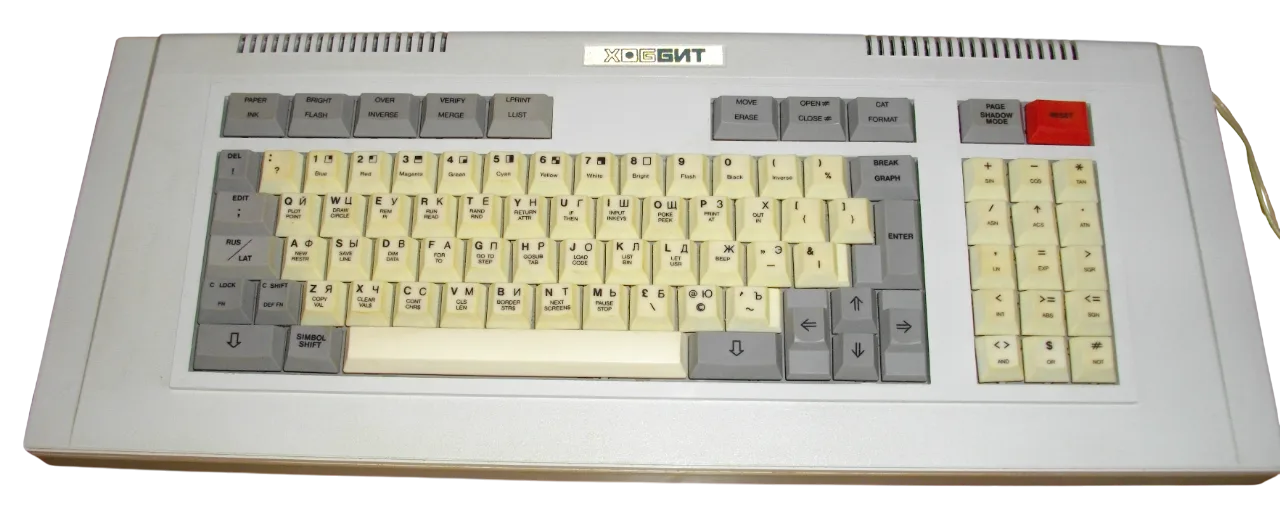
What made the Hobbit worth a magazine flying two writers to look at wasn’t that it ran Spectrum software; plenty of Eastern Bloc clones managed that. It was everything bolted on around the compatibility. Under the ROM sockets sat a Soviet-built CP/M clone called Beta, opening the door to serious business software; LOGO for teaching; and empty sockets standing by for Pascal, C and Forth. The 74-key keyboard carried Cyrillic and Roman characters on every key, and a single keypress swapped the whole machine’s alphabet—Russian, English or Arabic—mid-session. Three joystick ports. Twin 5.25-inch floppy drives as standard, at a time when most Spectrum owners were still feeding cassettes into rubber-keyed toys.
The engineering underneath backed up the ambition. A Z80A clocked at 3.5 MHz drove the whole machine, precisely the same chip and speed Sinclair had put in the Spectrum it was cloning, with 64K of RAM behind it and a proper RS232 serial port and Centronics parallel port round the back for anyone who wanted to plug in something more serious than a cassette deck. Bolt on the optional Screen and Memory Extension board, a 32Kb cache sitting between processor and display, and the Hobbit could drive a fast, windowed text screen good enough for FORTH programming or serious terminal work, the kind of thing a stock Spectrum never attempted.
The classroom features were where it stopped looking like a clone and started looking like a genuinely considered piece of design. Every Hobbit on a school network, running at what the machine’s own tech spec sheet clocked as 100K baud, could report to a teacher’s “master” machine, and if a student’s computer crashed mid-lesson, the teacher could reach across the network, inspect its registers and recover the work from another Hobbit entirely. Sinclair never built anything like that into a Spectrum, because Sinclair never had to fit a computer lab’s worth of unreliable hardware into a Soviet classroom and make it survivable.
None of this was stolen in any legal sense, and Dmitri wasn’t shy about why. There was no copyright or patent law in the Soviet Union covering software or hardware design in anything like the Western sense: “if you want something you just make or copy it,” as Your Sinclair’s writers put it after talking to him. The Hobbit was built on Sinclair’s architecture with total legal freedom to do so, at least on the Soviet side of the border.
The hacker, the KGB and a keyboard that cost less than a fiver
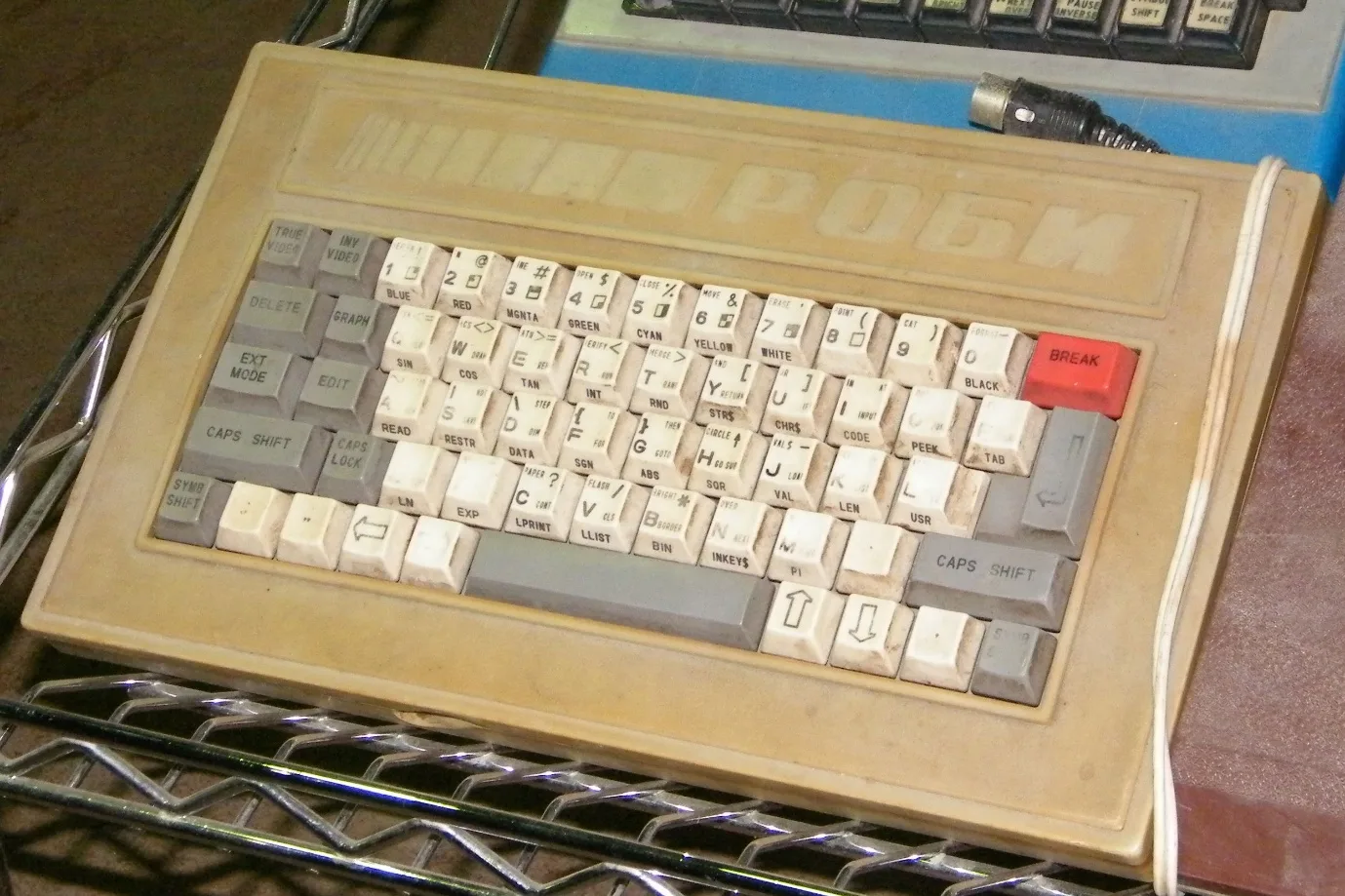
That freedom was still in force when Pomfret flew out to Leningrad four months later to see what had changed. It had changed a lot. The new Hobbit was finished in cream rather than the earlier grey and ran an updated CP/M implementation, and there was now a console version too, pulled from behind a curtain with something close to theatre: no keyboard built in, cartridge slots planned and an optional plug-in keyboard that Dmitri priced, grinning, at “less than a fiver.” Bet you Alan Sugar couldn’t do that.
At InterCompex’s offices Pomfret was introduced to a young man with long hair and the complexion of someone who hadn’t seen daylight in months. “Keith, meet Nicolas Rodionov, Leningrad’s greatest hacker,” his hosts said, and the description turned out to undersell him. Rodionov’s method for enjoying Western software was straightforward: crack it, translate the text into Russian and pass it round. He wasn’t especially worried about being caught, because there was nothing to catch him under. “You see, what happened is that these guys started by altering the few games we had so that the instructions were in Russian,” he explained, “so that we could play them more easily. In this country if you need something and it’s available you can have it; it isn’t regarded as theft.” He was, as it happened, entirely correct. New laws to protect Western copyright inside the Soviet Union were being drafted for 1991, but they hadn’t landed yet, and until they did, hacking a game wasn’t illegal because there was no law it could break.
It’s worth sitting with how strange that made the whole enterprise. A machine engineered with real sophistication, built by an economy that had no legal concept of the intellectual property it was quietly borrowing, was about to try selling itself into the one market on Earth that took intellectual property most seriously.
Break out the wodka
By August 1992, the Hobbit had a UK price list. Sinclair User’s review opened, memorably, with “break out the wodka, the Hobbit is here,” before describing the Hobbit 8030 as fully compatible with the 48K Spectrum, on sale through a London distributor called Intercompex-ADB for £79 including VAT and delivery, with an external 5.25-inch drive for another £59. For less than the price of a new 16-bit console, a Spectrum owner could pick up a machine with a proper keyboard, CP/M, FORTH and networking that Sinclair had never offered at any price.
It didn’t take. The commercial reasons were the mundane ones that kill most ambitious imports: by 1992 the Amiga and the Atari ST had already swallowed the market the Hobbit was built for, and a Spectrum-compatible machine, however clever, was chasing an audience that was steadily emptying out. On top of that sat two harder problems. InterCompex’s own account of it was that the machine’s mains cable had failed a UK safety test, though nobody ever specified which one, and it reads like the kind of unglamorous compliance detail that can sink an import regardless of what’s inside the case. And the ROM inside every Hobbit still contained Sinclair’s own system code — code that, since 1986, legally belonged to Amstrad, which had bought Sinclair Research’s computer business outright. A machine built in a country with no copyright law had wandered into a country with an owner very much prepared to enforce his.
What survives
Domestic production in the Soviet Union wound down as the country that had commissioned the Hobbit stopped existing. The commercial UK run had already been brief and small. What’s left is a handful of Cyrillic-keyed Spectrum clones scattered across collectors’ shelves, a couple of yellowing Your Sinclair spreads and one genuinely good story about a machine that tried to sell 1980s Soviet engineering ingenuity to the country whose own computer it had been built out of. It got stopped, in the end, not by the Cold War but by a fuse box and a photocopier’s worth of paperwork Amstrad had bought fair and square six years earlier.