MACHINE REFERENCE

Sinclair ZX81

The Sinclair ZX81 arrived in March 1981 as a machine so ruthlessly cost-engineered that its entire logic board, bar the processor, ROM and RAM, was reduced to a single custom chip doing the work of roughly eighteen separate ICs on its predecessor, the ZX80.

Why it matters

The ZX81 is arguably the moment cheap computing stopped being a hobbyist fantasy and became something a British family could actually buy without a second mortgage: at £49.95 for the kit version, it undercut nearly everything else on the market, and Clive Sinclair’s team got there by refusing to accept that a home computer needed the parts count of a small filing cabinet. Jim Westwood and Richard Altwasser’s ULA design folded synchronisation, timing, cassette I/O, keyboard scanning and memory decoding into one chip, and that single decision is why the ZX81 could be sold as a magazine mail-order product rather than a specialist import. It is not a subtle machine, and it is not a comfortable one to program seriously, but it put a programmable computer in front of more first-time British users than almost anything else of its era.

What to check before you buy

  • PSU included, and genuine or correctly rated. The wrong adaptor is a documented way to damage the board.
  • Keyboard responsiveness across all 40 keys, since membrane failure is common and not always obvious from a listing photo.
  • Whether it is being sold with an external RAM pack, and if so, whether a wobble fix has already been applied.
  • Case colour and yellowing, which affects value more than function.
  • Seller's claim of "tested working" versus "untested/spares or repairs" — given how common intermittent solder-joint faults are, a genuinely tested unit is worth paying more for.
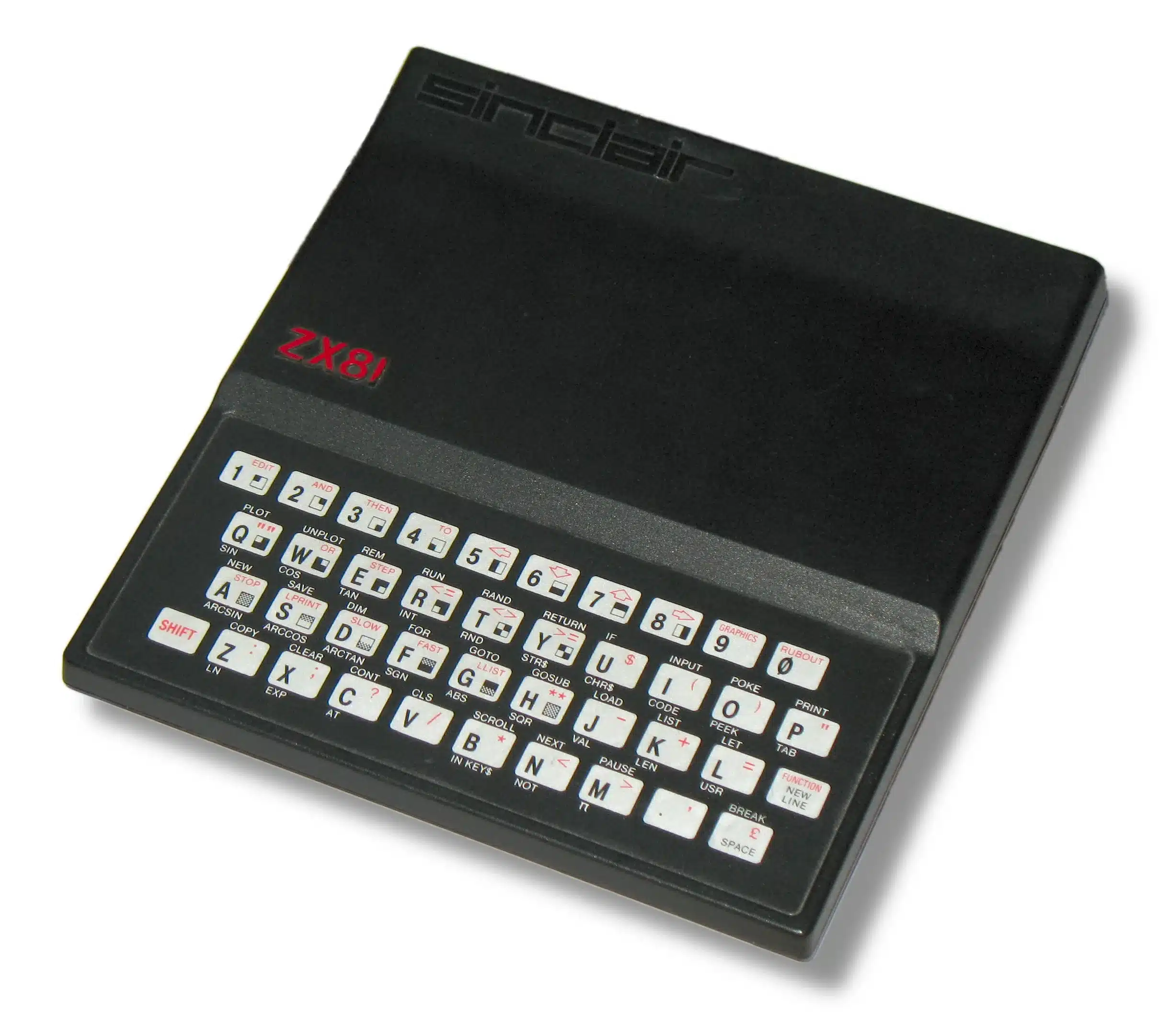
Sinclair ZX81

Photo: Journey234, Wikimedia Commons (Public domain)

Released

1981

RAM

1 KB on-board as standard, expandable to 16 KB via an external RAM pack plugged into the rear edge connector — a pack held in place by nothing but connector friction, the source of the notorious “RAM pack wobble”

CPU

Zilog Z80 (or NEC second-source equivalent), 3.25 MHz — some secondary sources quote 3.5 MHz, which is actually the later ZX Spectrum’s clock speed; contemporary schematics consistently give 3.25 MHz for the ZX81

Launch price

UK £49.95 (kit) / £69.95 (assembled) at launch, March 1981, with the assembled price cut to £49.95 by May 1982. US, as Timex Sinclair 1000 (July 1982): $99.95

Manufacturer

Designed by Sinclair Research; manufactured under contract by Timex Corporation in Dundee, Scotland

Form factor

Compact wedge-shaped single-board computer with an integral 40-key pressure-sensitive membrane keyboard, no separate monitor or drive, designed by Rick Dickinson. Roughly 167 x 175 x 40mm, 350g

CPU

Zilog Z80 (or NEC second-source equivalent), 3.25 MHz — some secondary sources quote 3.5 MHz, which is actually the later ZX Spectrum’s clock speed; contemporary schematics consistently give 3.25 MHz for the ZX81

Chipset

A custom Ferranti ULA, designed by Jim Westwood and Richard Altwasser, absorbed roughly 18 of the ZX80’s 21-odd discrete logic chips into one component, handling video sync, the 6.5 MHz master clock, cassette encode/decode, keyboard scanning and address decoding

RAM

1 KB on-board as standard, expandable to 16 KB via an external RAM pack plugged into the rear edge connector — a pack held in place by nothing but connector friction, the source of the notorious “RAM pack wobble”

ROM

8 KB, containing the Sinclair BASIC interpreter. Early ROM revisions had a documented bug miscalculating SQR(0.25) as 1.3591409 rather than 0.5

Graphics

Monochrome only, via UHF RF modulator. Text mode 32×24; block-graphics resolution equivalent to 64×48 pixels using character-set glyphs, no true bitmap mode

Audio

None built in

Storage

Compact cassette via 3.5mm MIC/EAR jacks, approximately 250 bit/s

Ports

Rear edge connector (expansion and RAM pack), UHF TV output, cassette MIC/EAR jacks, 9V DC power input

OS

None in the modern sense — Sinclair BASIC lived in ROM and doubled as the command environment

PSU

External 9V DC mains adaptor, current draw roughly 300-420mA depending on source; the power connector/joint is itself a commonly cited failure point

Units sold

More than 1.5 million ZX81 units sold worldwide by discontinuation in 1984; a March 1982 snapshot put Sinclair at around 250,000 units sold globally by that point. The US Timex Sinclair 1000 sold separately, reportedly around 550,000 units in its first five months

Successors

ZX Spectrum (April 1982), adding colour and sound while keeping strong BASIC/software continuity. Sinclair/Timex also produced the Timex Sinclair 1500 (August 1983) as a more direct US successor

  • RAM pack wobble
    The external 16K RAM pack was held in place only by the rear edge connector and was top-heavy, so it could rock or slip under the slightest knock, breaking the connection and crashing the machine, wiping whatever was in memory. Users famously fixed it with Blu-Tack, tape or elastic bands.
  • Membrane keyboard failure
    The 40-key keyboard uses a printed-conductor plastic membrane that becomes brittle with age; the ribbon tails commonly crack or snap, causing dead or intermittent keys. Reproduction membranes are available as the usual fix.
  • Cracked solder joints and power jack failures
    Thermal cycling and the ULA running hot near the edge of its logic-gate budget have left many surviving boards with dry or cracked solder joints, particularly around the ULA pins and DC power jack, causing intermittent crashes or a machine that won't power on reliably until joints are reflowed.
  • 1980 ZX80 launched, the direct, chip-heavy predecessor the ZX81's ULA was designed to simplify
  • 1981 ZX81 launched in the UK on 5 March, initially mail order
  • 1982 Timex Sinclair 1000 launched in the US as the rebadged ZX81 variant, in July
  • 1982 ZX Spectrum launched as the ZX81's direct successor, in April
  • 1984 ZX81 discontinued after selling more than 1.5 million units