MACHINE REFERENCE

Mattel Intellivision

The Mattel Intellivision was the console that, for the first time, made a games machine’s actual processing power part of the sales pitch — its General Instrument CP1610 was a genuine 16-bit chip at a moment when every rival on the shelf was running 8-bit silicon or less.

Why it matters

The Intellivision earned its “Intelligent Television” tagline honestly: the STIC graphics chip gave it a 16-colour palette and a tiled background system that made Atari 2600 games look genuinely crude sitting next to it, and Mattel built an entire advertising campaign, fronted by George Plimpton, around putting the two side by side and daring viewers to disagree. That rivalry is one of the first proper console wars in the industry’s history, fought as much on picture quality as on price. The numeric keypad and 16-direction control disc were just as ambitious in their own way, an attempt at a genuinely reconfigurable controller years before anyone else bothered, even if the mylar underneath it turned out to be the console’s most fragile component.

What to check before you buy

  • Test every direction on the control disc and every keypad button before handing over money; intermittent input is almost always the mylar contact sheet, not the console logic.
  • Ask whether the original internal power supply has been tested recently, or recapped, given its age.
  • If it's an Intellivision II, confirm the external 16.2V adapter is present and original spec, since a lost or blown one is genuinely hard to replace.
  • Check the RF switch and any composite/AV mods separately, since picture output issues are frequently a cabling or switch fault rather than a console fault.
  • Ask for a powered-on demo with a cartridge if at all possible rather than buying untested.
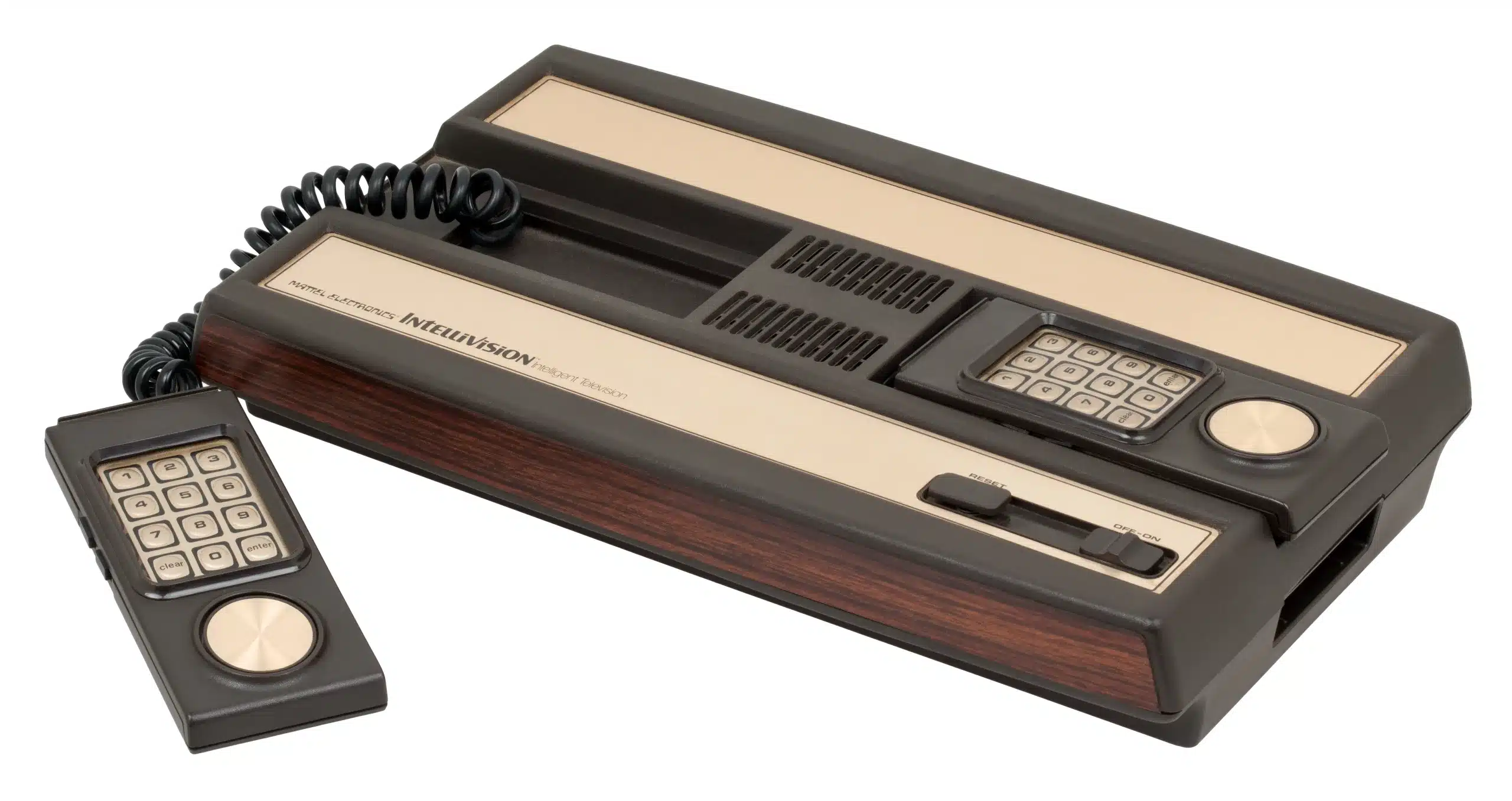
Mattel Intellivision

Photo: Evan-Amos, Wikimedia Commons (CC BY-SA 3.0)

Released

1979

RAM

1,456 bytes total — system RAM (BACKTAB/stack), 512 bytes of Graphics RAM (two GI GTE 3539 chips, for 64 user-defined 8×8 tiles), and 256 bytes of scratchpad RAM (147 bytes actually free for game programs). Some sources cite 1,472 bytes; 1,456 is the more consistently corroborated figure

CPU

General Instrument CP1610, a genuine 16-bit processor (the first 16-bit CPU in any home console), operating at an internal machine-cycle rate of 894.886 kHz

Launch price

Test-market price around $269.95-$275 (Fresno, December 1979); wide 1980 national release at $299, bundled with Las Vegas Poker & Blackjack

Manufacturer

Mattel Electronics (Mattel, Inc.), California, USA

Form factor

Low, brown wood-grain-effect plastic “Master Component” console with a built-in internal power supply, connecting to a TV via RF switch

CPU

General Instrument CP1610, a genuine 16-bit processor (the first 16-bit CPU in any home console), operating at an internal machine-cycle rate of 894.886 kHz

Chipset

General Instrument custom chipset — CP1610 CPU, AY-3-8900-1 STIC (graphics), AY-3-8914 (sound/PSG), plus supporting RAM/ROM chips

RAM

1,456 bytes total — system RAM (BACKTAB/stack), 512 bytes of Graphics RAM (two GI GTE 3539 chips, for 64 user-defined 8×8 tiles), and 256 bytes of scratchpad RAM (147 bytes actually free for game programs). Some sources cite 1,472 bytes; 1,456 is the more consistently corroborated figure

ROM

Approximately 7,168 bytes: 4 KB Executive ROM (two 2K chips) plus 2 KB GROM (213 built-in tile images) plus a small additional 344-byte block

Graphics

GI AY-3-8900-1 STIC. Resolution 159×96 active pixels, a 20×12 tiled background playfield at 8×8 pixels per card, plus 8 hardware sprites, from a 16-colour palette — a genuine generational leap over the Atari 2600’s TIA

Audio

GI AY-3-8914 programmable sound generator — three independent tone channels plus one noise generator

Storage

ROM cartridges, Mattel’s proprietary format, not compatible with the Atari 2600

Ports

Two permanently-attached hand controllers, each combining a 12-button numeric keypad (with swappable overlay cards per game), a 16-direction control disc, and four side action buttons

OS

No user-facing OS — a resident “EXEC” routine in ROM handled boot, STIC/controller management and other BIOS-like services

PSU

Internal linear power supply built into the original Master Component (mains-fed), producing +5V and +12V regulated rails plus an unregulated +16V rail. The later Intellivision II moved to a non-standard external 16.2V AC adapter, a genuine weak point if lost

Units sold

Commonly cited figures are “over 3 million” sold 1980-1983, with one estimate as high as roughly 3.75 million including cartridge attach data (20 million cartridges sold through 1983). “3 million-plus” is the safe, widely corroborated figure

Successors

Intellivision II (1982), a cost-reduced redesign with detachable controllers, launched at $150 before being cut to $69 by August 1983. A planned Intellivision III was cancelled mid-1983 as Mattel Electronics collapsed in the video game crash

  • Mylar keypad/disc degradation
    The original hand controllers use a mylar sheet coated with conductive material beneath the disc and keypad; this cracks, corrodes or wears through with heavy use, causing intermittent or dead inputs. Because the controllers aren't detachable, a full disassembly is needed to access and clean or replace it.
  • Non-detachable controller wiring failure
    Because the original controllers are hard-wired into the console rather than plugged in, any fault in the disc, keypad or wiring means the whole unit typically has to be sent for service rather than swapping a controller, a design Mattel corrected with plug-in controllers on the Intellivision II.
  • Power supply failure
    The internal linear PSU's regulators and smoothing capacitors are a known ageing point after four-plus decades; symptoms include no boot, a dim or scrolling picture, or random resets.
  • 1979 Intellivision Master Component previewed at Winter CES in Las Vegas, in January
  • 1979 Limited test-market launch in Fresno, California, in December
  • 1980 Wide US national release at $299, positioned directly against the Atari 2600
  • 1980–1983 The Mattel vs Atari advertising war, fronted by writer George Plimpton, whose side-by-side game comparisons and "Intelligent Television" tagline directly targeted Atari's graphics — arguably the industry's first true console war
  • 1982–1983 Intellivision II released as a cheaper redesign; the 1983 video game crash leads Mattel to shut down Mattel Electronics and cancel the in-development Intellivision III