MACHINE REFERENCE

Nintendo 64

The Nintendo 64 launched in Japan on 23 June 1996 with a 64-bit NEC VR4300 processor and a Silicon Graphics-designed graphics chip, and it kept cartridges when its rivals moved to CD-ROM.

Why it matters

The N64 gave home consoles real 3D and a four-controller design, and it sold 32.93 million units worldwide. Nintendo stayed with cartridges, which loaded fast but held far less than a CD.

What to check before you buy

  • Check the console boots with a Jumper Pak or Expansion Pak fitted; without one it shows a black screen.
  • Test every controller stick; loose or worn sticks are the most common fault.
  • Ask whether saves hold after power-off; a dead battery in a Controller Pak or cartridge is common.
  • Look at the cartridge slot and the reset and power switches; clean contacts fix many problems.
  • Check the power supply and AV cable are the correct region.
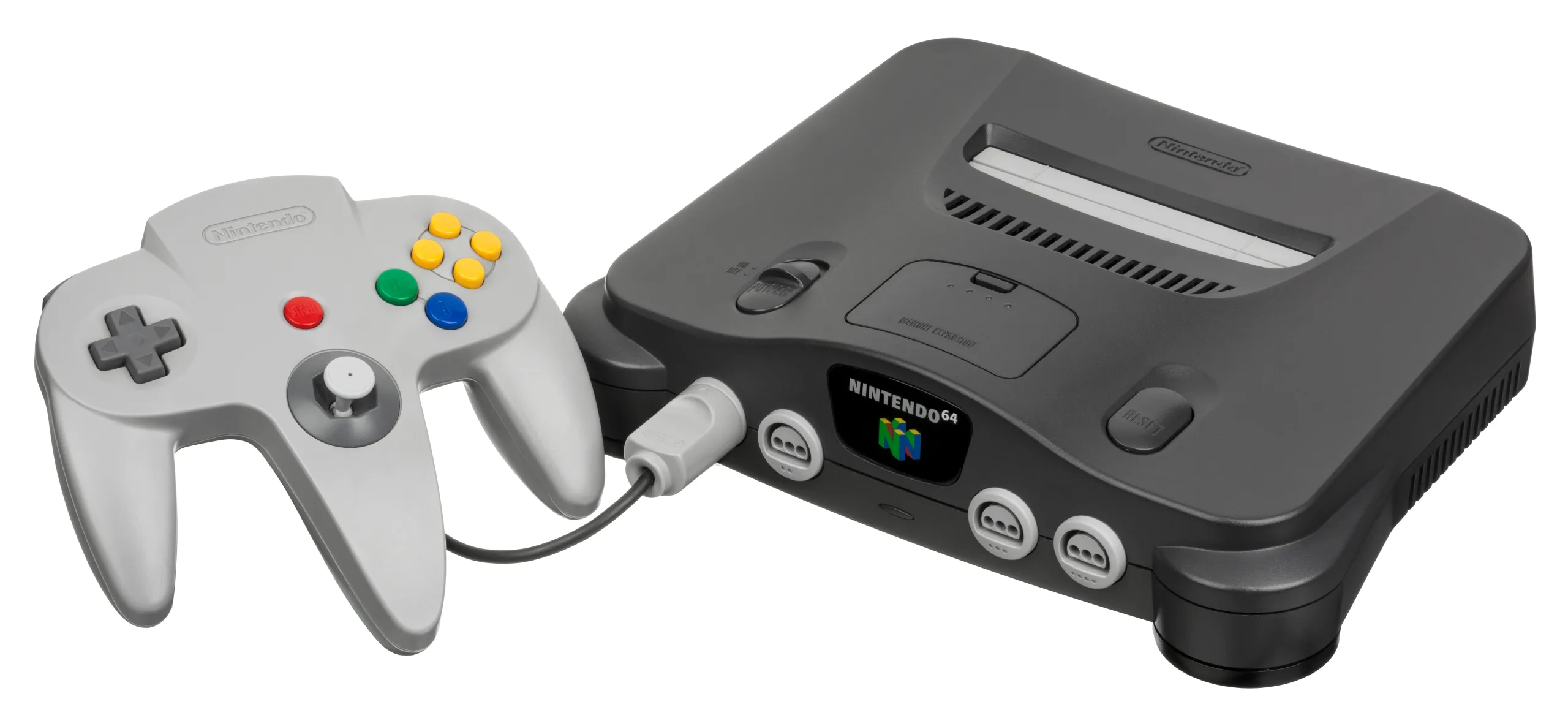
Nintendo 64 console with controller

Photo: Evan-Amos, Wikimedia Commons (Public domain)

Released

1996

RAM

4 MB RDRAM, expandable to 8 MB with the Expansion Pak

CPU

NEC VR4300, 93.75 MHz (64-bit)

Launch price

$199.99 (US); £249.99 (UK)

Manufacturer

Nintendo

Form factor

Home console, cartridge-based

CPU

NEC VR4300, 93.75 MHz (64-bit)

Chipset

SGI Reality Coprocessor (RCP), 62.5 MHz

RAM

4 MB RDRAM, expandable to 8 MB with the Expansion Pak

ROM

Unknown

Graphics

Handled by the Reality Coprocessor

Audio

16-bit, 44.1 kHz stereo; Dolby Pro Logic surround in selected games

Storage

Game Pak cartridges (4 to 64 MB); Controller Pak (32 KB); 64DD magnetic discs in Japan only

Ports

Four controller ports; expansion slot for the Expansion Pak or Jumper Pak; Controller Pak, Rumble Pak and Transfer Pak accessories

OS

None; games boot directly from the cartridge

PSU

External power adapter

Units sold

32.93 million worldwide

Successors

Nintendo GameCube (2001)

  • Worn controller stick
    The most common N64 problem is a loose or worn analogue stick, which spoils aiming and movement. It comes from wear in the stick mechanism, broken solder joints or dirt.
  • No boot without a Jumper Pak or Expansion Pak
    The N64's memory bus is left open if neither the Jumper Pak nor the Expansion Pak is fitted, and the console will not start. A dirty slot or cartridge connector causes the same black screen.
  • Dead save battery
    Save data that vanishes at power-off usually means the battery in a Controller Pak or cartridge has run out. It needs a special bit to open the case and a new battery soldered in.
  • 1993 Nintendo begins development with Silicon Graphics
  • 1994 The console is announced as the Ultra 64
  • 1996 Launches in Japan in June and North America in September
  • 1997 Launches in Europe and Australia on 1 March
  • 2002 Production is discontinued