MACHINE REFERENCE

Atari Lynx

The Atari Lynx was the first handheld with a backlit colour screen, released on 1 September 1989 for $179.95, shortly after the monochrome Game Boy.

Why it matters

The Lynx had a 4,096-colour LCD, hardware sprite scaling and a link cable, and cost $179.95. It sold about 2 million units. The Lynx II of July 1991 was smaller and cut to $99.

What to check before you buy

  • Test the screen for dimness and the speaker for sound; failed capacitors cause both.
  • Check it powers up on both batteries and the adapter.
  • Clean the cartridge slot and check for bent pins.
  • Ask whether it is a Lynx I or II; the II has a better screen and stereo headphone output.
  • Check the battery compartment for leaked battery residue.
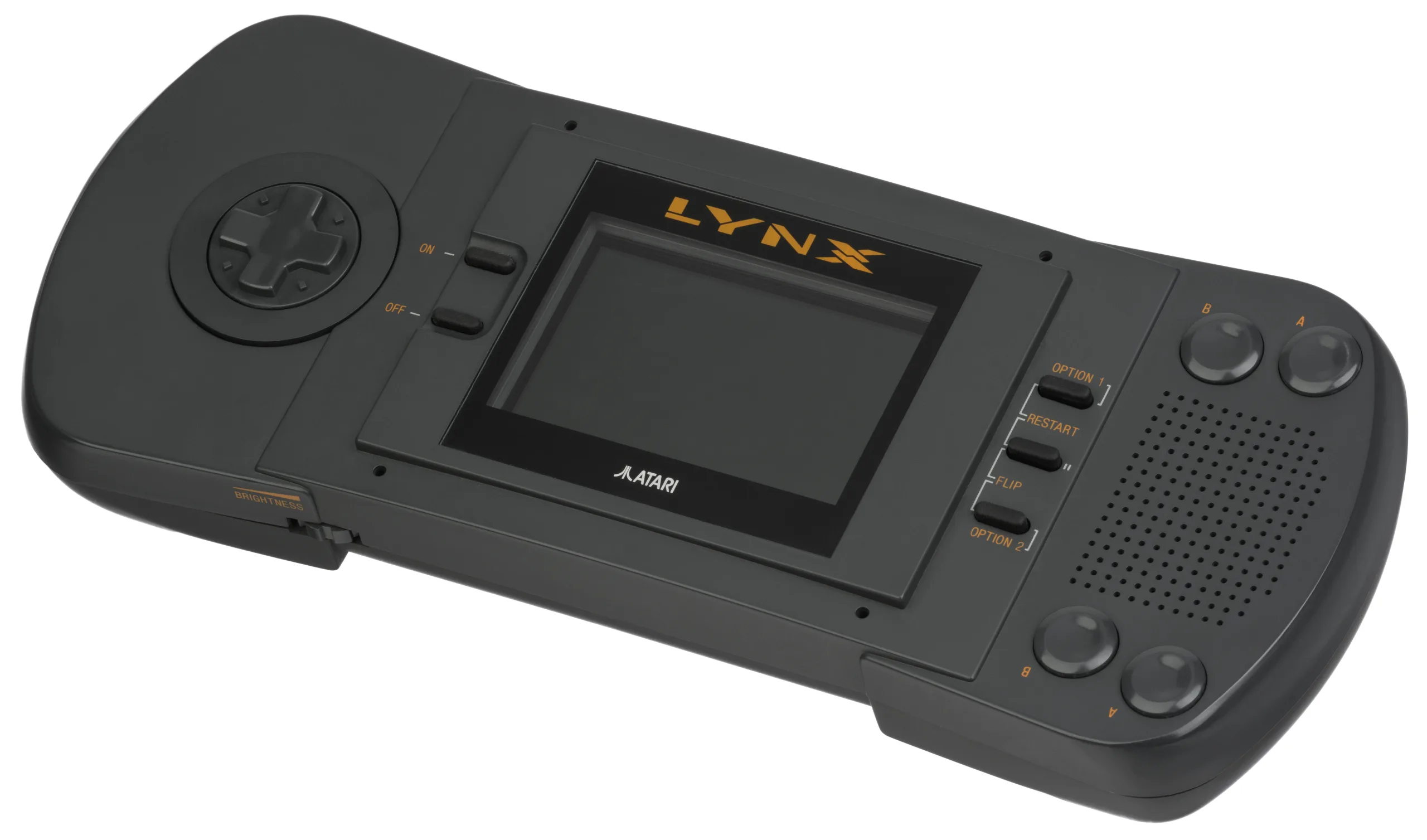
Atari Lynx handheld console

Photo: Evan-Amos, Wikimedia Commons (Public domain)

Released

1989

RAM

64 KB

CPU

VLSI VL65NC02 8-bit processor, 4 MHz (3.6 MHz average); the Lynx II uses a 65C02

Launch price

$179.95 (US)

Manufacturer

Atari Corporation (designed by Epyx)

Form factor

Handheld console with a backlit colour LCD

CPU

VLSI VL65NC02 8-bit processor, 4 MHz (3.6 MHz average); the Lynx II uses a 65C02

Chipset

Suzy (16-bit custom, 16 MHz, sprite scaling and distortion) and Mikey (8-bit custom, 16 MHz, video and audio DMA)

RAM

64 KB

ROM

Unknown

Graphics

3.5-inch backlit colour LCD, 160 x 102, with a 4,096-colour palette

Audio

Four channels, 8-bit DAC or PSG sound

Storage

ROM cartridges (128 KB to 1 MB with bank switching)

Ports

3.5 mm headphone jack (mono on the Lynx I, stereo on the Lynx II); ComLynx serial link

OS

None; games boot from the cartridge

PSU

Six AA batteries or external adapter; 4 to 5 hours of play (Lynx I), 5 to 6 hours (Lynx II)

Units sold

2 million

Successors

None directly; the Atari Jaguar followed as a home console

  • Failing capacitors
    Leaking or dried capacitors cause no sound, a dim or missing screen and no power. Lynx I repair kits have 16 capacitors and Lynx II kits have 20.
  • Power circuit failure
    The circuit that drops the 9 V from the batteries to 5 V can fail and let the higher voltage into the 5 V rail, which can destroy the CPU or the graphics chip.
  • Dirty cartridge slot
    A Lynx that will not start is more often a dirty slot or bent pins than a failed capacitor.
  • 1989 The Lynx launches in North America on 1 September
  • 1990 The Lynx reaches Europe and Japan
  • 1991 Atari releases the smaller, cheaper Lynx II in July at $99