MACHINE REFERENCE

Sinclair ZX80

The Sinclair ZX80 was advertised as the first personal computer for under £100, and it got there with 21 chips: a Z80, a 4 KB ROM, two 1K x 4 RAM chips and seventeen ordinary 74-series logic chips.

Why it matters

Jim Westwood’s board had no video chip at all. The Z80 draws the picture itself by running NOP instructions through the display data, which is why the screen blanks whenever a key is pressed or a BASIC program is running. It was a price-driven compromise, and a clever one. Production reached about 9,000 a month by the end of 1980, and Sinclair put total sales at 100,000 within 18 months, although a Computer History Museum label gives about 50,000. The 4 KB ROM held Nine Tiles’ integer-only BASIC, so there were no decimals and no trig. When the ZX81 arrived in March 1981, ZX80 owners could prise out the old ROM, fit the 8 KB ZX81 ROM and stick a thin keyboard overlay over the original keys. The result behaves like a ZX81 stuck permanently in FAST mode, because the ZX80 hardware has no NMI generator for SLOW mode.

What to check before you buy

  • Find out which ROM is inside. A 4K machine has the original keyboard legends and integer-only BASIC; an 8K machine has the ZX81 overlay and floating-point BASIC. The two BASICs differ, so 4K programs may not run on an upgraded machine.
  • Look at the case. Issue 1 cases, in thin vacuum-formed plastic, crack and warp easily. Later Issue 2 ABS cases are much sturdier.
  • Test every key on the membrane, and check the ribbon tail for cracks. Replacements exist, but fitting one is fiddly.
  • The machine has no power switch and runs from a 9 V unregulated supply with a positive tip on a 3.5 mm jack. Confirm the polarity of any supply before plugging it in, and check the regulator does not get alarmingly hot.
  • Check the rear edge connector and any RAM pack for wobble resets. The original RAM chips are socketed 2114s and easy to swap if a bank is faulty.
  • The TV output is UHF, so you need a TV with an analogue tuner or a modulator. The screen blanking on keypresses is normal behaviour.
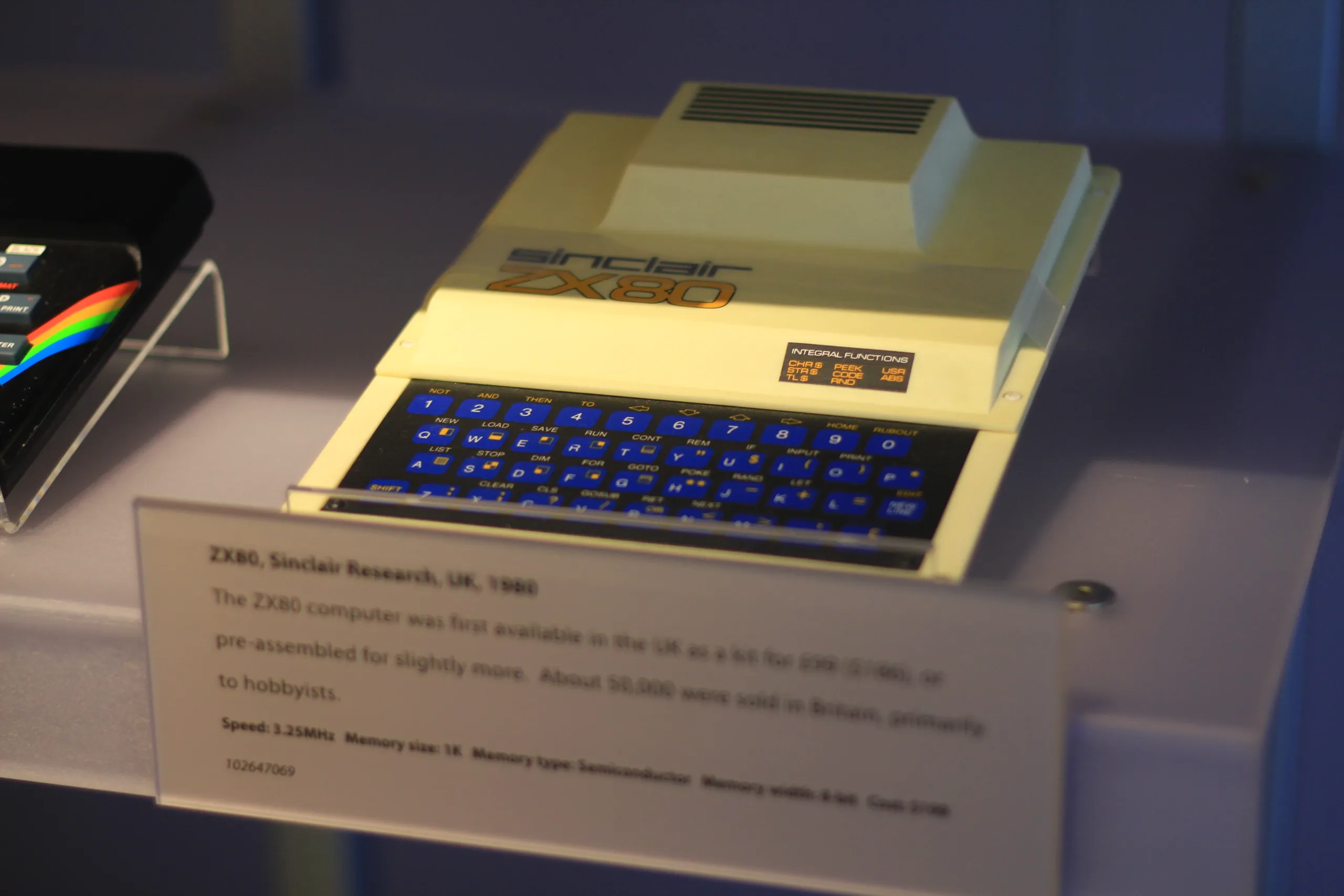
Sinclair ZX80 on display at the Computer History Museum

Photo: Michael Hicks, Wikimedia Commons (CC BY 2.0)

Released

1980

RAM

1 KB static RAM (two socketed 2114 1K x 4 chips). The same RAM holds the screen display, so the usable screen shrinks as a program grows. Expandable to 16 KB with an external RAM pack (launched September 1980)

CPU

Zilog Z80 compatible (many machines carry an NEC uPD780C-1) at 3.25 MHz, from a 6.5 MHz clock

Launch price

£79.95 kit, £99.95 ready-built

Manufacturer

Science of Cambridge Ltd, Cambridge, England (renamed Sinclair Computers Ltd in November 1980 and Sinclair Research Ltd in March 1981). Hardware by Jim Westwood, case and keyboard by Rick Dickinson, BASIC by Nine Tiles

Form factor

Wedge-shaped white plastic case with a one-piece blue membrane keyboard (40 keys) on the front, about 22 x 18 cm. Early Issue 1 machines have a thin vacuum-formed case; later Issue 2 machines have an injection-moulded ABS case

CPU

Zilog Z80 compatible (many machines carry an NEC uPD780C-1) at 3.25 MHz, from a 6.5 MHz clock

Chipset

No custom chip and no video chip. 21 chips in total: the Z80, the ROM, two RAM chips and seventeen 74-series TTL logic chips. The Z80 generates the picture itself. UM1233 UHF modulator for the TV output

RAM

1 KB static RAM (two socketed 2114 1K x 4 chips). The same RAM holds the screen display, so the usable screen shrinks as a program grows. Expandable to 16 KB with an external RAM pack (launched September 1980)

ROM

4 KB (Sinclair 4K integer BASIC, editor and monitor). Upgradeable to the 8 KB ZX81 ROM (floating-point BASIC)

Graphics

Monochrome, character-based, 32 x 24 characters, including simple block-graphics glyphs. The picture is generated only while the CPU is idle, so the screen blanks when a key is pressed or a BASIC program runs. No SLOW mode, even with the 8K ROM upgrade, because the hardware has no NMI generator

Audio

None

Storage

External cassette recorder via 3.5 mm EAR and MIC sockets. No named files; tapes are saved and loaded sequentially

Ports

UHF TV output (phono socket, tune the TV to about channel 36), 3.5 mm EAR and MIC jacks, 3.5 mm DC power jack, rear edge connector for the expansion bus

OS

Sinclair 4K integer BASIC in ROM (Nine Tiles, John Grant). Whole numbers only (-32768 to 32767), one statement per line, keywords entered by single keypress. The 8K ROM upgrade gives ZX81 BASIC with floating point and trig functions

PSU

External 9 V DC unregulated plug-in adaptor, 3.5 mm jack, positive tip, regulated to 5 V on board by a 7805-type regulator. Sources give about 400-600 mA. There is no power switch

Units sold

About 100,000 by Sinclair’s own account (within 18 months of launch). Other sources say about 50,000, and Sinclair User reports over 20,000 by September 1980

Successors

Sinclair ZX81 (5 March 1981, £49.95 kit / £69.95 built), then the ZX Spectrum (1982)

  • Runs hot, vents are fake
    The black stripes on the top rear of the case are cosmetic, not ventilation, and the 7805-type regulator runs hot. Failures show up as no power or thermal shutdown.
    ZX80 troubleshooting guide, Retro Tech Collection →
  • RAM pack wobble
    The 16K RAM pack plugs into the rear edge connector and is easily nudged. That interrupts the bus and resets the computer, losing the program. Sinclair User records users wedging packs in place with Blu-Tack.
    The Sinclair Story, Sinclair User 46 →
  • Fragile case and membrane keyboard
    Issue 1 cases were thin vacuum-formed plastic and crack. The membrane keyboard's ribbon tail and key pads fail with age.
    Sinclair ZX80 on Dataserve Retro →
  • 1978 Science of Cambridge sells the MK14 kit, its first computer product and the forerunner of the ZX80
  • 1980 On 29 January the ZX80 launches at £79.95 as a kit and £99.95 ready-built, advertised as the first personal computer for under £100
  • 1980 By September over 20,000 are sold and the 16K RAM pack arrives; Timex takes over production late in the year
  • 1981 On 5 March the ZX81 launches, and its 8 KB ROM is soon sold to ZX80 owners as an upgrade
  • 1982 Sinclair puts total ZX80 sales at about 100,000 in the 18 months from launch