MACHINE REFERENCE

Thomson TO7

The Thomson TO7 was a French home computer with a built-in light pen and no graphics chip: Thomson built its video circuitry from ordinary logic chips around a Motorola 6809.

Why it matters

Thomson’s first home computer went on show at the Sicob exhibition in late 1982, with a light pen on a coiled lead built into the case. In March 1983 Sonotec, Apple’s main French reseller, signed a supply contract with the education ministry, and between 30,000 and 40,000 TO7s had been built by the 1983 Sicob. The Informatique pour tous schools plan was announced in January 1985, after the TO7 had gone out of production, and it was carried out with the MO5 and the TO7/70, which stayed software-compatible with the TO7. The machine had real limits: 8 KB of user RAM (about 6 KB once BASIC was loaded), a BASIC cartridge sold separately at 500 francs and a membrane keyboard that people disliked.

What to check before you buy

  • Confirm it is a TO7, not a TO7/70 or MO5. The TO7 has a TO7 label, 8 colours and 8 KB of user RAM, and listings mix the three up constantly.
  • Test the light pen and its coiled lead. It only works on a CRT, so a modern LCD is no use for trying it.
  • You need an RGB SCART (Peritel) display or a converter. The TO7 does not output composite video.
  • Ask whether it comes with the BASIC cartridge, since the TO7 cannot run BASIC without it. Extensions such as Musique et jeux (game ports and sound) and the 16 KB RAM module are also sold separately.
  • A working Thomson cassette reader matters, because it is proprietary and cassette was the normal software medium. Check that the DIN lead is included.
  • Look at the keyboard membrane for cracks or dead keys, and at the rear heatsink and captive mains lead for heat damage or fraying.
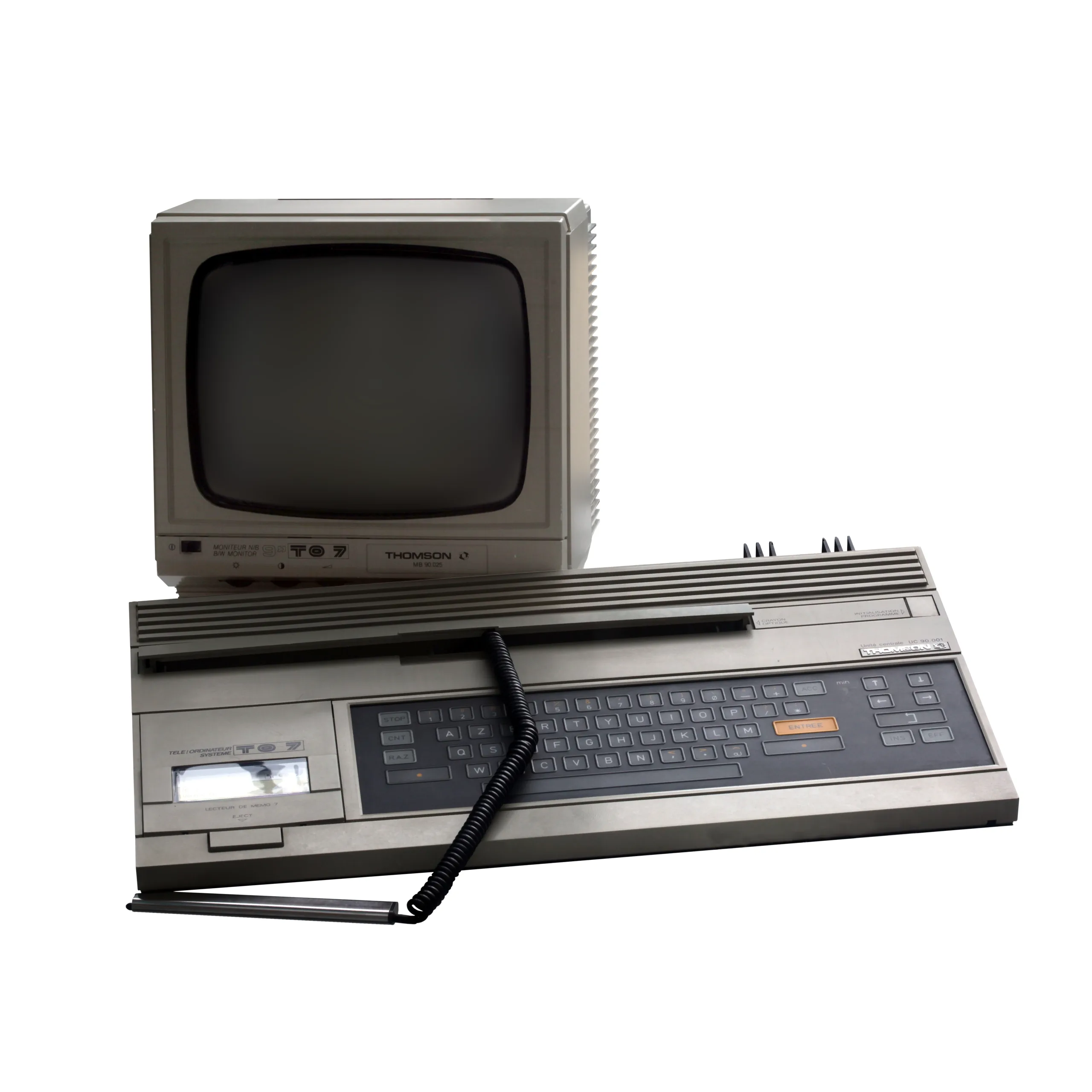
Thomson TO7 home computer with its light pen and MEMO7 cartridge reader

Photo: Rama & Musée Bolo, Wikimedia Commons (CC BY-SA 2.0 fr)

Released

1982

RAM

8 KB user RAM, plus 8 KB of pixel video RAM and 8 K x 6 bits of colour video RAM (about 22 KB in total). Expandable to 24 KB with the Thomson EM90-016 16 KB extension. About 6 KB is left for programs once BASIC is loaded

CPU

Motorola 6809 at 1 MHz (some sources say 6809E; French Wikipedia states it is the 6809)

Launch price

Reported between 3,750 and about 7,000 francs; sources disagree and no 1982 price list was found. The later cuts are consistent: 3,250 F at the end of 1983 (BASIC cartridge extra at 500 F) and 2,900 F in January 1984

Manufacturer

Thomson SA (Thomson-Brandt group), France

Form factor

All-in-one keyboard computer in a flat case with a ribbed heatsink along the rear and a 58-key membrane keyboard. A MEMO7 cartridge bay sits at the front left and a light pen on a coiled lead is built into the case. No monitor was supplied with the computer

CPU

Motorola 6809 at 1 MHz (some sources say 6809E; French Wikipedia states it is the 6809)

Chipset

No custom graphics chip: the video circuitry is built from conventional TTL logic, with DMA taking half the CPU cycle. Support chips are an EF6846 (timer, I/O and ROM) and a Motorola 6821 PIA

RAM

8 KB user RAM, plus 8 KB of pixel video RAM and 8 K x 6 bits of colour video RAM (about 22 KB in total). Expandable to 24 KB with the Thomson EM90-016 16 KB extension. About 6 KB is left for programs once BASIC is loaded

ROM

4 KB monitor ROM plus 2 KB of ROM inside the EF6846 chip. BASIC 1.0 is a separate 16 KB MEMO7 cartridge

Graphics

320 x 200, 8 colours (3-bit RGB), limited to 2 colours per 8 x 1 pixel cell; 40 x 25 text. Output is RGB over Peritel (SCART) at 50 Hz

Audio

1-bit buzzer driven from the 6846. The optional Musique et jeux extension adds a 6-bit DAC and two joystick ports

Storage

MEMO7 ROM cartridges, and a proprietary Thomson external cassette reader on a DIN socket. An optional QDD (Quick Disk Drive, 2.8-inch spiral-track, made by Mitsumi) was available, and later 3.5-inch floppy drives came via a separate controller

Ports

Peritel RGB; DIN socket for the cassette reader; MEMO7 cartridge slot (front); 3 or 4 expansion connectors depending on the source; built-in light pen. Optional extensions include RS-232, IEEE-488, a modem cartridge, a printer interface and a network card

OS

Monitor ROM (a small test and start-up program), with Microsoft BASIC 1.0 supplied on a MEMO7 cartridge sold separately at 500 F

PSU

Internal mains supply (220 V AC) with a captive mains lead, cooled by the large rear heatsink

Units sold

No audited figure found. Between 30,000 and 40,000 had been produced by the 1983 Sicob (production figures, not sales)

Successors

Thomson TO7/70 (1984), which replaced it and is software-compatible. The Thomson MO5 launched the same year as a cheaper, incompatible sibling, not a direct successor

  • Rear heatsink runs very hot
    On some units the large heatsink fixed to the back of the case became scorching hot after a few hours of use. Check that it is firmly mounted and that the case vents are clear.
    Thomson TO7 (French Wikipedia) →
  • Ageing graphics logic chips
    Obsolete Tears reports that the most common failures come from one of the TTL logic chips in the home-built graphics circuit, which has aged badly. The chips are standard parts, so they are easy to replace.
    Thomson TO7 (Obsolete Tears) →
  • Poor MEMO7 cartridge contact
    The cartridge connections get progressively less reliable. The same source recommends cleaning the contacts with alcohol and gently lifting them to improve the connection.
    Thomson TO7 (Obsolete Tears) →
  • 1979 Thomson decides to enter home computing in August, and a team of three at Moulins starts the prototype
  • 1980 A working prototype is running by October; the pre-production T9000 uses the same hardware with a different start-up screen
  • 1982 The TO7 is shown at the Sicob exhibition in Paris, late in the year, as Thomson's first home computer
  • 1983 In March Sonotec, Apple's main French reseller, signs a supply contract with the education ministry; by the end of the year the price has fallen to 3,250 F, plus 500 F for BASIC
  • 1984 The price drops to 2,900 F in January, production ends in May or June, and the TO7/70 and MO5 take over