MACHINE REFERENCE

Thomson MO5

The Thomson MO5 hides most of its BASIC vocabulary on the keyboard itself: press the dedicated BASIC key together with a letter and the machine drops a whole keyword such as PRINT or GOTO onto the screen, a trick borrowed from Sinclair's ZX81 and Spectrum. Underneath that spongy black "clavier gomme" sat a machine built at the French government's request and priced at 2,390 francs, cheap enough to reach classrooms the costlier Thomson TO7/70 never would.

Why it matters

The MO5 mattered less as a piece of engineering than as a policy instrument. France's Plan Informatique pour Tous put around 120,000 computers into schools by September 1985, with Thomson supplying both the MO5 and the TO7/70 as the core hardware, and roughly half a million MO5 units were sold in total before Thomson withdrew from microcomputing in 1989. It gave a generation of French schoolchildren their first hands-on contact with a keyboard and a screen, at a scale no other French manufacturer matched. The scheme was later judged a failure by the government's own inspectorate, undone by rushed teacher training and a curriculum that never kept pace with the rollout, but that was a failure of planning rather than of the machine Thomson's engineers built to a tight budget and an even tighter deadline.

What to check before you buy

  • Test the K7 cassette recorder on its own before trusting it to load anything; drive belts perish and it's the easiest single point of failure to isolate.
  • Check any replacement power adapter's polarity before connecting it; the MO5 wants 17V DC with a centre-negative plug, and getting this wrong is a well-documented way to kill the machine.
  • Try every key on an early rubber-dome unit; there's no drop-in replacement membrane, so a dead key means a repair job rather than a swap.
  • Confirm exactly which accessories are included; the light pen, joysticks and Mémo5 cartridge port peripherals are often missing from listings that only photograph the console.
  • Treat a scrambled but stable picture as a motherboard fault to investigate rather than a dead unit; it's rarely the SCART lead or the television at fault.
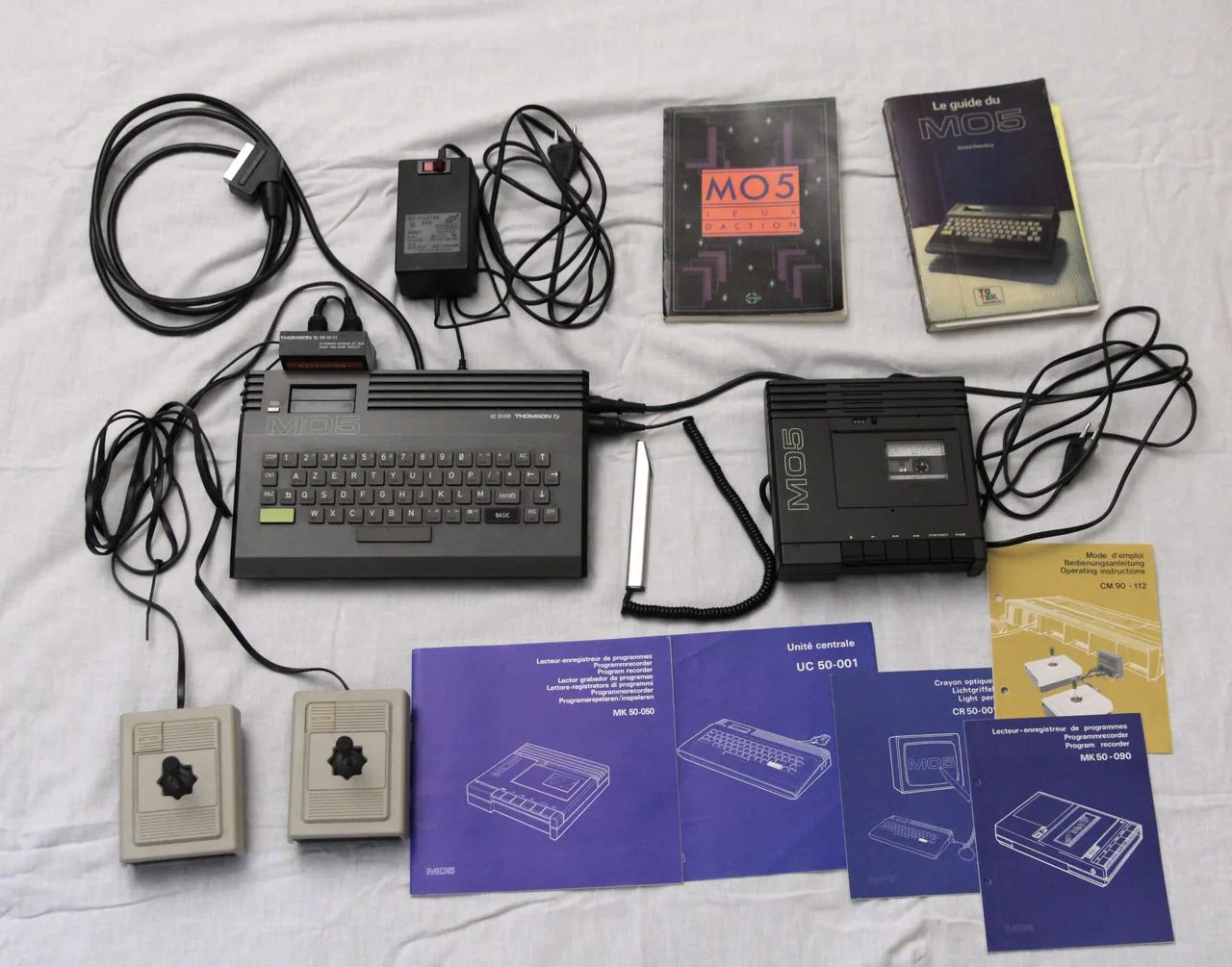
Thomson MO5

Photo: Deep silence (Mikaël Restoux), Wikimedia Commons (CC BY-SA 3.0)

Released

1984

RAM

48KB (32KB user RAM + 16KB video RAM); expandable via the network/cartridge port, though sources differ on the ceiling (English-language sources cite 64KB via the Nanoréseau card, French Wikipedia gives 96KB)

CPU

Motorola 6809E, 1MHz

Launch price

2,390 French francs (one source gives 3,500 francs, which may reflect confusion with the costlier Thomson TO7/70)

Manufacturer

Thomson SA

Form factor

Single-unit wedge-shaped keyboard computer

CPU

Motorola 6809E, 1MHz

Chipset

Thomson/Motorola EFGJ03L (MA4Q-1200) gate array (video); Motorola 6821 PIA (I/O and sound)

RAM

48KB (32KB user RAM + 16KB video RAM); expandable via the network/cartridge port, though sources differ on the ceiling (English-language sources cite 64KB via the Nanoréseau card, French Wikipedia gives 96KB)

ROM

16KB (4KB monitor + 12KB BASIC interpreter)

Graphics

320×200 pixels bitmap, 40×25 text mode, 16-colour palette limited to two colours per 8×1 pixel attribute block

Audio

1-bit square wave tone generator via the 6821 PIA, no dedicated sound chip (later MO5E added 4-voice sound)

Storage

Proprietary Thomson cassette recorder (K7) as standard; external floppy drive and Quick Disk Drive (QDD) supported as options

Ports

SCART/Péritel RGB video output, 5-pin DIN cassette port, DIN light pen port, single “Mémo5” cartridge/expansion port, joystick port(s)

OS

MO5 BASIC 1.0 (ROM-resident BASIC and monitor)

PSU

External supply delivering about 17V DC (centre-negative, 5.5×2.1mm plug) to an internal 7812 regulator producing 12V DC

Units sold

Approximately 500,000 units across the MO5 range

Successors

Thomson MO6 (1986)

  • Power supply failure from reversed polarity
    The MO5 expects a centre-negative 17V DC supply; fitting a modern centre-positive adapter is a common mistake and the onboard 7812 voltage regulator often cannot survive the reversal. A blown fuse is also the single most frequent power fault reported by owners.
    Thomson MO5 repair forum thread (system-cfg.com) →
  • Degraded "clavier gomme" rubber-dome keyboard
    Early MO5 units used a soft rubber-dome keyboard, nicknamed the "clavier gomme", which owners and contemporary reviewers found uncomfortable for extended typing and which can develop unresponsive or sticking keys with age. Thomson replaced it with a mechanical keyboard on the later MO5E revision.
  • Stable but garbled display
    A stable yet scrambled picture is a commonly reported fault, usually traced to dry solder joints, failing RAM, a poorly seated ROM, or the EFGJ03L gate array rather than the display output stage itself.
    Thomson MO5 fault diagnosis thread (system-cfg.com) →
  • 1983 Thomson develops the MO5 as a cheaper companion to its TO7/70, under pressure to bring prices down ahead of a planned French government computing-in-schools programme
  • 1984 MO5 launched in France in June at 2,390 francs
  • 1985 Deployed as a core machine of the "Plan Informatique pour Tous", with roughly 120,000 computers installed in French schools by September; MO5E revision introduces a mechanical keyboard, a parallel port, two joystick ports and 4-voice sound
  • 1986 MO5NR variant adds 128KB RAM, an EF9369 palette chip for 4,096 colours and integrated Nanoréseau networking; original MO5 discontinued and succeeded by the MO6
  • 1989 Thomson withdraws from the microcomputer market; the Plan Informatique pour Tous is separately judged a failure by the French government's general inspectorate and wound down