MACHINE REFERENCE

Fairchild Channel F

Fairchild Channel F got there first and is remembered for it least. Three years before the Atari 2600 made cartridge-based gaming a household idea, Fairchild had already built the console that proved a microprocessor and a slot full of swappable ROM could replace a machine hard-wired to play one game forever.

Why it matters

The Channel F’s F8 processor and its pair of 3851 support chips did something nobody had shipped in a console before: they ran software loaded from a cartridge, rather than logic burned permanently into the hardware. Atari’s own engineers studied the Channel F before finishing the 2600, and the resemblance in the two machines’ cartridge slots is not a coincidence. Fairchild still only moved around 350,000 units before quitting the games business in 1979 and selling the rights on to Zircon International, undercut by a company with a bigger marketing budget and, soon after, by the Atari console its own idea had made possible. The Channel F’s real legacy sits in every cartridge-based system that followed it, not in its own sales figures.

What to check before you buy

  • Test both controllers before agreeing a price; broken centring springs and snapped internal wiring are the console’s most common faults by a wide margin
  • Ask whether the seller has tested it with a cartridge rather than just powered it on, since a dead screen can come from the console, the cartridge edge connector, or the RF lead
  • Check the AC adapter is the correct dual-voltage type for this console rather than a generic replacement, since the Channel F rectifies and regulates inside the case rather than in the brick
  • Budget for cartridges separately — only 27 were ever released, and prices for the rarer titles can exceed the console itself
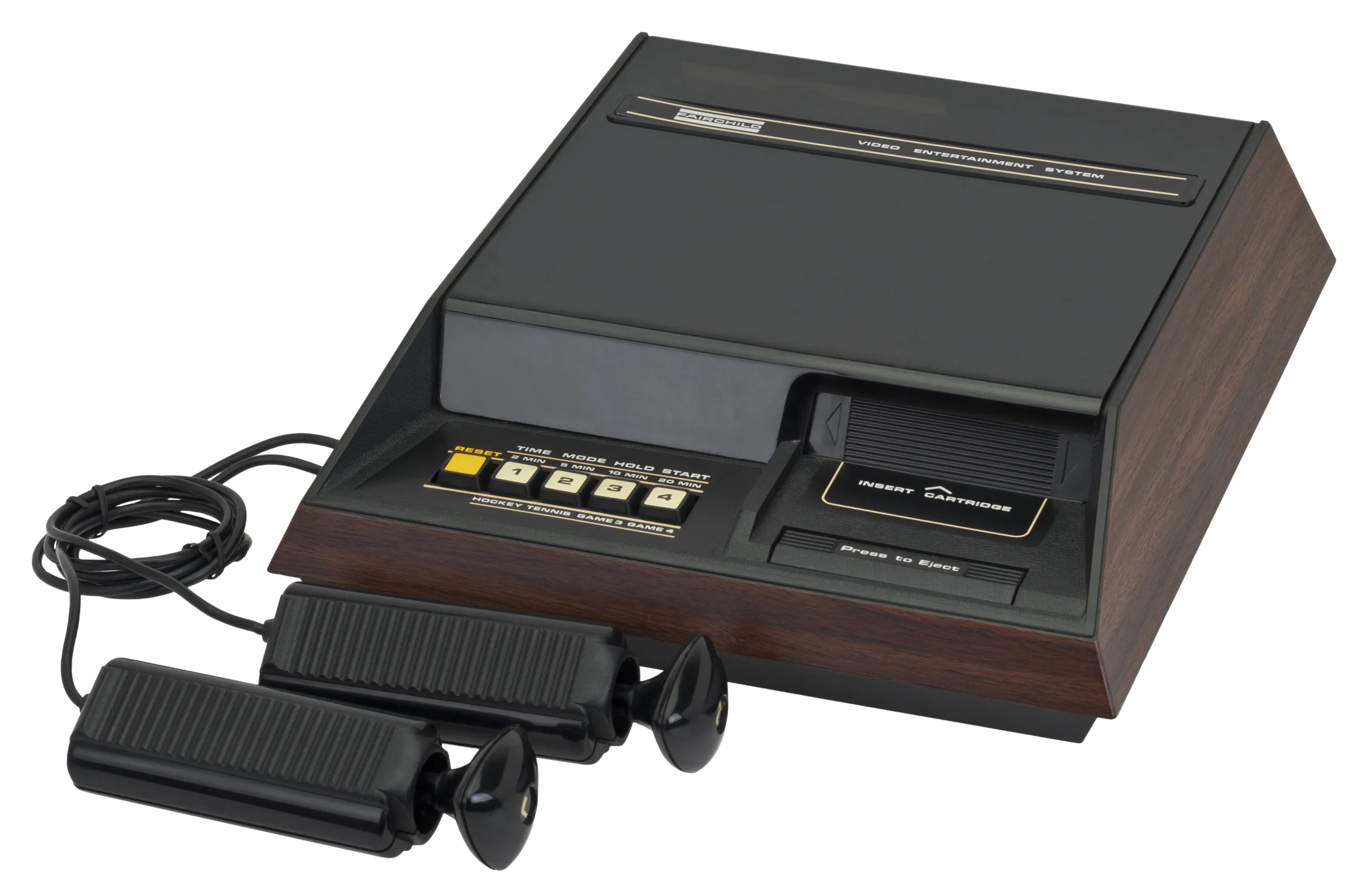
Photo: Evan-Amos, Wikimedia Commons (CC BY-SA 3.0)

Released

1976

RAM

64 bytes of scratchpad RAM plus a separate 2 KB video buffer

CPU

Fairchild F8 (a 3850 CPU plus two 3851 Program Storage Unit chips handling I/O and timing), 1.79 MHz NTSC

Launch price

US$169.95

Manufacturer

Fairchild Camera and Instrument Corporation

Form factor

Console with a cartridge slot and two controllers wired directly into the case (later replaced with removable controllers on the Channel F System II)

CPU

Fairchild F8 (a 3850 CPU plus two 3851 Program Storage Unit chips handling I/O and timing), 1.79 MHz NTSC

Chipset

None beyond the F8 set itself — there is no separate graphics or sound chip; the 3851 PSUs generate the video timing and tones directly

RAM

64 bytes of scratchpad RAM plus a separate 2 KB video buffer

ROM

2 KB, holding the BIOS and two built-in games (Tennis and Hockey)

Graphics

Roughly 102×58 visible pixels inside a 128×64 framebuffer, 8 colours maximum

Audio

Three fixed tones (120 Hz, 500 Hz and 1 kHz) through an internal speaker on the original console, or via RF on the System II

Storage

ROM cartridges, branded “Videocarts”; 27 official titles were released across the system’s life

Ports

RF modulator output to the TV aerial socket; two hardwired controller sockets on the original console

OS

None as such — BIOS in ROM boots directly into the built-in Tennis/Hockey game or a loaded cartridge

PSU

External step-down transformer brick (120V AC input; two unrectified AC outputs, 15V AC at 3.75VA and 10V AC at 16.5VA), rectified and regulated inside the console itself

Units sold

Around 350,000 by 1979, when Fairchild sold the system’s rights to Zircon International

Successors

Channel F System II (1978 redesign with removable controllers and RF switch box; continued under Zircon International after the 1979 sale)

  • Controller centring spring failure
    The plunger's centring spring tabs crack or detach with age, so the stick no longer returns to centre on its own and the console reads a constant directional input even when the player lets go.
  • Controller cable wire breakage
    The thin internal wires inside the controller cable fatigue and snap, especially on units whose cable was habitually wound tightly around the controller body for storage; the fault shows up as a direction or button that stops responding.
  • 1976 Announced at the Consumer Electronics Show (14 June)
  • 1976 Receives FCC approval (20 October)
  • 1976 Released in North America as the first microprocessor-based, cartridge-based home console (November)
  • 1977 Released in Japan (October)
  • 1978 Channel F System II released, with removable controllers
  • 1979 Fairchild exits the video game market and sells the system's rights to Zircon International (April)
  • 1983 Production ends