MACHINE REFERENCE

Tandy 1000

Tandy 1000 was Radio Shack’s answer to a question IBM never quite finished asking. IBM had built the PCjr to be a cheaper, friendlier PC for the home, then crippled it with a chiclet keyboard and a memory ceiling nobody wanted. Tandy looked at the PCjr’s enhanced graphics and sound, kept them, threw out everything that had made the PCjr a punchline, and shipped the result for the same money in November 1984.

Why it matters

Tandy made one decision that defined the whole machine: when PC compatibility and PCjr compatibility pulled in different directions, PC compatibility won. That choice meant the 1000 ran the growing library of IBM PC software without the PCjr’s compromises, while still keeping that machine’s 16-colour graphics and three-voice sound on the motherboard, no add-in card required. It worked. Tandy’s own figures say the 1000 outsold every other product the company made in its first month on sale, and by early 1985 it was Tandy’s best-selling computer outright, a title it held onto as the SX, TX and later models carried the line through to 1993. Game developers followed the sound and graphics hardware for the rest of the decade, which is why “Tandy-compatible” sits in the credits of PC games that had nothing else to do with Radio Shack.

What to check before you buy

  • Smell the case before powering it on if it’s been in storage; a burst PSU capacitor leaves a distinctive residue and a repair bill to match
  • Listen for the floppy drive motor spinning without the heads moving, a sure sign the belt has turned to goo
  • Don’t assume a spare PC/XT keyboard will work — the 8-pin DIN port needs either an original Tandy keyboard or a protocol-aware adapter
  • Check which model you’re actually looking at, since the enhanced SX/TX/TL machines are more capable and more collectible than the original 1984 unit
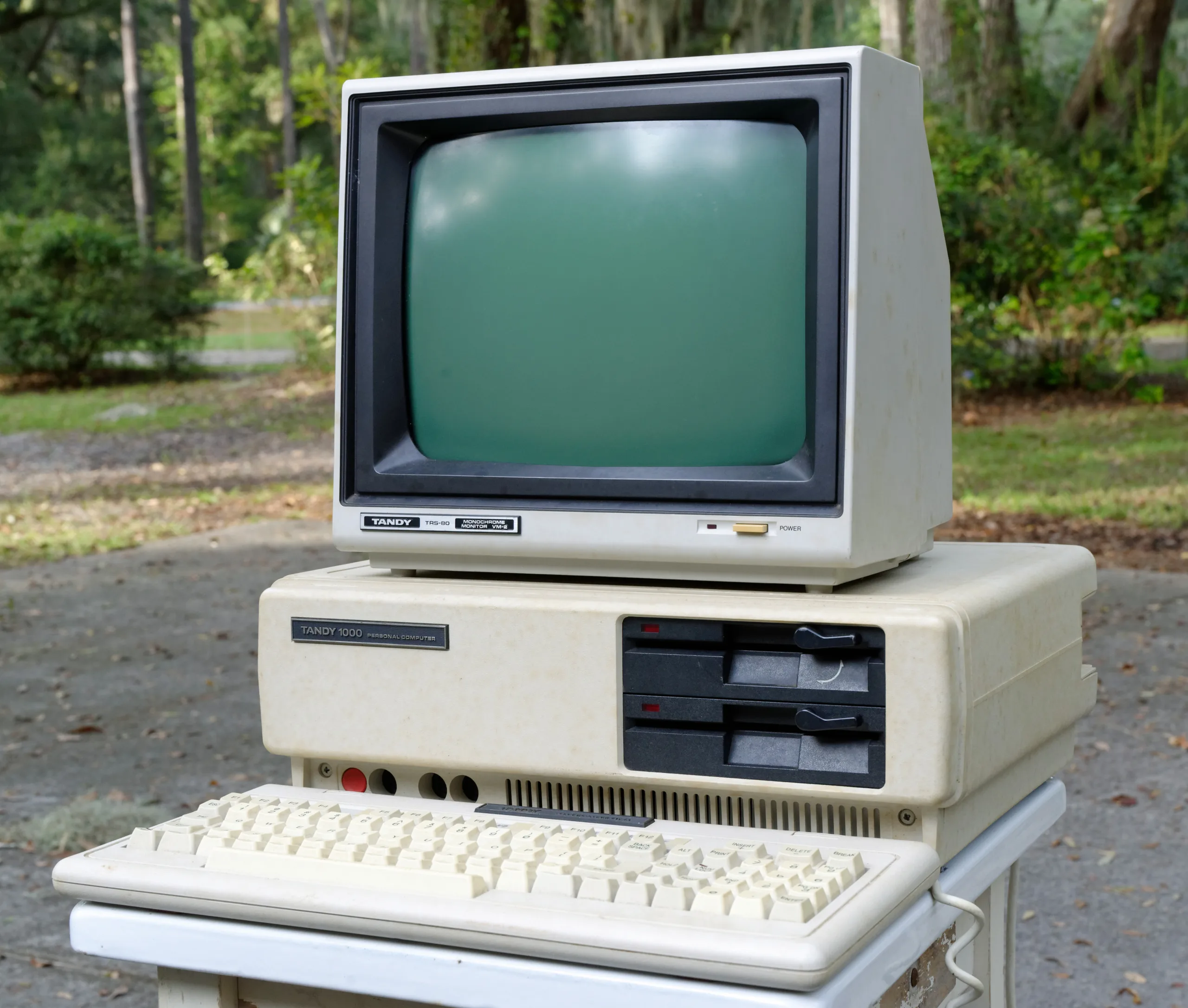
Photo: Jud McCranie, Wikimedia Commons (CC BY-SA 4.0)

Released

1984

RAM

128 KB standard, expandable to 640 KB

CPU

Intel 8088 (or a second-sourced equivalent, e.g. AMD), 4.77 MHz; no socket fitted for a maths co-processor

Launch price

US$1,200

Manufacturer

Tandy Corporation (sold through Radio Shack stores)

Form factor

Desktop case with separate keyboard; a plastic shell over an aluminium chassis, styled to resemble the IBM PCjr it was built to outcompete

CPU

Intel 8088 (or a second-sourced equivalent, e.g. AMD), 4.77 MHz; no socket fitted for a maths co-processor

Chipset

Tandy’s own proprietary ASICs, integrating a CGA-compatible video adapter and sound generator directly onto the motherboard rather than on an add-in card

RAM

128 KB standard, expandable to 640 KB

ROM

MS-DOS 2.11 and Tandy’s DeskMate 1.0 environment built into ROM, alongside the BIOS

Graphics

Tandy Graphics Adapter — CGA-compatible, plus an enhanced 16-colour bitmap mode CGA itself couldn’t do

Audio

Texas Instruments SN76496 or NCR 8496 programmable sound generator, 3 voices

Storage

One internal 5.25-inch double-density floppy drive, with a bay for a second

Ports

Card-edge parallel printer port, TTL RGB monitor output (DE-9), composite video out (RCA), audio line out (RCA), light pen connector (DE-9), two 6-pin DIN Color Computer-style joystick ports, 8-pin DIN keyboard port

OS

MS-DOS 2.11 (Tandy’s own build), with DeskMate as the bundled graphical shell

PSU

Internal supply

Units sold

Not broken out individually, but Tandy’s own account says it outsold every other Tandy product in its first month and was the company’s best-selling computer by early 1985

Successors

Tandy 1000A (1985), then the SX, TX, EX, HX, HD, and later SL/TL/RL/RLX/RSX lines, continuing through 1993

  • Power supply capacitor failure
    The 470µF capacitor on the -12V rail (commonly referenced as C23) is a known weak point and can fail explosively with age, scattering debris inside the case and taking the +12V rail down with it.
  • Floppy drive belt degradation
    Early belt-driven floppy mechanisms turn the drive belt to a sticky, non-functional mess after decades of storage; the drive powers up and the motor runs, but the heads never actually move.
  • Proprietary keyboard protocol
    The 8-pin DIN keyboard port looks similar to other machines of the era but speaks a different 9-bit serial protocol to the IBM PC/XT standard — IBM's stream starts with a 1 bit where Tandy's stream ends with a 0 bit — so a standard PC/XT keyboard won't work without an adapter built for the difference.
  • 1983 A Tandy executive publicly anticipates competition from IBM's PCjr (December)
  • 1984 Original Tandy 1000 released (November)
  • 1985 Becomes Tandy's best-selling computer
  • 1986 Tandy reaches roughly 9.5% of the US home-computer market
  • 1993 Tandy 1000 production ends and Tandy's computer division is sold to AST Research