MACHINE REFERENCE

Galaksija

The Galaksija shipped inside a magazine, not a box. In late December 1983, readers of the Yugoslav popular-science title Galaksija found a special edition with a full computer design printed across its pages, schematic and parts list included, because the country’s import restrictions had made buying a finished Western computer either illegal or close to a month’s salary.

Why it matters

Voja Antonić’s trick was to make the Z80A draw the screen itself, in software, rather than paying for dedicated video hardware the design couldn’t afford. It was slower than a machine with a proper video chip, and it was also something ordinary Yugoslavs could actually build: sources put kit orders at around 8,000, from parts bought through Računari magazine or imported via Microtechnica in Graz, against well over 100,000 copies of the magazine issue itself sold. A state broadcaster, Ventilator 202, spent the next three years transmitting Galaksija software over the radio for listeners to tape off-air, which is not a distribution method any Western computer of the era needed. One surviving example sits in the Computer History Museum in Mountain View; the design itself has outlasted the country that produced it.

What to check before you buy

  • Decide early whether you want a genuine 1983–84 build or a modern reproduction kit: originals are scarce outside the former Yugoslavia, and Antonić’s own 2020 double-layer PCB redesign is a realistic, well-supported alternative
  • If buying or building with a modern Z80A, check whether the RFSH refresh-timing fix has been applied, since CMOS-process chips can misbehave without it
  • Test cassette loading early and be ready to adjust the R14/C2 values if loads are unreliable. This is a known quirk of the original circuit, not necessarily a fault with your particular tape
  • Don’t expect dedicated sound or colour graphics; both are outside what this design was ever built to do
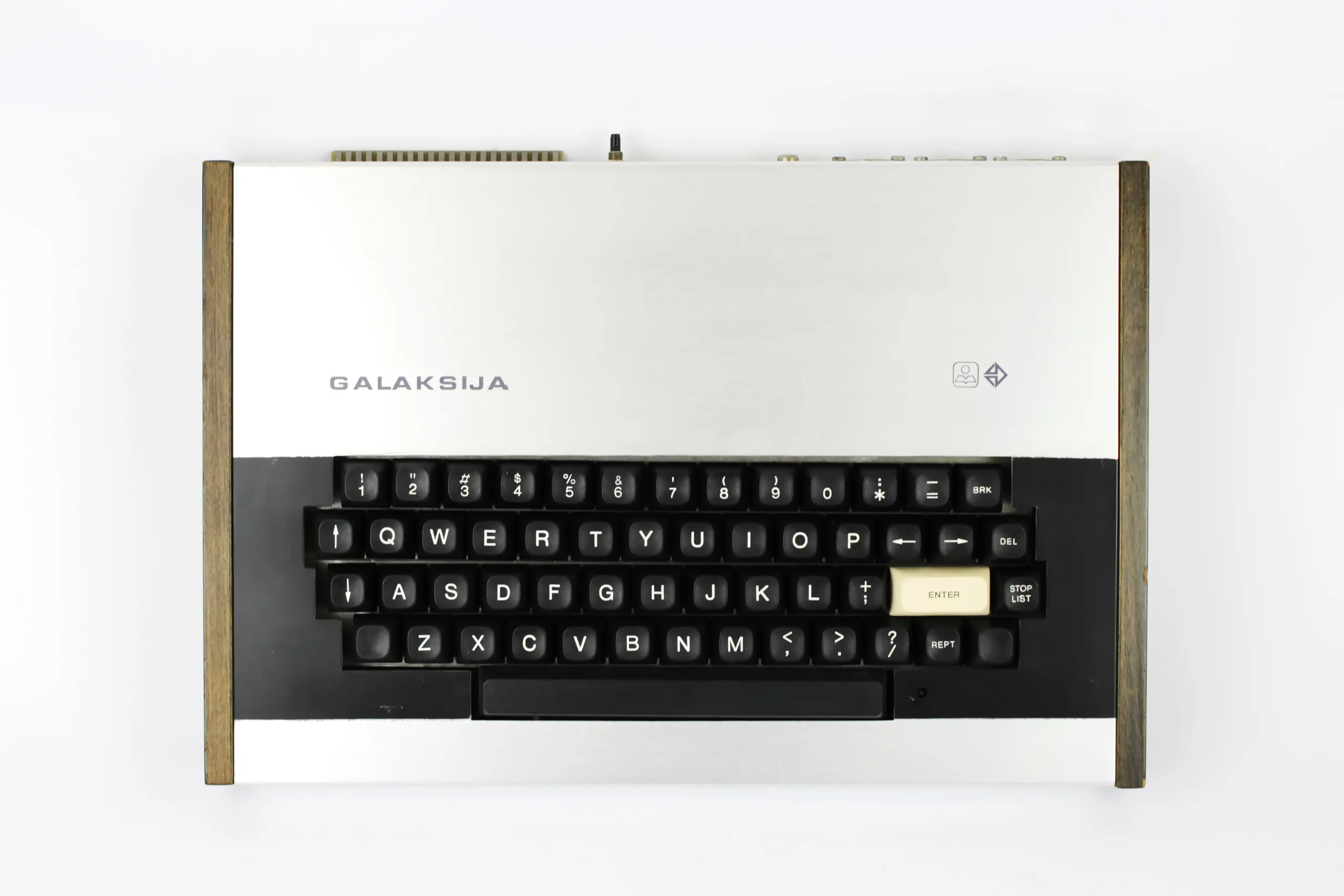
Galaksija computer, 1983

Photo: Tekiii, Wikimedia Commons (CC BY-SA 3.0)

Released

1983

RAM

2–6 KB standard (static RAM), expandable to 54 KB

CPU

Zilog Z80A, 3.072 MHz

Launch price

Components for a self-built kit cost around 4,500 Yugoslav dinars, or about 100 Austrian schillings’ worth of imported ICs sourced through Microtechnica in Graz; factory-assembled units from the Institute for Textbooks and Teaching Aids ranged from roughly 45,500 to 59,500 dinars in 1984 depending on RAM and ROM fitted

Manufacturer

None as a commercial manufacturer: designed by Voja Antonić and published as a build-it-yourself project; later production-run units were assembled by the Institute for Textbooks and Teaching Aids with Elektronika Inženjering

Form factor

Build-it-yourself kit, buildable entirely from standard off-the-shelf parts, with a case later built from Pertinax PCB material and an acrylic base; factory-assembled versions followed

CPU

Zilog Z80A, 3.072 MHz

Chipset

None: the Z80A generates the video image itself in software, the design’s defining simplification, rather than offloading it to dedicated video hardware

RAM

2–6 KB standard (static RAM), expandable to 54 KB

ROM

Two 4 KB EPROMs (ROM A: bootstrap and Galaksija BASIC; ROM B, optional: extended commands, assembler and monitor), plus a 2 KB character-generator EPROM

Graphics

32×16 monochrome text, or 64×48 block graphics built from a 2×3 dot matrix; an 8×13 character cell supporting 64 distinct block patterns and Serbian Cyrillic characters

Audio

None dedicated; the cassette port could be used to output basic tones, in the same spirit as the ZX Spectrum’s cassette-port beeper tricks

Storage

Compact cassette, at a deliberately slow and reliable 280 bit/s

Ports

44-pin Z80 bus edge connector, 5-pin DIN cassette interface, DIN monochrome video out, RCA UHF TV output

OS

Galaksija BASIC, an interpreter partly derived from TRS-80 Level 1 BASIC

PSU

Unknown: no source consulted gives a specific voltage or current rating for the external supply

Units sold

No official figure exists for a DIY project of this kind; sources put kit orders at around 8,000, against well over 100,000 copies of the magazine special edition sold

Successors

Galaksija Plus, announced mid-1984

  • Unreliable cassette loading
    Builders commonly report failed or inconsistent tape loading, traced to R14 and C2 on the cassette input circuit being too fast for the signal the original design expected; replacing R14 with a 1 kΩ resistor and C2 with a 1 µF ceramic capacitor is the documented community fix.
  • DRAM refresh timing instability on CMOS Z80A builds
    Builds using a modern CMOS-process Z80A can suffer refresh-timing faults that prevent booting or cause instability, because the chip's electrical characteristics differ from the NMOS parts the 1983 design assumed; Antonić's own errata, and the 2020 double-layer PCB redesign, add a small capacitor between -RFSH and ground to stabilise it.
  • 1983 Voja Antonić conceives the software-generated video approach after reading an RCA CDP1802 handbook while on holiday
  • 1983 Late December: Računari u vašoj kući published in Belgrade with the full Galaksija kit instructions
  • 1984 Factory-assembled units go on sale through the Institute for Textbooks and Teaching Aids
  • 1984 June/July: Galaksija Plus announced as a successor
  • 1984 Onward: the radio show Ventilator 202 broadcasts more than 150 Galaksija programs over three years, distributing software over the airwaves for listeners to record onto cassette