MACHINE REFERENCE

Pravetz 82

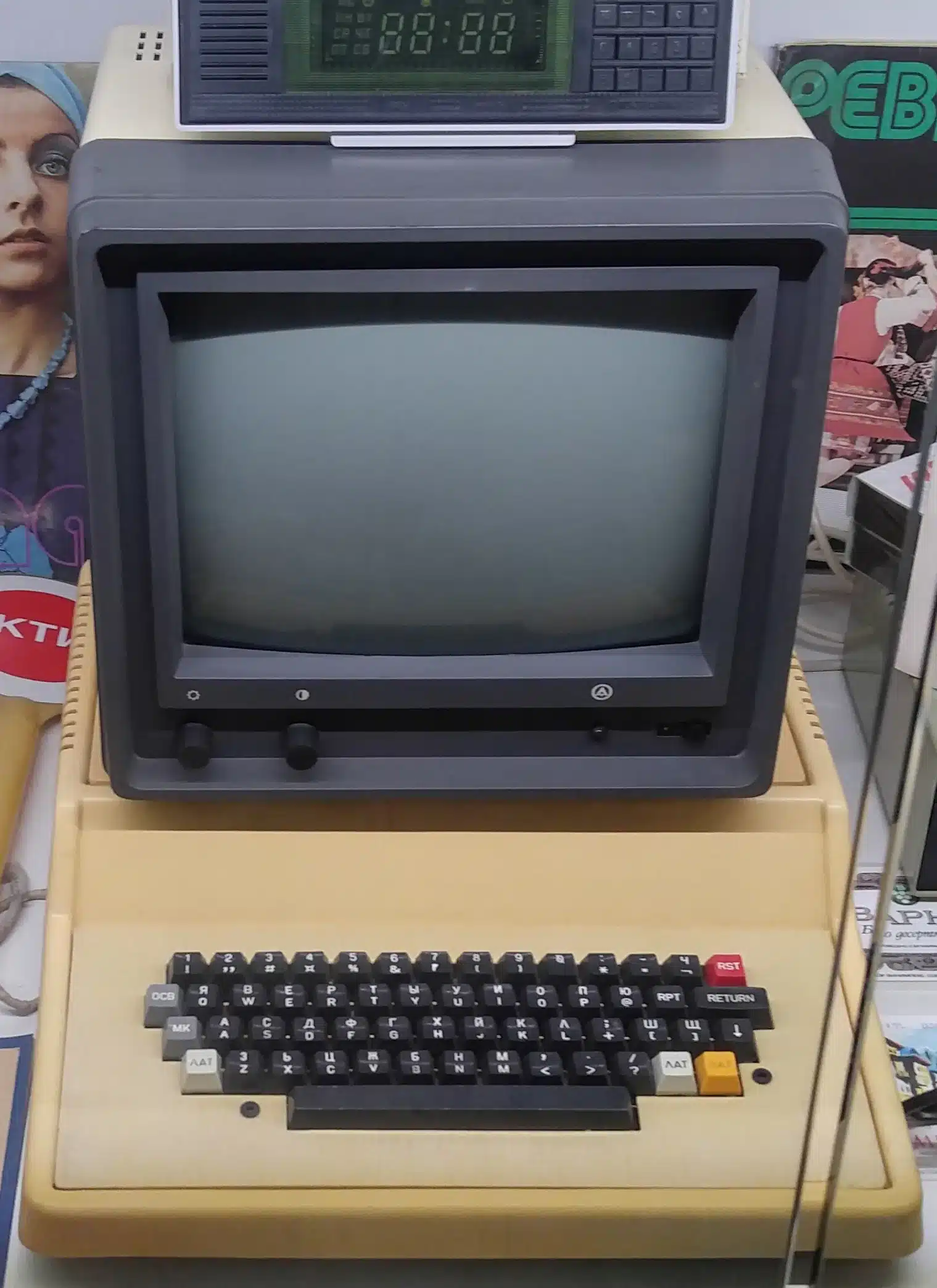
The Pravetz 82 was the first personal computer to be manufactured on a serial production line anywhere in Bulgaria, and it did the job by tracing an Apple II Plus’s electrical diagrams almost line for line, right down to reusing the original ROM content untouched. Sit one next to a real Apple II Plus and the family resemblance stops at a glance: the case is a distinctive vacuum-formed yellow, the keyboard answers in Cyrillic as readily as Latin, and inside, plenty of the chips carry Bulgarian or Soviet markings rather than the expected American ones. Underneath, though, it thinks in exactly the same 6502 machine code Cupertino wrote.

Why it matters

There’s a particular kind of irony sitting inside every Pravetz 82’s case: a socialist state that officially had no truck with Silicon Valley capitalism quietly reverse-engineered one of its most successful products, down to the ROM, and then manufactured it by the hundreds of thousands to teach an entire generation of Bulgarian schoolchildren how to program. It wasn’t sold in shops. It went to state institutions, because a Comecon economy had no retail channel for it and no citizen with 4,190 Leva to spare regardless. What it does represent, cleanly, is Bulgaria’s genuinely dominant role in Eastern Bloc computing: this small country accounted for a large share of Comecon’s computer exports, and the Pravetz 82 is where that dominance started.

What to check before you buy

  • Expect to import. Complete units essentially never surface on Western marketplaces, what does turn up there is loose chips and expansion cards.
  • Ask specifically about the DRAM sockets. The one well-documented failure point on this machine is poor-quality IC sockets working loose around the DRAM chips.
  • Get the power supply revision before you plug anything in. Early units ran a linear PSU, later ones a switching PSU, either one is decades old now.
  • Confirm what storage it actually has. Cassette-only Pravetz 82s are common; the 5.25" floppy option came via an add-in card.
  • Don't expect documentation in English. Most sources on this specific machine are in Bulgarian.
Pravetz 82

Photo: Scroch, Wikimedia Commons (CC BY-SA 4.0)

Released

1982

RAM

48 KB on-board, expandable to 64 KB via a “language card” in slot 0, the same mechanism as the Apple II Plus

CPU

MOS Technology 6502, 1 MHz — identical to the Apple II; some production runs used Synertek-manufactured 6502s under MOS licence

Launch price

4,190 Bulgarian Leva, cited as approximately $2,600 at the time — though this was not a retail consumer price, the machine sold exclusively to state institutions

Manufacturer

Priborostroitelen Zavod (Instrument/Electronic Devices Factory), Pravetz, Bulgaria, assigned by Bulgaria’s Ministry of Electronics

Form factor

All-in-one keyboard-case desktop, yellow plastic case, black keyboard with red RESET key; 40 x 48 x 16 cm, 8 kg

CPU

MOS Technology 6502, 1 MHz — identical to the Apple II; some production runs used Synertek-manufactured 6502s under MOS licence

Chipset

Not documented as a named chipset — the 82 used discrete TTL-equivalent logic (Bulgarian and Soviet clone chips substituting the originals); a dedicated chipset only appears later, on the Pravetz 8A

RAM

48 KB on-board, expandable to 64 KB via a “language card” in slot 0, the same mechanism as the Apple II Plus

ROM

12 KB, described as unchanged/identical to Apple II ROM content

Graphics

Apple II-standard modes: 40×24 text; graphics 280×192 pixels at 6 colours from a 16-colour palette, plus mixed modes

Audio

Not explicitly documented in sources checked. As an electrical/ROM clone of the Apple II it almost certainly used the same 1-bit speaker toggled via a memory-mapped soft switch, but this is an inference rather than a directly sourced fact

Storage

Cassette tape via a Unitra MK232 cassette recorder initially; 5.25″ floppy drives added later via an expansion card

Ports

One cassette player port; 8 expansion card slots (slot 0 reserved for the language/RAM card). No documented joystick or serial port on the base 82

OS

Applesoft BASIC in ROM (same version as Apple II Plus); Apple DOS used for floppy-drive connectivity via the expansion card

PSU

Early units used linear power supplies; later production revisions switched to switching power supplies. No wattage/voltage spec found

Units sold

Only “hundreds of thousands of units were shipped until 1986” is documented, with no precise figure available

Successors

Pravetz 8M (dual-CPU CP/M variant), Pravetz 8A (Bulgarian-made chipset, near-identical clone of the Apple //e, Cyrillic support), Pravetz 8C (streamlined 8A with built-in 128 KB RAM), Pravetz 8D (not Apple II-compatible, architecturally derived from the Oric Atmos instead). A minor interim revision, “Pravetz 83” (1984), added arrow keys to the 82’s keyboard

  • Socketed DRAM contact failures
    The single most consistently documented reliability issue — widespread use of substandard-quality IC sockets, particularly for the DRAM chips, causing intermittent faults from poor chip-to-socket contact rather than chip failure itself.
  • Early linear power supply wear
    Early production runs used linear power supplies, a documented weak point on the design's predecessor, the IMKO-1, before later revisions moved to switching power supplies.
  • 1979 Pravetz computer programme founded by engineer Ivan Vasilev Marangozov; the IMKO-1 (Apple II clone) developed at the Institute of Technical Cybernetics and Robotics, Bulgarian Academy of Sciences
  • 1982 IMKO-2 prototype built in a roughly 50-unit test batch; serial manufacturing of the renamed Pravetz 82 begins, premiering at the Plovdiv Technical Expo
  • 1983 Formal release date as recorded in some sources
  • 1984 Pravetz 83 revision adds arrow keys to the keyboard
  • 1986 Mass shipment of the Pravetz 82 line to Bulgarian schools and Comecon-bloc export ends