MACHINE REFERENCE

Acorn Atom

The Acorn Atom was a 6502 home computer that arrived in March 1980 as a kit you soldered together yourself, or as a finished machine for £50 more.

Why it matters

The Atom was Acorn’s first finished, cased home computer, a cut-down System 3 with the keyboard built in. Sophie Wilson wrote its Atom BASIC, which ran fast and carried a 6502 assembler you could call from the same program. Acorn sold it at £120 as a kit and £170 ready-built. Stairway to Hell’s history of the company puts sales at over 20,000, although 8bs.com says over 10,000, so the exact figure is unsettled. Acorn kept making the Atom until 1983 and sold it alongside the BBC Micro (December 1981) for a while. Both are 6502 machines from the same Cambridge team.

What to check before you buy

  • Look under the two voltage regulators. Brown, caramelised board around them means the machine has run hot for years, and the fix (removing the regulators and feeding in external 5 V) is documented but is a modification.
  • Ask whether the original 8 V adaptor is included and whether anything has been done to the power connector. Several surviving machines have lost theirs or had the plug cut off.
  • Find out which board issue it is (Issue 4 and Issue 5 boards are both being sold) and what has been added. A PAL colour card, extra ROMs, a 32 KB RAM board or an AtomMMC SD interface all change both the price and how original the machine is.
  • Power it on and watch for jumbled characters that clear when you press BREAK. That points to the reset circuit and is a cheap fix.
  • Press every key and check the chips are seated. The sockets are known to be poor, and at least one Atom needed a keyboard rebuild.
  • Disc packs and colour boards are sold separately and are worth more with their cables, manuals and a matching PSU.
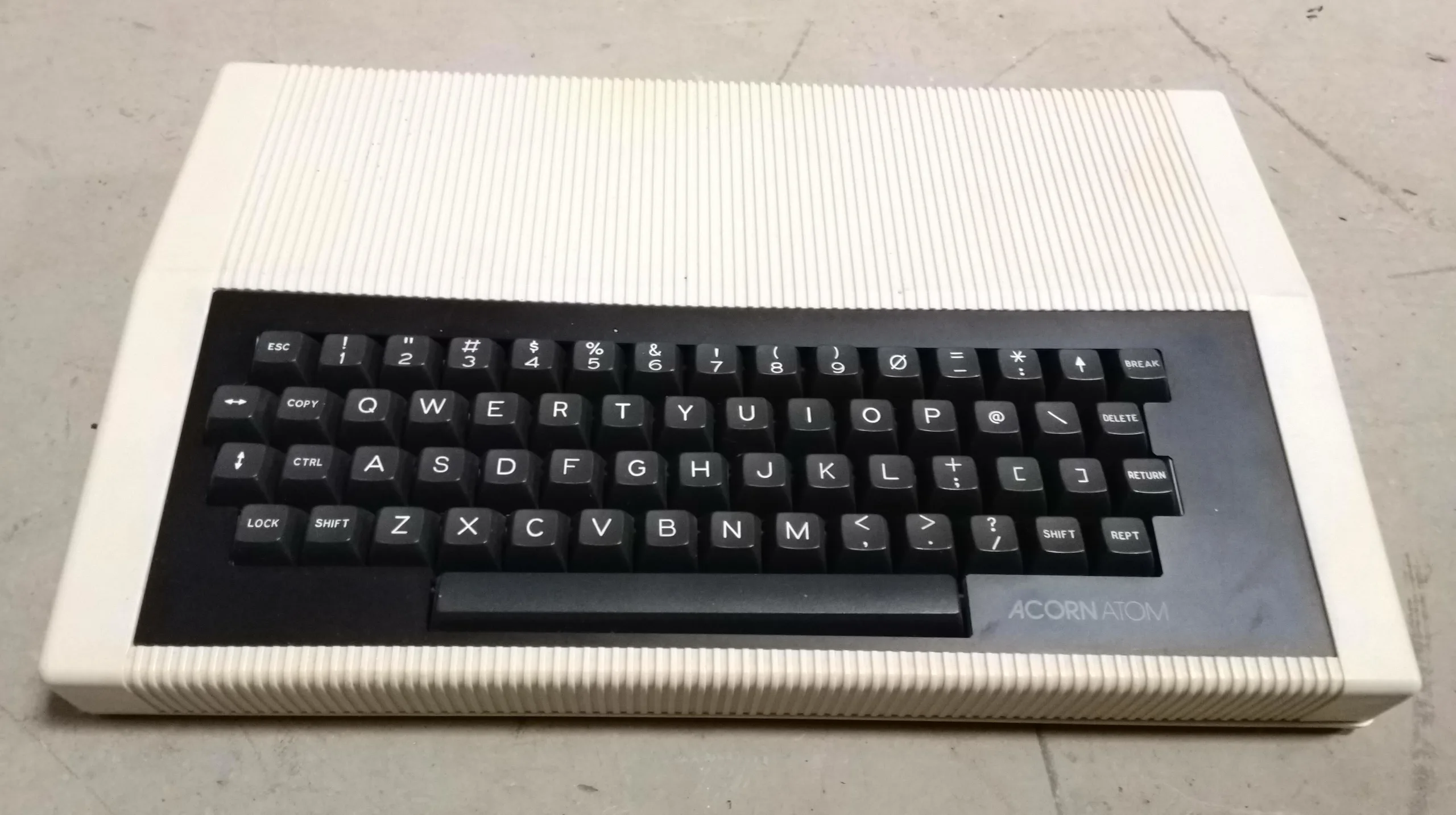
Acorn Atom home computer in its cream ribbed case

Photo: Jamesfcarter, Wikimedia Commons (CC BY-SA 4.0)

Released

1980

RAM

2 KB as standard, expandable to 12 KB

CPU

MOS 6502 at 1 MHz

Launch price

£120 as a kit, £170 ready-built, over £200 fully expanded (12 KB RAM plus floating-point ROM)

Manufacturer

Acorn Computers Ltd, Cambridge, UK

Form factor

Single-board home computer with integral keyboard in a cream ribbed case (381 x 241 x 64 mm), designed by Allen Boothroyd of Cambridge Product Design. The internals derive from the Acorn System 3 and accept the same Acorn Eurocards

CPU

MOS 6502 at 1 MHz

Chipset

Motorola MC6847 video display generator (VDG); INS8255 PPI (keyboard, cassette, speaker); optional 6522 VIA (printer and user port)

RAM

2 KB as standard, expandable to 12 KB

ROM

8 KB as standard (OS and Atom BASIC), expandable to 12 KB with an optional 4 KB Floating Point ROM and 4 KB Utility ROM

Graphics

MC6847 with nine modes, from 64×64 in 4 colours to 256×192 monochrome, plus 32×16 text. Colour on UK sets needed the optional PAL colour card. Outputs are UHF TV and composite video

Audio

One channel through an internal speaker (a single bit toggled via the 8255)

Storage

Cassette via a CUTS-style interface at 300 baud. The optional Atom Disc Pack was a separate 5.25-inch drive with an Intel 8271 controller (40-track single-sided, about 92-100 KB)

Ports

UHF TV out, video out, tape in/out, DC power in, 64-way Acorn bus edge connector (for Eurocard expansion, Econet and disc), Centronics-style printer port (needs the optional 6522 VIA)

OS

Acorn Atom OS in ROM with Atom BASIC, written by Sophie Wilson. It includes an inline 6502 assembler, semicolon statement separators and label-based GOTO. A BBC BASIC upgrade board appeared in late 1982

PSU

External 8 V unregulated DC adaptor, with two LM7805 5 V regulators on the board. Sources give the adaptor rating as 1.5 A or 1.8 A and the discrepancy is unresolved

Units sold

Over 10,000 by most accounts, with one history of Acorn putting it above 20,000. No primary sales ledger has been found

Successors

BBC Micro (December 1981), which did not replace it directly; the Atom stayed on sale alongside it. The budget Acorn Electron (1983) later took over the low-cost slot

  • Undersized PSU and overheating regulators
    The 8 V adaptor was rated for about 1.5 A, which is not enough for a board with fully populated RAM sockets, and the two on-board 7805 regulators run very hot. Heat can scorch the PCB underneath. A documented fix is to remove the regulators, fit links LK6 and LK7 and feed in an external regulated 5 V supply.
    Acorn Atom restoration part 1 (LinuxJedi) →
  • Weak power-on reset
    Some Atoms show jumbled characters at power-on because the reset circuit does not hold reset long enough, although pressing BREAK works. One restorer found the reset capacitor missing altogether and fitted a 22 uF replacement.
    My 1982 Acorn Atom (Retro Repairs and Refurbs) →
  • Poor-quality IC sockets
    One restorer describes the factory sockets as of incredibly poor quality and replaced two of them with better double-sided types. Intermittent contact is a likely cause of odd behaviour on an otherwise sound board.
    My 1982 Acorn Atom (Retro Repairs and Refurbs) →
  • 1979 Acorn's Chris Curry conceives the Atom as a low-cost consumer machine, built on the company's System 3 design
  • 1980 The Atom goes on sale in March at £120 as a kit and £170 built, in a case by Allen Boothroyd, with Sophie Wilson's Atom BASIC in ROM
  • 1981 The BBC Micro launches in December; the Atom stays on sale alongside it
  • 1982 An upgrade board lets the Atom run BBC BASIC as well as Atom BASIC
  • 1983 Atom production ends and the Acorn Electron takes the low-cost slot