MACHINE REFERENCE

Amstrad CPC 6128

The Amstrad CPC 6128 arrived with something none of its cassette-based rivals could offer out of the box: a floppy disk drive built straight into the case, ready to load a game in seconds rather than minutes.

Why it matters

Every home micro of the period had a cassette problem: load times measured in minutes, a wonky tape head between you and a working game, the particular dread of watching a loading screen freeze at ninety per cent. The 6128 sidestepped all of it with a genuinely built-in 3-inch drive, not a bolt-on add-on you had to save up for separately, at a time when a disk drive for a Commodore 64 or Spectrum still cost nearly as much as the computer itself. That single decision, more than the extra 64 KB of RAM over the 464, is what made the 6128 feel like a step up rather than a spec bump. It found a particularly strong following in France, where Amstrad sold under its own name and the CPC range as a whole became one of the country’s most popular home computer lines of the mid-1980s.

What to check before you buy

  • Confirm the disk drive actually spins and the head moves — a dead or grinding drive almost always means a perished belt or dried-out lubrication, both fixable but worth knowing about before you pay.
  • Check whether the listing includes the matching monitor. The 6128 has no PSU of its own; without the monitor, it's dead weight.
  • Ask whether the drive belt or capacitors have been serviced recently — both are common enough that a "never touched since 1987" unit should be priced accordingly.
  • Test that both disk sides read cleanly, since a worn pressure pad can gouge grooves into a disk surface and ruin it permanently.
  • Look for yellowing or case damage around the drive door, a common stress point on units that saw heavy use.
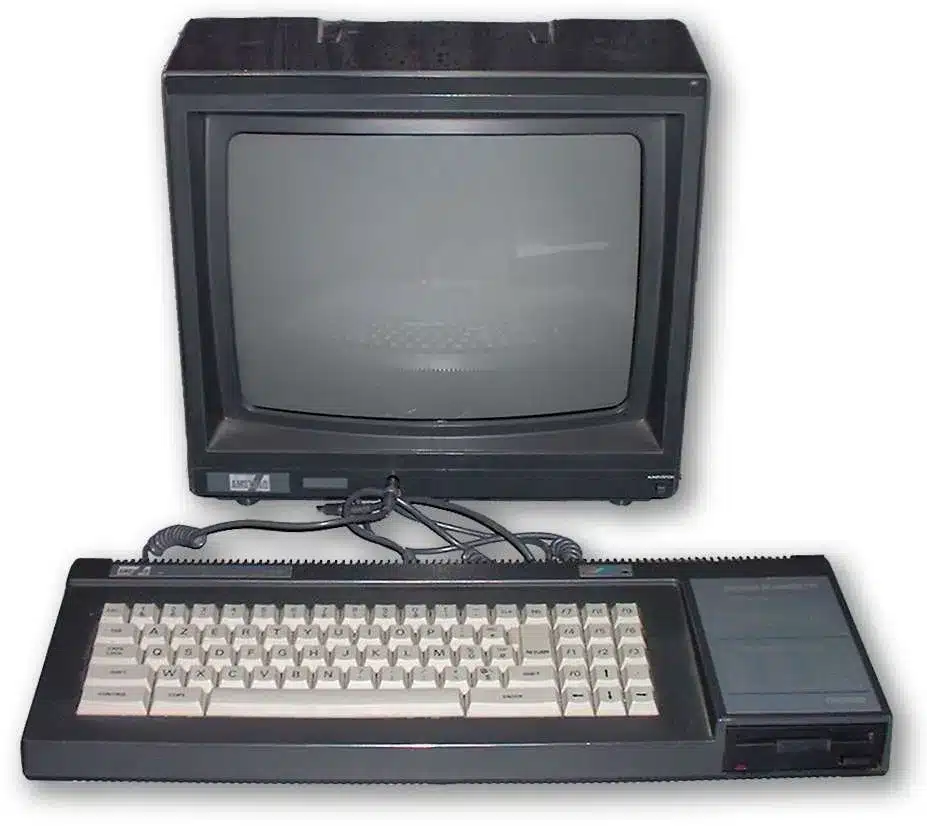
Amstrad CPC 6128

Photo: NaSH, Wikimedia Commons (CC BY-SA 3.0)

Released

1985

RAM

128 KB. Since the Z80 can only address 64 KB directly, the extra memory is reached through bank switching via the Gate Array/PAL. Expandable to 576 KB with third-party expansions

CPU

Zilog Z80A, 4 MHz nominal; effective throughput closer to 3.3 MHz because the Gate Array steals cycles for video memory access

Launch price

US$699 (green-screen bundle) / US$799 (colour bundle); UK £299 (green-screen) / £399 (colour); West Germany DM1598 / DM2098

Manufacturer

Amstrad plc (UK)

Form factor

Single keyboard/computer unit with a 3-inch floppy disk drive built directly into the casing — a format that saw little adoption outside the CPC and PCW ranges. Powered from, and cabled to, a separate matching monitor

CPU

Zilog Z80A, 4 MHz nominal; effective throughput closer to 3.3 MHz because the Gate Array steals cycles for video memory access

Chipset

Amstrad’s own custom Gate Array (part number 40010), handling video timing, memory banking, interrupt generation and the colour palette/border, alongside a 6845-compatible CRT controller and an NEC uPD765-compatible floppy disk controller. An additional PAL chip assists the Gate Array with memory banking on the 6128 specifically

RAM

128 KB. Since the Z80 can only address 64 KB directly, the extra memory is reached through bank switching via the Gate Array/PAL. Expandable to 576 KB with third-party expansions

ROM

48 KB total (16 KB firmware/OS, 16 KB Locomotive BASIC, plus a 16 KB AMSDOS extension added for the disk-equipped 664/6128 models)

Graphics

Three selectable modes — 160×200 in 16 colours, 320×200 in 4 colours, 640×200 in 2 colours — from a palette of 27 colours generated from 3-level RGB

Audio

General Instrument AY-3-8912, three tone channels plus white noise and hardware volume envelopes

Storage

Built-in single-sided, 40-track, 3-inch floppy disk drive — 180 KB per side, 360 KB total per disk, with the disk turned over by hand to access side two

Ports

6-pin DIN RGB/monitor connector (also carries power from the monitor’s PSU), 9-pin D-sub joystick port, 5-pin DIN cassette port for an external datacorder, 34-pin edge-connector printer port, 50-pin edge-connector expansion bus

OS

AMSDOS (built into ROM, running under Locomotive BASIC 1.1) for native disk use, plus bundled CP/M 2.2 and CP/M Plus (3.1, with the GSX graphics extension) on disk

PSU

No standalone power supply — the bundled monitor (CTM644 colour or GT65 green-screen) contains the PSU and feeds DC to the computer over the RGB cable, including a 12V line specifically to run the 6128’s disk drive motor

Units sold

No figure is published specifically for the 6128 alone. The CPC range as a whole sold around 3 million units, with the original CPC 464 accounting for roughly 2 million of those — no reliable per-model breakdown exists for the 664 and 6128

Successors

No direct same-generation successor — the 6128 stayed in production largely unchanged (aside from a 1988 cost-down board revision) until the CPC 6128 Plus arrived in 1990 with a 4096-colour palette, hardware sprites and cartridge support, sharing silicon with the GX4000 console

  • Perished disk drive belt
    The 3-inch drive's rubber belt dries out and slips or snaps with age, the single most commonly cited disk drive fault on the 6128; it's a cheap, well-documented fix.
  • Worn head-positioning mechanism and missing pressure pad
    Dried lubrication on the worm-drive head carriage causes seek errors, and the felt pad on the spring-loaded pressure arm degrades or falls away entirely, which can misread disks or physically score them.
  • Degraded electrolytic capacitors in the monitor's power supply
    Ageing capacitors in the CTM644/GT65 monitor's internal PSU are a recognised failure point, causing no-power or overvoltage faults; recapping services exist specifically for this.
  • 1984 Amstrad enters the home computer market with the CPC 464
  • 1985 CPC 6128 launched at Summer CES in June, initially US-only
  • 1985 CPC 6128 reaches Europe in August, replacing the CPC664; Schneider begins selling it in Germany, Austria and Switzerland
  • 1988 Amstrad and Schneider's distribution partnership ends after Schneider declines to sell Amstrad's PC-compatible line
  • 1990 CPC 6128 Plus launches as the enhanced successor, sharing hardware with the GX4000 console