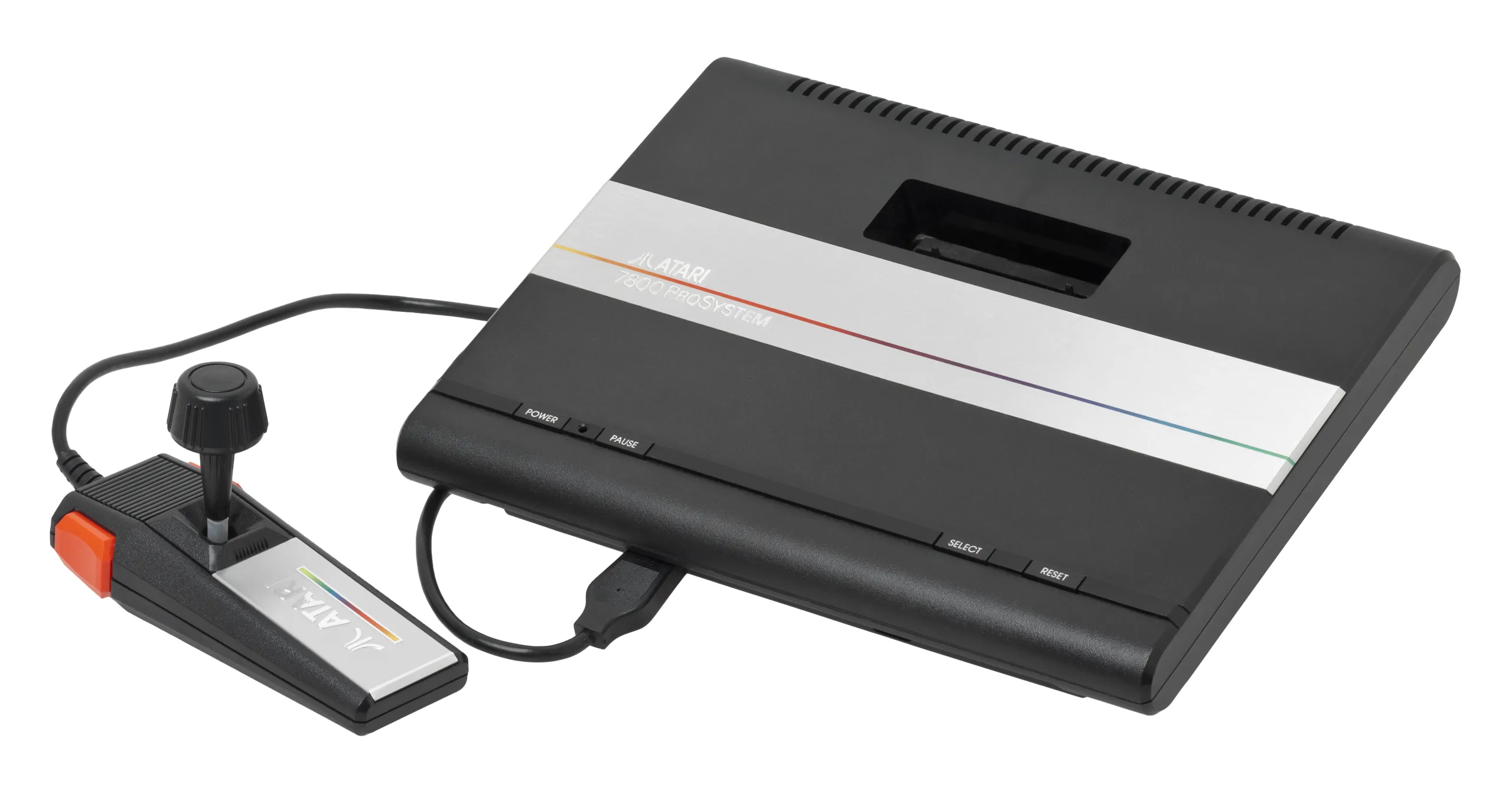
The Atari 7800 ProSystem was announced in May 1984, shelved within weeks when Warner sold Atari’s consumer division, and reached shops nationwide only in May 1986.
Why it matters
General Computer Corporation, an outside firm, designed the 7800, and its MARIA graphics chip works the way an arcade board does: everything on screen is a sprite described in a display list, with up to 25 colours on a scanline. The delay was a business decision. GCC went unpaid until May 1985, and the console sat in warehouses while the Tramiel-owned company sorted out the sale. Internal Atari documents later released by Curt Vendel show 3.77 million units shipped to retailers between 1986 and 1990, 1.42 million of them in 1988, although shipments are not the same as units sold through to customers. The sound is still the 1977 TIA chip, because GCC’s planned replacement was cancelled with the sale.
What to check before you buy
- Switch on with and without a cartridge. A 7800 game shows the full-screen Atari logo; a 2600 game goes straight to the game. Test one of each, because the two modes use different chips.
- Decide between NTSC and PAL. PAL consoles skip the signature check, so they handle unsigned cartridges, and they are rare enough that prices are patchy.
- Look at the power supply before anything else. The original is 9V DC at 1A with a blue connector tip. Inspect the cable where it enters the adapter, and the connector for signs of heat.
- Look inside the cartridge slot for broken or missing tabs, then push a cartridge in and check it seats firmly.
- Expect RF output only. A composite or RGB modification is common, so ask whether one has been fitted and who did the work.
- Test both controllers. US consoles came with the Pro-Line two-button joystick, which Atari replaced with a joypad on European units. Check both fire buttons work, since only some games use the second one.