MACHINE REFERENCE

BBC Master 128

The BBC Master 128 looks almost identical to the BBC Micro Model B it replaced, same beige wedge case, same red function keys, but Acorn had rebuilt nearly everything underneath: a 2 MHz Rockwell 65SC12 in place of the old 6502, 128 KB of RAM as standard, and BBC BASIC IV, View, ViewSheet, Edit and Terminal all sitting ready in ROM from the moment it left the factory.

Why it matters

Acorn launched the Master at £499, and it kept the company’s computers in British classrooms until production stopped in 1993. The Master AIV variant drove the BBC’s Domesday Project, pairing its extra memory and interfaces with a Philips laserdisc player to run the BBC’s interactive Domesday survey, and the Master 512 bolted on an Intel 80186 so the same architecture could run MS-DOS software through Digital Research’s DOS Plus. A serial-number survey puts total Master Series production at somewhere around a quarter of a million units, modest next to the 1.5 million BBC Micros sold across the whole family, but its job was to keep Acorn’s schools contracts running, and it did that for seven years.

What to check before you buy

  • Ask whether the power supply's RIFA mains capacitors have been replaced; if the seller doesn't know, budget for a recap before running the machine for any length of time.
  • Check which ROMs are actually fitted in the sideways sockets. A Master advertised as complete but missing its ADFS or DFS chip won't boot from disc the way the listing photos suggest.
  • Test the numeric keypad and the main keyboard as separate concerns, since the Master's two-membrane switch design means one half can fail while the other still works fine.
  • Note which variant you're actually being sold. Turbo, ET, 512 and Compact boards aren't interchangeable with a standard 128, and the price should reflect which one it is.
  • Confirm a power supply is included and ask its condition specifically; original 35 W units are increasingly hard to find undamaged, and modern replacements add to the final cost.
  • If you want it for Econet or Domesday-related work, check for the expansion module those need, since a standard Master doesn't ship with either fitted.
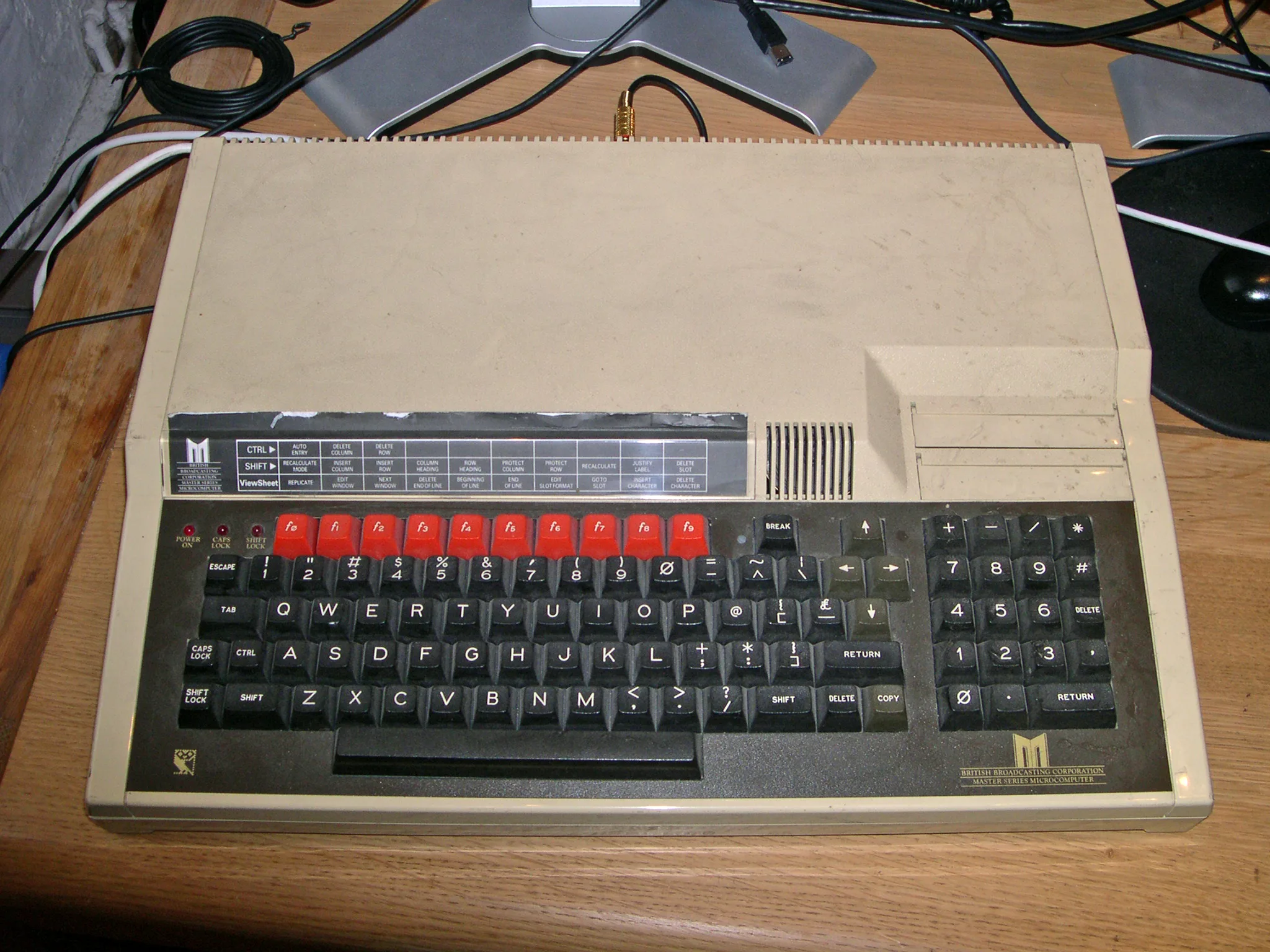
BBC Master 128

Photo: Dejdżer / Digga, Wikimedia Commons (CC BY-SA 2.0)

Released

1986

RAM

128 KB DRAM standard, banked into main program space, a shadow-mode display area, OS workspace and sideways RAM pages. The separate Master 512 variant added a 512 KB expansion board alongside its 80186 co-processor

CPU

Rockwell/GTE 65SC12 (CMOS-based 6502-compatible), 2 MHz. Optional second processors: 65C102 at 4 MHz (Master Turbo) or Intel 80186 at 10 MHz (Master 512)

Launch price

£499 for the standard Master 128 (Master Compact £599, Master ET £399, Master 512 £499 initially, later cut to £199 + VAT and then £99)

Manufacturer

Acorn Computers (built for the British Broadcasting Corporation)

Form factor

All-in-one keyboard computer, the same beige wedge-shaped case style as the BBC Micro Model B

CPU

Rockwell/GTE 65SC12 (CMOS-based 6502-compatible), 2 MHz. Optional second processors: 65C102 at 4 MHz (Master Turbo) or Intel 80186 at 10 MHz (Master 512)

Chipset

Motorola 6845 CRTC (video timing), Mullard SAA5050 (Teletext/Mode 7), Texas Instruments SN76489 (sound), WD1770 (floppy disc controller), plus Acorn’s own gate arrays replacing logic that was discrete on the Model B

RAM

128 KB DRAM standard, banked into main program space, a shadow-mode display area, OS workspace and sideways RAM pages. The separate Master 512 variant added a 512 KB expansion board alongside its 80186 co-processor

ROM

128 KB total: 16 KB Acorn MOS 3.20 plus seven 16 KB sideways ROM sockets, populated from the factory with BBC BASIC IV, View, ViewSheet, Edit, Terminal and the DFS/ADFS filing systems

Graphics

The same eight BBC Micro display modes (0-7) inherited from the Model B, from 640×256 two-colour down to 160×256 eight-colour, plus Mode 7 Teletext via the SAA5050. The extra RAM enabled “shadow mode” so high-resolution graphics no longer ate into user program space

Audio

Texas Instruments SN76489: three tone channels plus one noise channel, same chip as the Model B

Storage

5.25 inch floppy disc via WD1770 controller, running DFS and Acorn’s own ADFS from ROM; cassette interface retained (Kansas City-derived encoding) for Model B tape compatibility

Ports

34-way disc interface, 26-way Centronics-compatible parallel printer, 5-pin DIN RS-423 serial, 5-pin DIN Econet socket, composite video (phono) and separate 6-pin DIN RGB output, 15-pin D-type analogue port (joysticks/light pen), 20-way user port, 40-way external Tube interface for second processors, 34-way 1 MHz bus, 7-pin DIN cassette port

OS

Acorn MOS 3.20 with BBC BASIC IV built in; View, ViewSheet, Edit and Terminal supplied in ROM. The separate Master 512 could run Digital Research’s DOS Plus via its Intel 80186

PSU

Internal 35 W switch-mode power supply, +5V, -5V and +12V rails (+12V, mainly for disc drive motors, only present on the auxiliary power connector)

Units sold

A serial-number-based survey (bbcmicro.computer) puts total Master Series production at roughly 251,000-259,500 units, plus around 55,500 Master Compacts. The same survey flags a substantial margin of error, since it extrapolates from about 2,640 sampled serial numbers against a BBC Micro family total usually quoted as 1.5 million

Successors

Acorn Archimedes. The Master 128 was Acorn’s last 8-bit machine before the company moved to its own 32-bit ARM architecture

  • RIFA mains capacitors in the power supply
    The PSU's mains-side X2-rated RIFA capacitors are the same parts that fail across this generation of Acorn machines, cracking and venting smoke as their epoxy coating degrades with age; most surviving units need these replaced before being run for any length of time.
  • Two-membrane keyboard faults
    The Master's keyboard uses a different two-layer membrane switch design from the Model B's, and keys left unused for years develop intermittent or dead contacts that usually need the membrane cleaning or replacing.
  • Reverse-charging backup battery on early units
    Early Master 128 boards charged their real-time-clock backup battery in a way contrary to the manufacturer's own guidance, creating a risk of the cell venting or catching fire; Acorn corrected this and later boards used a safer arrangement.
  • 1986 Acorn launches the BBC Master 128, successor to the BBC Micro Model B, priced at £499
  • 1986 Further variants follow the same year on the same 128 KB architecture: Master Turbo, Master ET, Master 512 and Master Compact, each built for a different job
  • 1986 The Master AIV variant drives the BBC's Domesday Project, pairing its extra memory and interfaces with a Philips laserdisc player to run the BBC's interactive Domesday survey
  • 1989 The Master Compact is discontinued, the first of the range's variants to go
  • 1993 Acorn discontinues the Master 128 itself, seven years after launch and well into the Archimedes era