MACHINE REFERENCE

Commodore 128

The Commodore 128 was, at launch, the only mainstream home computer that could boot into three completely different machines depending on which key you held down at power-on. Press nothing, and it ran a full, bit-for-bit compatible copy of the Commodore 64. Hold the right combination, and it woke up as its own machine: 128 KB of RAM, an 80-column display, and BASIC 7.0. Hold another, and it handed control to an entirely separate Zilog Z80 processor and booted CP/M 3.0, a business operating system with its own enormous software library that had nothing to do with the 6502 family running the rest of the machine.

Why it matters

The C128 exists because Commodore had painted itself into a corner: the C64 was, by 1985, the single most successful home computer in history, and abandoning that installed base with an incompatible follow-up would have been commercial suicide, yet the C64’s ageing architecture had no route into the 80-column business market that machines like the IBM PC and its clones were starting to dominate. The triple-mode design was Commodore’s answer to both problems at once, built by pairing a second, faster 8502 with an entirely separate Z80 and VDC chip rather than trying to force a single processor to do a job it wasn’t built for. It’s an unusually honest piece of engineering for the mid-1980s home computer market: instead of pretending compatibility and ambition could be squeezed into one chip, Commodore simply built three computers into one case.

What to check before you buy

  • Ask whether the original external power supply is included, and if so, whether it's been tested independently — its documented over-voltage failure mode can take the motherboard with it.
  • Test the keyboard fully before relying on a "working" listing; carbon-pad oxidation causes intermittent or dead keys that a quick power-on test won't reveal.
  • Confirm whether 80-column (VDC) output has actually been tested, not just the 40-column/C64-compatible display.
  • If CP/M mode matters to you, check that a CP/M boot disk or working drive is actually available to test it.
  • Check for the classic Commodore capacitor and corrosion issues under the RF shield, especially on a machine that hasn't been opened or serviced in years.
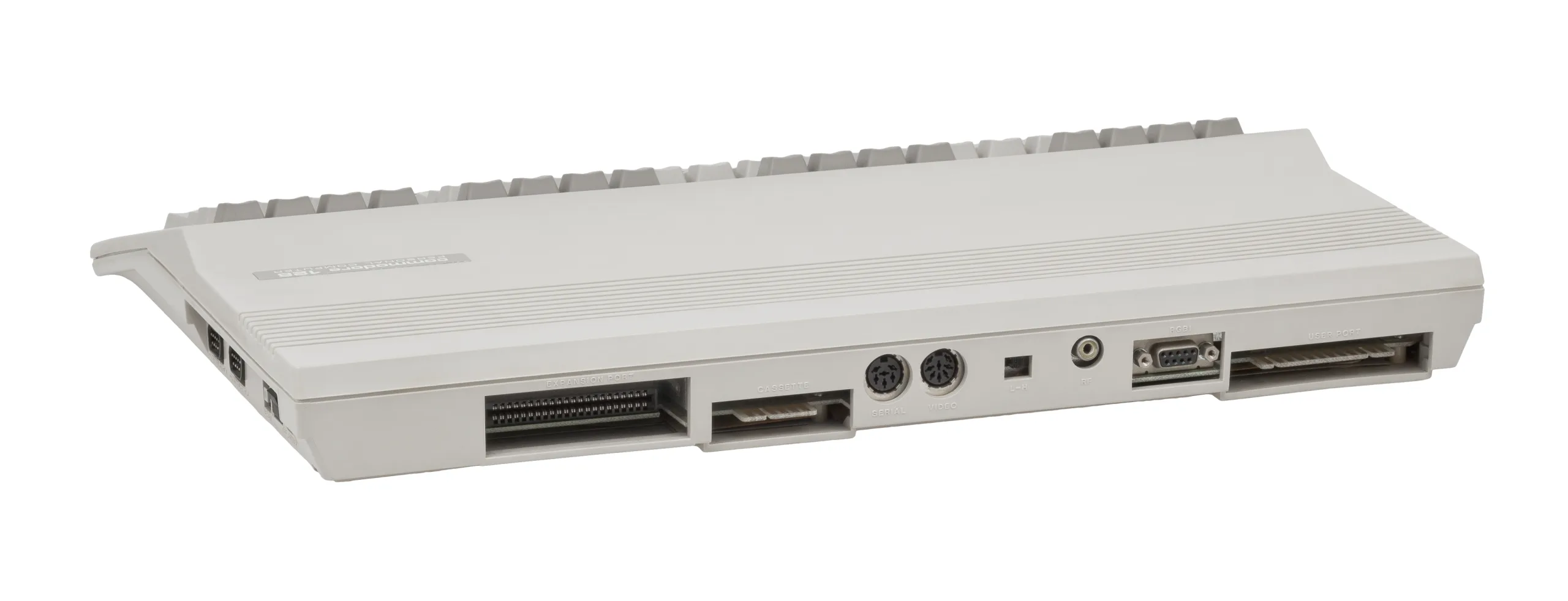
Commodore 128

Photo: Evan-Amos, Wikimedia Commons (CC BY-SA 3.0)

Released

1985

RAM

128 KB standard, two 64 KB banks, expandable to 256 KB-1 MB via a RAM Expansion Unit. Separate video RAM: 16 KB (64 KB on the later 8568/DCR variant) for the VDC, plus 2 KB colour RAM for the VIC-IIe

CPU

Dual-processor design. Primary: MOS Technology 8502 (an enhanced 6510), roughly 1 MHz in C64-compatible/40-column mode, up to 2 MHz in native C128 fast mode. Secondary: a Zilog Z80 at 4 MHz, used exclusively for CP/M mode, effective throughput closer to 2 MHz once video bus-sharing is accounted for

Launch price

US$299 is the figure most commonly cited, with $299.95 as the likely exact shelf price

Manufacturer

Commodore Business Machines (CBM)

Form factor

Single-unit “wedge-style” computer with integrated full-travel keyboard, numeric keypad and dedicated function keys. Later C128D and C128DCR variants moved to a separate detachable keyboard with an integrated 1571 drive

CPU

Dual-processor design. Primary: MOS Technology 8502 (an enhanced 6510), roughly 1 MHz in C64-compatible/40-column mode, up to 2 MHz in native C128 fast mode. Secondary: a Zilog Z80 at 4 MHz, used exclusively for CP/M mode, effective throughput closer to 2 MHz once video bus-sharing is accounted for

Chipset

VIC-IIe for 40-column/C64-compatible video; MOS Technology 8563 VDC for 80-column output, upgraded to the 8568 in the later C128DCR

RAM

128 KB standard, two 64 KB banks, expandable to 256 KB-1 MB via a RAM Expansion Unit. Separate video RAM: 16 KB (64 KB on the later 8568/DCR variant) for the VDC, plus 2 KB colour RAM for the VIC-IIe

ROM

72 KB total: BASIC 7.0, KERNAL, screen editor, Z80 boot/BIOS routines, and the full C64-compatibility ROM set

Graphics

Genuinely dual video output. VIC-IIe drives 40-column mode (320×200, 16 colours, hardware sprites, identical capability to the C64). The 8563/8568 VDC independently drives 80-column mode (typically 640×200) via a dedicated RGBI connector. The two can’t be used simultaneously for the same display but are electrically independent subsystems

Audio

MOS SID chip, either the 6581 or later 8580 depending on production date, same part family as the C64

Storage

No built-in drive on the base C128 — used external Commodore drives via the serial bus: the existing 1541, plus new-for-this-machine 1570 and 1571 5.25-inch drives, later the 1581 3.5-inch drive. Datasette port also present

Ports

IEC serial bus for disk drives/printers, two DB9 joystick ports, cassette port, user port, cartridge/expansion port, composite/RF video and audio out, a second independent RGBI video output for 80-column mode, DC power input

OS

Three distinct boot modes selectable at power-on: C64 mode (loads the original C64 KERNAL and BASIC 2.0 for full binary compatibility), native C128 mode (BASIC 7.0, full 128 KB RAM, 40- or 80-column display), and CP/M mode (hands control to the Z80, boots CP/M 3.0/CP/M Plus)

PSU

External “brick” power supply, physically larger than the C64’s with added cooling vents and a user-replaceable fuse. Has a documented reputation for output faults that can over-volt and damage the motherboard. The later C128DCR moved to a redesigned, more reliable switched-mode supply

Units sold

Genuinely disputed — Wikipedia and several retrospectives cite roughly 2.5 million as a middle estimate, older sources cite up to 4 million, and a more recent analysis working from Commodore’s own annual reports suggests closer to 1.75 million. Commodore never broke out C128 sales separately. “Around 2.5 million” is the most defensible mainstream figure

Successors

Commodore 128D (late 1985, detachable keyboard, integrated 1571 drive, cooling fan), Commodore 128DCR (1986/87, cost-reduced respin with improved 8568 VDC). No further 8-bit successor followed — the C128 is widely described as the last 8-bit home computer Commodore commercially released

  • RF shield thermal/contact failures
    The internal RF shield over the mainboard can develop poor contact and limited heat conductivity in some units, and the SID sound chip in particular runs hot enough to be vulnerable to this — removing or reworking the shield is a commonly cited remedy.
  • Original power supply over-voltage failure
    The launch-era external "brick" PSU has a well-documented failure mode where it can output significantly more than its rated voltage, permanently damaging the motherboard and chips if the machine is powered on with a failing original unit; most experienced restorers now recommend testing the PSU independently before ever connecting it.
  • Keyboard carbon-pad and VIA (U1) faults
    The keyboard uses carbon conductive pads under each key that oxidise and stop registering keystrokes over time, and separately, failure of the VIA chip at position U1 presents as complete loss of keyboard, joystick port and cassette port function simultaneously.
  • 1985 Announced and shown at Winter CES in January; UK release follows in July
  • 1985 Commodore 128D variant released in Europe, with detachable keyboard and integrated 1571 drive
  • 1986 Commodore 128DCR cost-reduced revision released, with improved 8568 VDC chip and corrected ROMs
  • 1989 Commodore 128 production ends after roughly four years
  • 1994 Commodore 64 production ends in April, closing out the Commodore 8-bit computer line entirely, shortly before the company's bankruptcy