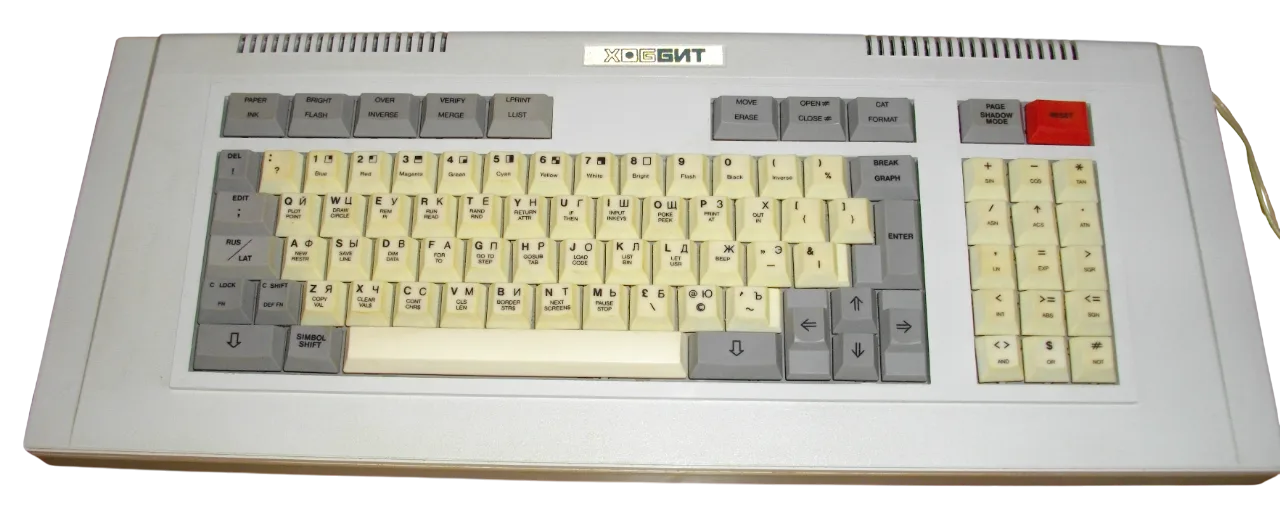
The InterCompex Hobbit was a Soviet ZX Spectrum “super-clone” built in Leningrad by Michail Osetinskij and Dmitri Michailov, adding CP/M, FORTH, LOGO and a dual Cyrillic/Latin keyboard on top of full Spectrum software compatibility — and, briefly between 1990 and 1992, it was sold in the UK.
Why it matters
The Hobbit was one of the few Eastern Bloc computers to attempt a genuine commercial export into the West as the Cold War ended, built with real engineering ambition — twin floppy drives, classroom networking, three separate operating environments — rather than as a bare-bones clone, only to be undone by mundane problems: a reported UK electrical safety failure and Sinclair’s copyrighted ROM code, by then owned by Amstrad.
What to check before you buy
- Confirm which of the three Hobbit variants you’re looking at: the original full-keyboard Hobbit with floppy support, the keyboard-less Hobbit console (IA), or the integrated-keyboard Programmable Console Hobbit (PIA) from 1992 — they’re frequently confused online and have different capabilities.
- Check the keyboard connection carefully — it’s wired to the mainboard with thin, individually soldered wires rather than a ribbon cable, and is a common point of damage.
- Verify the ROM configuration, since surviving units vary in which operating environments (Beta/CP/M, FORTH, LOGO) are actually fitted in the ROM sockets.
- Expect to source parts, documentation and even basic identification help primarily from Russian-language collector communities — English-language information is thin and sometimes contradictory.