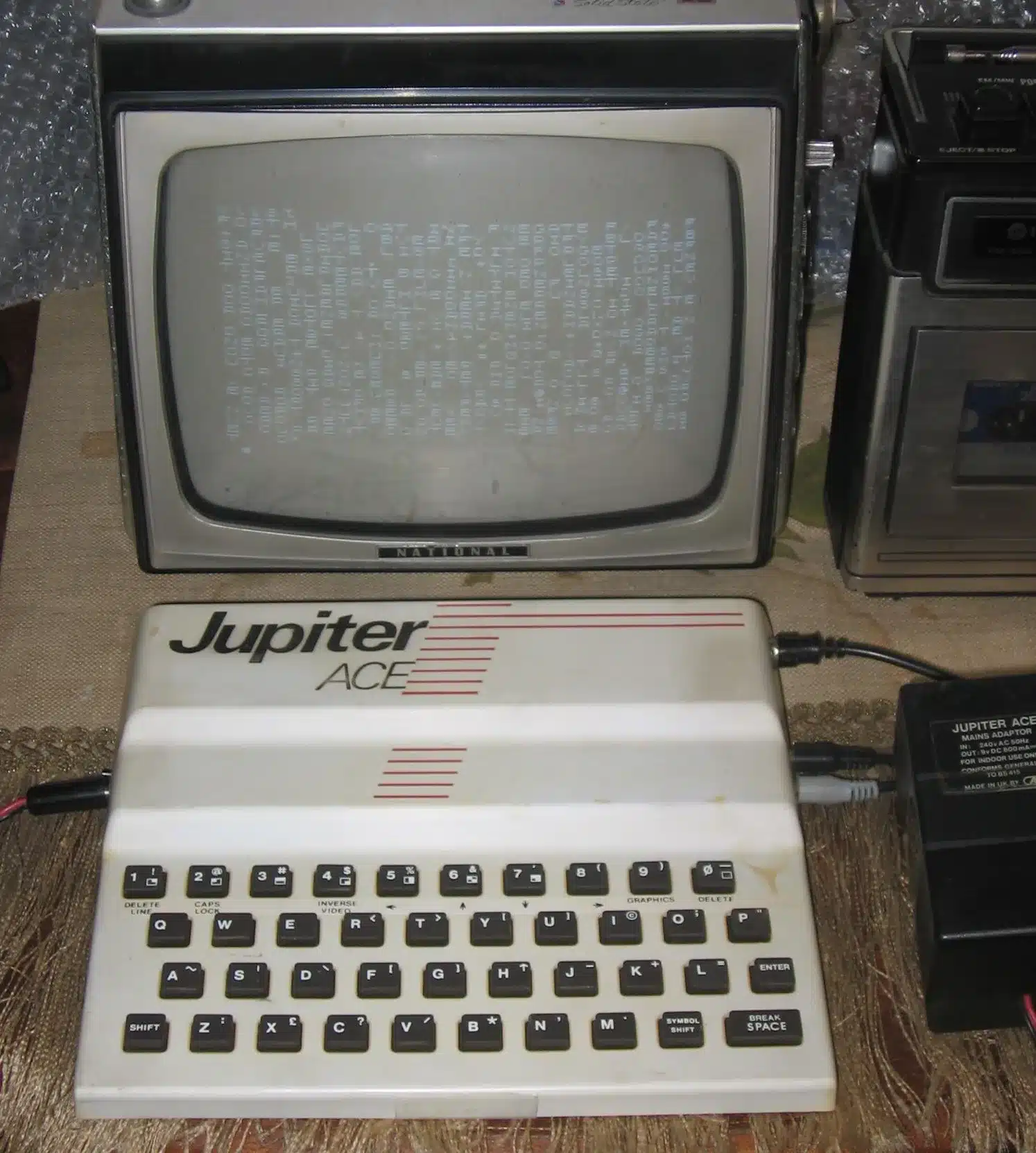
The Jupiter Ace arrived in September 1982 wearing a rubber keyboard that looked suspiciously like a ZX Spectrum’s, built by two engineers who’d left Sinclair Research a few months earlier, and switched it on to find no BASIC waiting behind the cursor at all. Type a line, hit enter, and the Ace answered in Forth: a compact, stack-based language squeezed into 8 KB of ROM, the kind of thing you’d expect on a minicomputer, not a machine that undercut £90.
Why it matters
Betting an entire product on Forth instead of BASIC, in a market where every rival from Sinclair to Commodore to Acorn shipped BASIC as standard, was either visionary or reckless depending on who you ask, and the honest answer is probably both. Forth ran rings around interpreted BASIC for speed, and its structure genuinely suited a machine with almost no RAM to spare. But it also demanded that a home-computer buyer in 1982, most of whom just wanted to type in a listing from a magazine, learn an entirely different way of thinking about programming before they could do anything useful with it. Jupiter Cantab folded fourteen months after launch, and it’s tempting to read that purely as commercial misjudgement. It’s fairer to call it a machine that was honest about what it believed programming should look like, in a market that had already decided otherwise. That same stubbornness is exactly why it has a devoted following among collectors and Forth enthusiasts today, decades after the company that made it stopped existing.
What to check before you buy
- Expect to pay a real premium over comparably specced Spectrums or VIC-20s. Only a few thousand Aces were ever made.
- Test the keyboard thoroughly before buying, or budget time for cleaning it. The conductive rubber pads are a known weak point.
- Never power an original PSU into an empty socket. The adaptor is unregulated and its output climbs well above 9V with nothing connected.
- Watch out for the "wavy" video fault, characters visibly drifting a pixel or two, a documented and generally fixable issue.
- Confirm whether a RAM pack is included. The Ace's base 1 KB is workably tiny for anything beyond small programs.