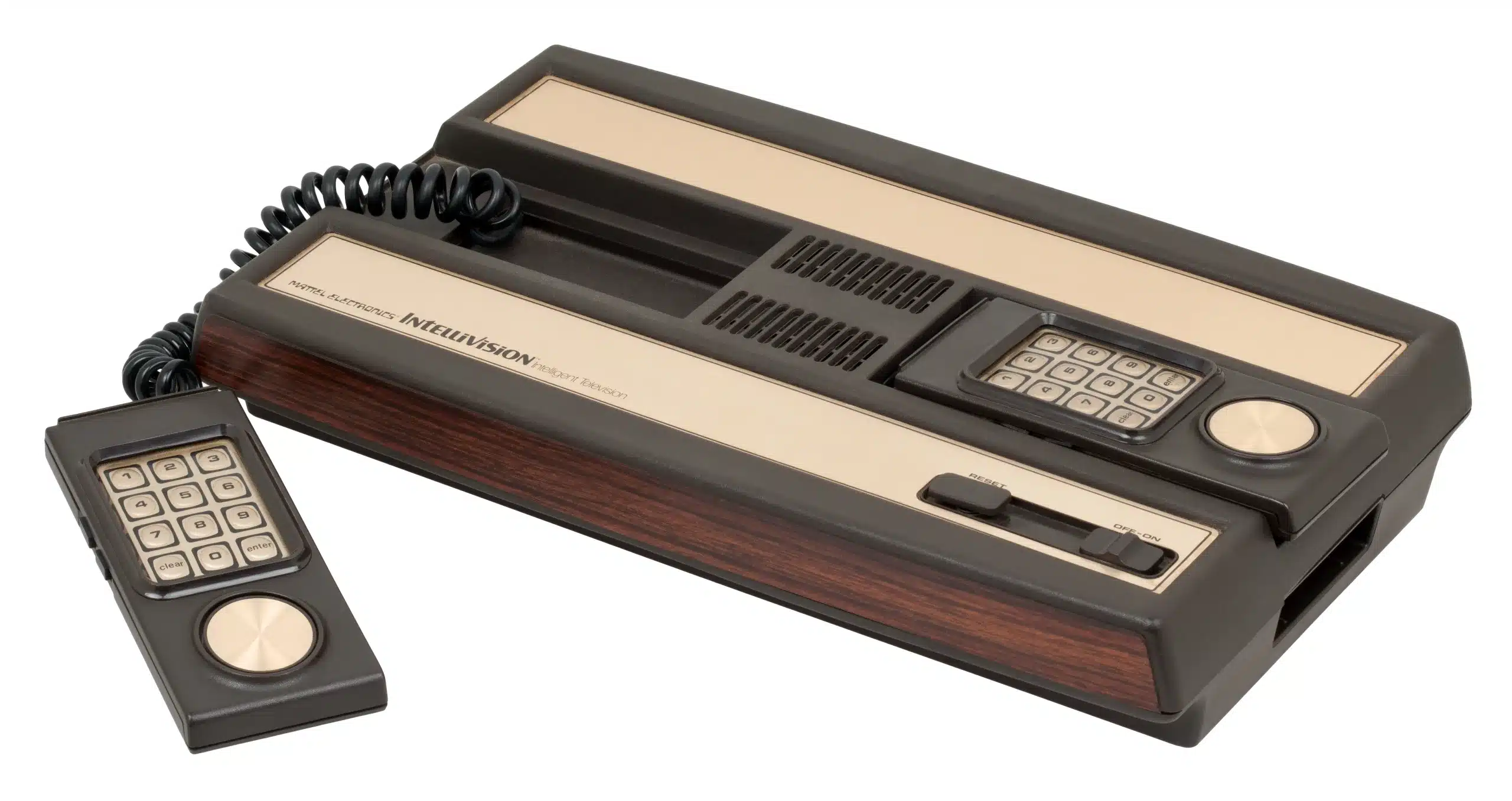
The Mattel Intellivision was the console that, for the first time, made a games machine’s actual processing power part of the sales pitch — its General Instrument CP1610 was a genuine 16-bit chip at a moment when every rival on the shelf was running 8-bit silicon or less.
Why it matters
The Intellivision earned its “Intelligent Television” tagline honestly: the STIC graphics chip gave it a 16-colour palette and a tiled background system that made Atari 2600 games look genuinely crude sitting next to it, and Mattel built an entire advertising campaign, fronted by George Plimpton, around putting the two side by side and daring viewers to disagree. That rivalry is one of the first proper console wars in the industry’s history, fought as much on picture quality as on price. The numeric keypad and 16-direction control disc were just as ambitious in their own way, an attempt at a genuinely reconfigurable controller years before anyone else bothered, even if the mylar underneath it turned out to be the console’s most fragile component.
What to check before you buy
- Test every direction on the control disc and every keypad button before handing over money; intermittent input is almost always the mylar contact sheet, not the console logic.
- Ask whether the original internal power supply has been tested recently, or recapped, given its age.
- If it's an Intellivision II, confirm the external 16.2V adapter is present and original spec, since a lost or blown one is genuinely hard to replace.
- Check the RF switch and any composite/AV mods separately, since picture output issues are frequently a cabling or switch fault rather than a console fault.
- Ask for a powered-on demo with a cartridge if at all possible rather than buying untested.