MACHINE REFERENCE

PC Engine

The PC Engine was a small NEC and Hudson Soft console released in Japan on 30 October 1987, with an 8-bit HuC6280 processor and two 16-bit graphics chips.

Why it matters

The PC Engine reached the market in 1987, before the Mega Drive, and a CD-ROM² drive was available as an add-on. In America it was sold as the TurboGrafx-16, and the ’16’ was criticised as misleading because the CPU was 8-bit. The TurboGrafx-16 sold about 2.5 million consoles in North America, and NEC’s successor, the PC-FX, followed in 1994 in Japan only.

What to check before you buy

  • Check which console it is; PC Engine, TurboGrafx-16, CoreGrafx and Duo are not the same.
  • Test video and sound for capacitor faults.
  • Ask whether HuCards from other regions work; US and Japanese cards are not interchangeable without an adapter.
  • On a Duo or CD-ROM², check the drive spins and the CD sits flat.
  • Look for the controller; a single port means a multitap for more players.
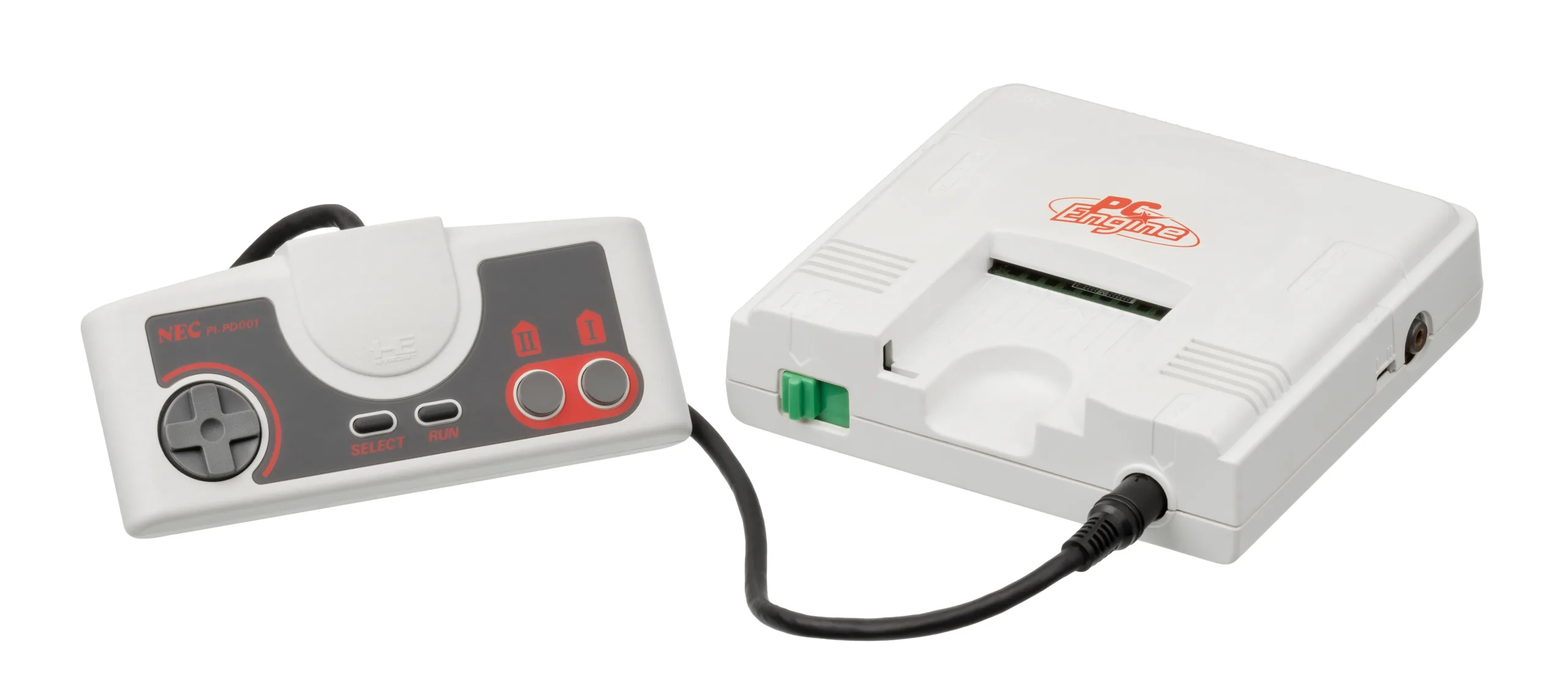
NEC PC Engine console with controller

Photo: Evan-Amos, Wikimedia Commons (Public domain)

Released

1987

RAM

8 KB main RAM, 64 KB video RAM

CPU

HuC6280, 7.16 MHz (8-bit)

Launch price

¥24,800 (Japan); $199.99 (US, as TurboGrafx-16)

Manufacturer

NEC and Hudson Soft

Form factor

Compact home console using HuCards

CPU

HuC6280, 7.16 MHz (8-bit)

Chipset

HuC6270 video display controller and HuC6260 video colour encoder

RAM

8 KB main RAM, 64 KB video RAM

ROM

Unknown

Graphics

482 colours on screen from a palette of 512

Audio

Programmable sound generator at 3.58 MHz, with 5 to 10-bit stereo PCM

Storage

HuCard cartridges; CD-ROM² add-on

Ports

One controller port (a multitap is needed for more than one player), expansion port

OS

None; games boot from the HuCard or CD

PSU

External power adapter

Units sold

Unknown (sources quote about 10 million HuCard consoles and 1.92 million CD-ROM² and Duo units)

Successors

PC Engine SuperGrafx (1989), PC Engine Duo (1991), PC-FX (1994, Japan only)

  • Ageing electrolytic capacitors
    Capacitors across PC Engine hardware, particularly the Duo and Super CD-ROM² units and the portable GT and TurboExpress, have started to leak. They cause damage to the board and daughterboards and need replacing.
  • CD-ROM² drive problems
    Some Super CD-ROM² units have interference from failing decoupling capacitors, and the drive can sit slightly low so the disc magnet does not hold the CD.
  • 1987 NEC and Hudson Soft launch the PC Engine in Japan on 30 October
  • 1989 The TurboGrafx-16 launches in North America on 29 August; the SuperGrafx follows
  • 1991 The PC Engine Duo combines the console and CD-ROM²
  • 1994 NEC releases the PC-FX in Japan