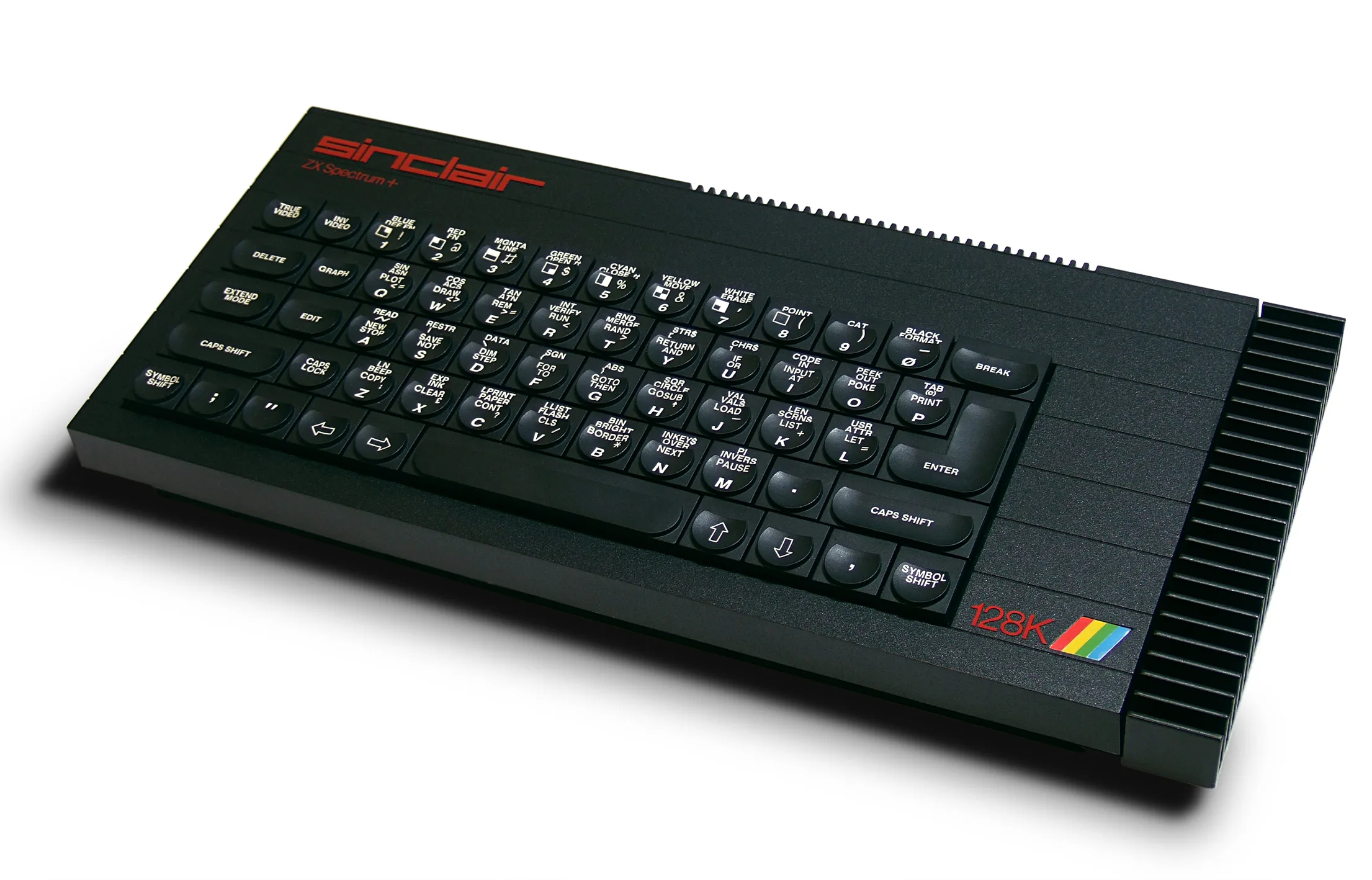
The Sinclair ZX Spectrum 128 carries its power regulator on the outside of the case: a ribbed aluminium heatsink along the right-hand end, which is where the ‘toastrack’ nickname comes from. Sinclair Research built it with its Spanish distributor Investrónica, showed it at SIMO 85 in September 1985 at 44,250 pesetas, and released it in the UK in January 1986.
Why it matters
The 128 took the Spectrum from 48 KB to 128 KB of RAM on a Z80 that can only address 64 KB. The trick was bank switching: 80 KB paged in as eight 16 KB banks, with two 16 KB ROMs swapped in and out. It also added the AY-3-8912 sound chip for three-channel audio, an RS-232 and MIDI-capable port and an RGB output. At £179.95 it was the last Spectrum Sinclair Research launched before Amstrad bought the brand in 1986, and the +2 followed at £149.
What to check before you buy
- Ask whether the 7805 regulator on the heatsink has been replaced or reflowed. It is rated at 1 A and the board asks a lot of it.
- Test the sound on the AY chip against the beeper. A large volume gap is common and fixable with one resistor.
- Check the RGB and RF pictures for jailbars, ghosting or a very faint image.
- Confirm the power supply is the correct 9V DC, negative-centre unit. A wrong-polarity supply is a known way to kill the regulator.
- Load a 128-only game to prove the extra RAM banks work, and run the menu options (128 BASIC, Calculator, 48 BASIC, Tape Loader).
- Press every key on the rubber-and-plastic keyboard, and look for lifted or worn membrane tracks.