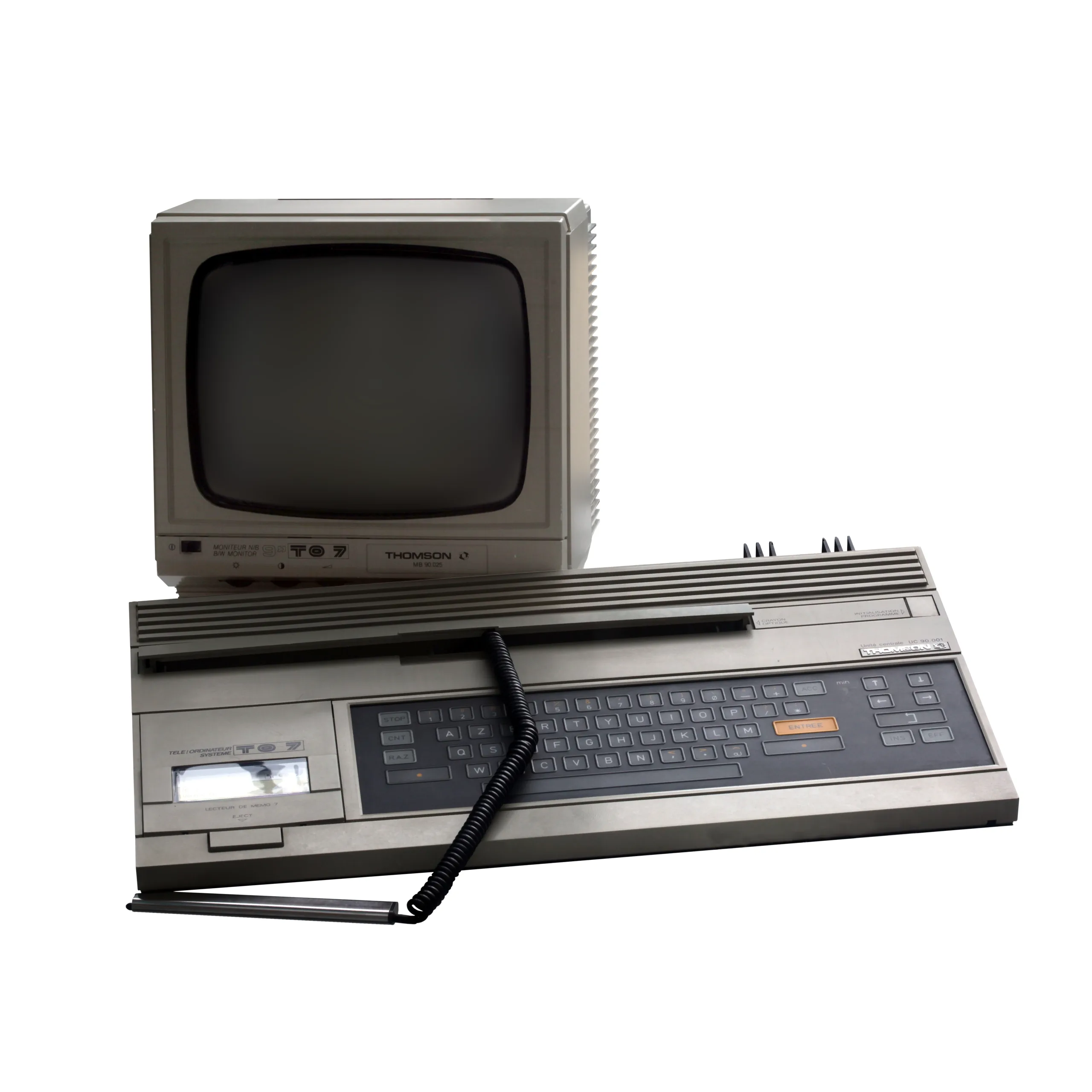
The Thomson TO7 was a French home computer with a built-in light pen and no graphics chip: Thomson built its video circuitry from ordinary logic chips around a Motorola 6809.
Why it matters
Thomson’s first home computer went on show at the Sicob exhibition in late 1982, with a light pen on a coiled lead built into the case. In March 1983 Sonotec, Apple’s main French reseller, signed a supply contract with the education ministry, and between 30,000 and 40,000 TO7s had been built by the 1983 Sicob. The Informatique pour tous schools plan was announced in January 1985, after the TO7 had gone out of production, and it was carried out with the MO5 and the TO7/70, which stayed software-compatible with the TO7. The machine had real limits: 8 KB of user RAM (about 6 KB once BASIC was loaded), a BASIC cartridge sold separately at 500 francs and a membrane keyboard that people disliked.
What to check before you buy
- Confirm it is a TO7, not a TO7/70 or MO5. The TO7 has a TO7 label, 8 colours and 8 KB of user RAM, and listings mix the three up constantly.
- Test the light pen and its coiled lead. It only works on a CRT, so a modern LCD is no use for trying it.
- You need an RGB SCART (Peritel) display or a converter. The TO7 does not output composite video.
- Ask whether it comes with the BASIC cartridge, since the TO7 cannot run BASIC without it. Extensions such as Musique et jeux (game ports and sound) and the 16 KB RAM module are also sold separately.
- A working Thomson cassette reader matters, because it is proprietary and cassette was the normal software medium. Check that the DIN lead is included.
- Look at the keyboard membrane for cracks or dead keys, and at the rear heatsink and captive mains lead for heat damage or fraying.