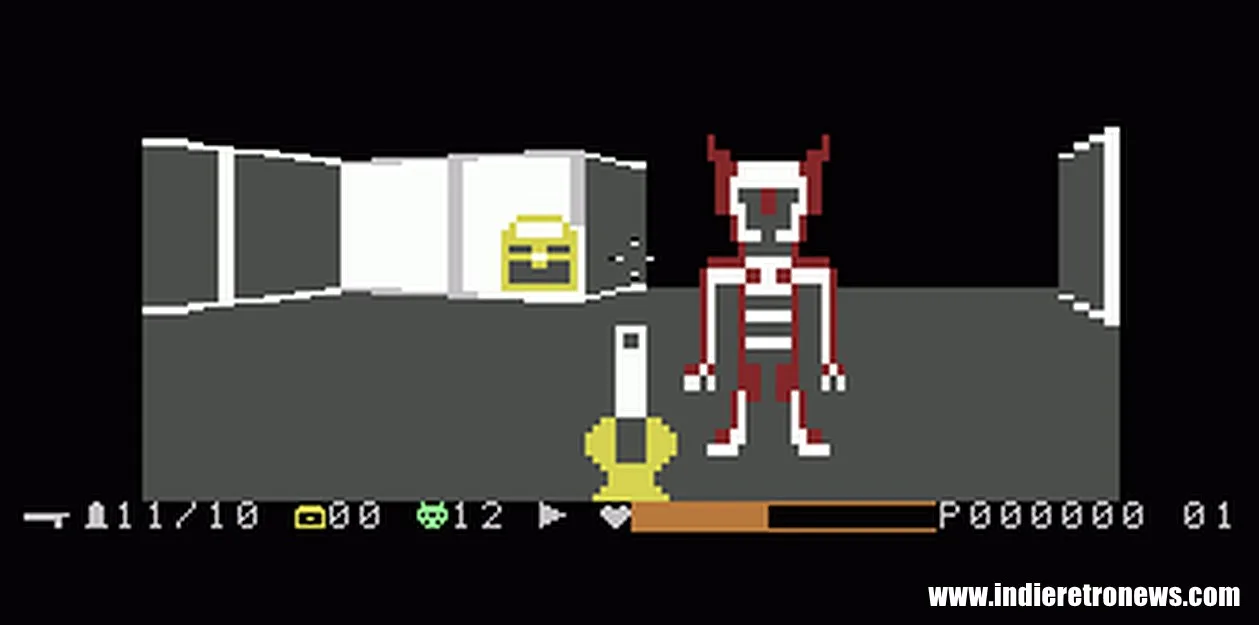
The Commodore Plus/4 spent most of 1984 being quietly ignored by everyone who wasn’t Hungarian. It shipped with a built-in word processor nobody asked for and a TED graphics chip with no hardware sprites. It did not get first-person shooters. Forty-two years on, somebody’s fixed that.
Cuthbert in Castle Wolfenstein, coded by Proky with Csabo credited alongside him, starts exactly where a long-time Cuthbert fan would expect: a stone shaft, blocky platform graphics, an exit at the bottom. Cuthbert’s been Microdeal’s climbing, digging, treasure-hunting mascot since the early 1980s, and this opens like any other outing for him. Then you step through that exit and the whole game changes shape. Pseudo-3D corridors. A genuine first-person view. All on a machine whose graphics chip was built to sell spreadsheets to Hungarian civil servants, not corridor-crawlers.
The plot is silly on purpose. It’s 1943, B. J. Blazkowicz is upstairs handling the actual Nazi-punching everyone remembers from id Software’s original, and Cuthbert has decided this is the perfect moment to sneak downstairs and loot Dr Schabbs’ laboratories instead. Ten levels of pillared halls, ring-shaped courtyards and lab blocks stand between him and however much stolen gold he can carry out, with the objective staying pure arcade throughout: grab every treasure chest, stay alive, find the way down.
None of this was meant to happen on a Plus/4. The TED chip was Commodore’s cut-price answer to a machine that had already cut corners twice — no sprites, and a colour palette that fights the programmer at every turn. Getting anything resembling a first-person engine running on it, at a speed you’d actually want to play, is the sort of thing that shouldn’t need saying twice, and yet here we are.
Whether ten levels of basement treasure-hunting counts as a proper genre entry or a very good technical party trick is exactly the argument worth having in the comments. Wolfenstein 3D needed a 386 and a maths coprocessor to feel special in 1992. The Plus/4 needed a coder called Proky and, going by the results, a healthy grudge against the idea that some hardware just isn’t built for this.